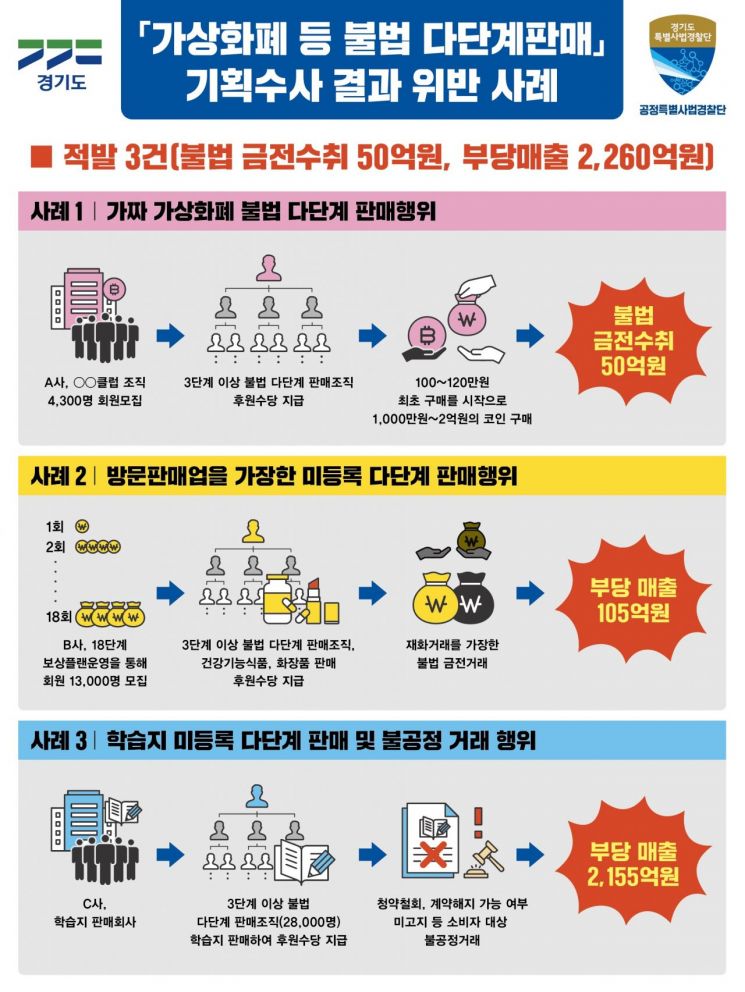
[Asia Economy (Suwon) = Reporter Lee Young-gyu] Gyeonggi Province has uncovered a large number of cases involving a virtual currency sales company that set up an unregistered multi-level marketing (MLM) organization and embezzled a total of about 5 billion KRW under the pretext of membership fees, as well as a door-to-door sales company operating a similar MLM organization by luring with high-value sponsorship rewards.
Gyeonggi Province announced on the 29th that from October last year to November this year, through an investigation into 'unregistered multi-level marketing virtual currency and other illegal MLM sales companies,' it identified a total of 30 people from 3 companies who violated the Door-to-Door Sales Act.
The illegal money received by these individuals or the unfair sales revenue earned through illegal MLM sales amounted to a total of 231 billion KRW.
Company A, caught selling virtual currency through illegal MLM methods, established a corporation in the province and created a financial investment group called 'Y Club.' They recruited members by enticing them with high-profit business rights such as mobile phone and mask dealership rights or high-value reward payments. Company A made members pay 1 million to 1.2 million KRW in cash or transfer an equivalent amount in X virtual currency to join. Afterwards, members were paid 50% of the membership fee in Y Coins, which could only be traded among members, and the remaining 50% was paid as sponsorship rewards such as referral margins, team margins, and sponsorship margins to higher-level members. Company A did not register as an MLM seller and in fact only traded money through virtual currency, recruiting about 4,300 members and embezzling about 5 billion KRW.
Unregistered MLM company B, disguised as a door-to-door sales company, operated a compensation plan from the 1st to the 18th round, starting with an initial 110,000 KRW and setting sales and sponsorship reward criteria up to the 18th round to effectively run an MLM organization.
They recruited salespeople by promoting that if they purchased a total of 49 million KRW worth of products such as cosmetics and health supplements and reached the final round, they could receive rewards worth about 250 million KRW, approximately 500% of the individual salesperson’s sales amount. This was a pyramid-like structure requiring continuous influx of new sellers to receive rewards at the end of each round. From July to November, it was confirmed that they generated illegal sales worth about 10.5 billion KRW through 13,000 members. They paid the top-level 17th round salesperson 130 million KRW and the 18th round salesperson 250 million KRW in sponsorship rewards and economic benefits.
Learning material sales company C received corrective orders twice from the Fair Trade Commission for unregistered MLM sales, but exploited loopholes in related regulations to reorganize the organization lukewarmly and continuously operated an MLM sales organization with about 28,000 members, generating unfair sales of about 215.5 billion KRW. It was also revealed that they engaged in unfair product sales practices such as ▲inducing consumers and concluding contracts using inaccurate information ▲failure to disclose important terms regarding non-cancellable products ▲contracts using others’ names without authorization.
The current 'Door-to-Door Sales Act' stipulates that those who engage in gambling-like salesperson expansion activities or establish, manage, or operate unregistered MLM organizations shall be punished by imprisonment for up to 7 years or a fine of up to 200 million KRW (however, if the total sales or transaction amount exceeds 200 million KRW, a fine of up to three times the total transaction amount may be imposed).
Reports of damages related to illegal MLM sales of virtual currency and other daily necessities and health supplements can be made through the Gyeonggi Provincial Government website, KakaoTalk Plus Friend (Gyeonggi Province Fair Special Judicial Police Unit), and the Gyeonggi Call Center.
Kim Young-soo, head of the Gyeonggi Fair Special Judicial Police Unit, said, "We launched an investigation because we judged that the damage to residents is serious due to repeated reports of illegal MLM sales targeting those seeking high-yield investments amid the rapid rise in asset markets." He emphasized, "Especially since consumer damage can spread more rapidly than before through social networking services (SNS) and YouTube, we will respond more strongly."
© The Asia Business Daily(www.asiae.co.kr). All rights reserved.

















