The Waiting Line in Front of the Store Is Now a Thing of the Past
Sales Decline and Rising Ingredient Costs Bring 'Sorrow'
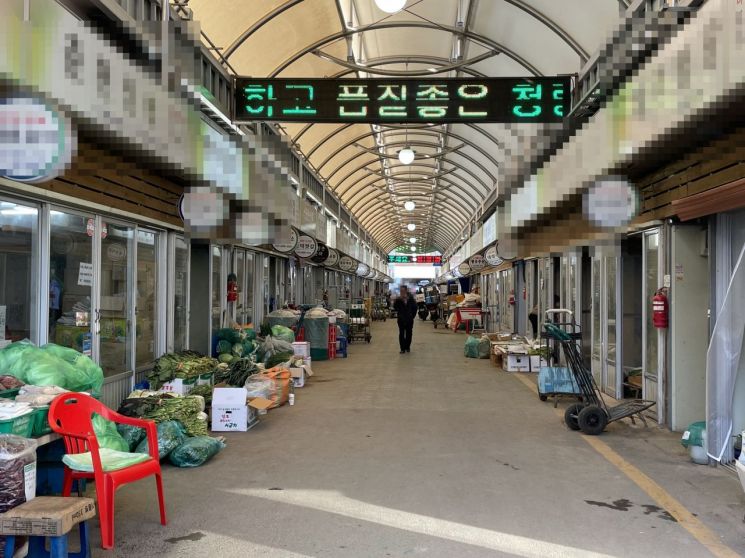 On the morning of the 26th, the streets of Cheongnyangni Agricultural and Marine Products Market in Dongdaemun-gu, Seoul, are quiet.
[Asia Economy Reporter Lee Jung-yoon] "The year-end rush has long disappeared."
Choi Young-ha (52), who runs a croquette stall at Mangwon Market in Seoul. Before COVID-19, there used to be a waiting line in front of the store as soon as 9 a.m. hit, but now that is just a memory. Although the transition to phased daily recovery (With COVID-19) began on the 1st of this month, the effect is minimal. It is difficult to find foot traffic in the market except on weekends. Choi said, "We don’t see customers flocking to the market like in the past," adding, "Sales are down and ingredient costs are rising, so the situation keeps getting harder."
The market, which should be bustling with the year-end rush, is filled only with sighs. Market merchants who finished preparing for business waited for customers by the heater to escape the cold, but the streets were quiet. Merchants complain that they have been hit hard since the surge in confirmed cases after With COVID-19 and the cluster infections at Noryangjin Fisheries Market in Dongjak-gu and Garak Market in Songpa-gu. The Seoul Metropolitan Government has strengthened quarantine measures for traditional markets and installed mobile screening clinics at 37 markets with cluster infections or high risk.
The special demand during kimchi-making season has also disappeared. Lee Jae-deok (67), who runs a vegetable store at Cheongnyangni Agricultural and Marine Products Market in Dongdaemun-gu, said on the 26th, "It’s the peak season for kimchi-making, but there has been a big hit because people infected with COVID-19 recently appeared at nearby Cheongnyangni General Market and Gyeongdong Market," adding, "Last year, daily sales were around 2 million won, but these days it’s less than 1 million won." Park Jong-sim (70), who sells seafood, has also given up hope. Repeating the phrase "business is really bad," he said, "Usually, many people buy shrimp or oysters, but it seems people are not making kimchi," adding, "Since business is bad, goods don’t sell and keep piling up, and in the end, we have to sell at a loss."
Many market merchants in Seoul met that day expressed negative views on the strengthened quarantine measures due to the increase in confirmed cases. They said, "There are already few customers, and if measures are strengthened further, sales will drop even more."
There are also voices calling for stronger quarantine measures to attract customers. Jo (65), who sells groceries at Tongin Market in Jongno-gu, said, "Sales have not changed much even after With COVID-19," adding, "Foot traffic is increasing, so the concern is high, and quarantine measures should not be loosened too much." Kim (77), who runs a restaurant, said, "They say about 3,000 to 4,000 confirmed cases keep coming out, so we need to control this situation quickly," adding, "If social distancing is eased, only areas around Itaewon or Gangnam Station improve, but it doesn’t relieve the struggles of all self-employed people."
© The Asia Business Daily(www.asiae.co.kr). All rights reserved.

















