Sharp Rise in Bituminous Coal Prices, Urea Shortage, and Cargo Solidarity Strike Compound Challenges
Companies Advance Winter Equipment Maintenance, Leading to Early Cement Shortage
Inventory at Year-End December 500,000~600,000 Tons, Supply Crisis Inevitable Next Spring
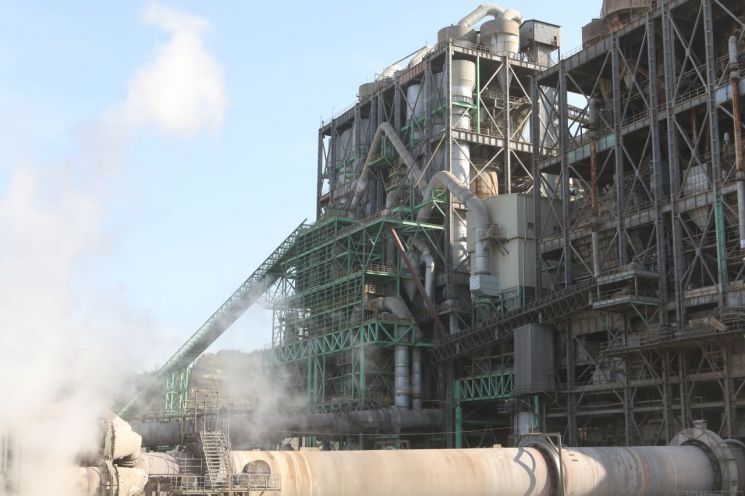
[Asia Economy Reporter Kim Jong-hwa] A supply crisis of cement and ready-mixed concrete (Remicon) has begun. Typically, from December, cement companies enter winter facility maintenance, reducing production and inventory, which leads to cement shortages (shortage) in the following spring construction season when site operation rates increase. However, this year, due to a combination of adverse factors such as a sharp rise in thermal coal prices, a shortage of urea solution, and a strike by the Cargo Solidarity Union, the cement shortage started earlier than usual.
According to the cement industry on the 29th, the current inventory at cement production plants and distribution bases is only 880,000 tons. This has decreased below the appropriate inventory level of 1.26 million tons (60%) out of the total storage capacity of 2.1 million tons. Inventory, which had been maintained at around 1.2 million tons until September, sharply dropped this month as construction projects increased this fall.
In particular, this year, negative external factors such as the surge in thermal coal prices, shortage of urea solution, and suspension of bulk cement trailer (BCT) vehicle operations due to the Cargo Solidarity Union strike have led companies to advance their winter facility maintenance periods earlier than planned.
The biggest cause is the rise in raw material prices. This month, the average import price of thermal coal for the cement industry is $240?260 per ton, the highest ever. Most companies sign one-year long-term contracts around the end of the year, but it is expected that long-term contracts will be impossible at current market prices. The Korea Cement Association estimated that if the same amount of cement as last year is produced, about 3 to 3.3 million tons of thermal coal will be consumed next year, requiring approximately 893 billion to 982 billion KRW in purchase costs. This is about 50 billion KRW more than this year’s purchase costs.
The industry’s stock of urea solution is also nearly depleted. Without urea solution, an essential material for low-emission devices, factories must halt operations, and about 2,500 BCT vehicles also stop running, causing logistics disruptions. This month, BCT vehicle operation volume decreased by about 10% compared to the previous month due to delayed urea solution supply.
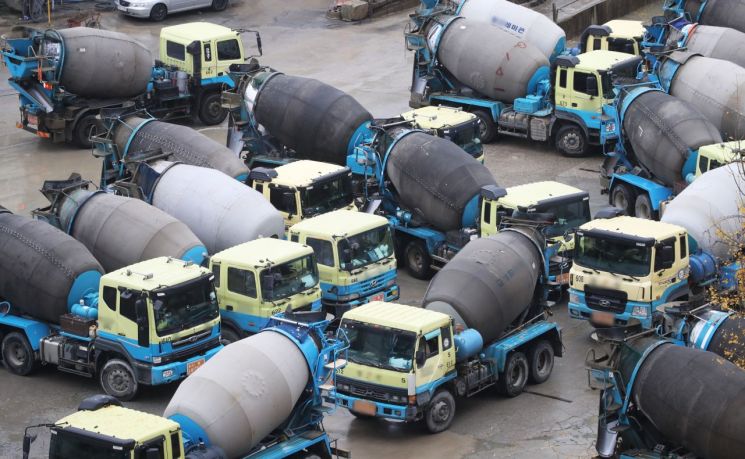 An emergency has been declared in the distribution of construction materials such as cement and ready-mixed concrete. A ready-mixed concrete truck is moving at a ready-mixed concrete plant in Anyang-si, Gyeonggi Province.
 [Photo by Yonhap News]
Damage from the Cargo Solidarity Union strike is also one reason for hastening winter facility maintenance. From the 25th, a three-day general strike halted product shipments from cement plants nationwide, delivering a direct blow to the cement industry. As BCT drivers, the main transporters of cement by land, joined the strike, the daily average shipment volume from cement production plants and distribution bases nationwide plummeted from about 200,000 tons during peak season to 40,000?50,000 tons, with daily losses estimated at around 11 billion KRW. With the Cargo Solidarity Union announcing a second indefinite general strike within the year, the cement, Remicon, and construction industries are on high alert.
Accordingly, some cement companies are advancing the usual late-December start of winter eco-friendly facility improvement work to early December. If some companies begin facility improvement work in early December, cement production will sharply decrease, and inventory at the end of December could fall to 500,000?600,000 tons.
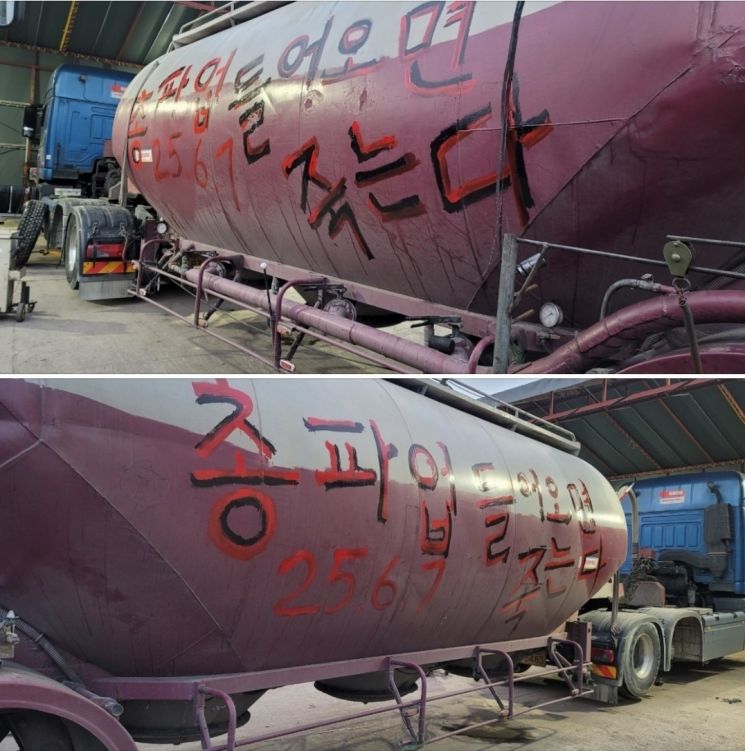 As the Cargo Solidarity Union went on strike, the entrance of a cement factory in a provincial area was blocked by Bulk Cement Trailer (BCT) vehicles.
 [Photo by Korea Cement Association]
The problem lies in next spring. In March and April last year, cement inventory also dropped below 600,000 tons, causing a cement supply crisis. Moreover, this winter, the period for companies’ eco-friendly facility investments is expected to be 1?2 months longer than last winter, making a cement supply crisis at construction sites inevitable.
The Remicon industry is also on edge. Since the Cargo Solidarity Union strike was anticipated, they secured cement inventory in advance and coordinated construction site and delivery schedules, so major damage was avoided. However, if additional strikes occur or cement supply becomes insufficient, the situation could worsen uncontrollably.
A Remicon industry official said, "We are closely monitoring the situation in a state of high alert," adding, "This year, adverse factors have overlapped unusually, making the situation increasingly difficult. We are already seeing signs of a cement shortage, which is very concerning."
A cement industry official said, "Due to rising raw material prices, profitability has worsened, and some companies are trying to advance their winter facility maintenance periods," adding, "There is a high possibility of cement shortages occurring next spring in forward industries such as Remicon and construction."
© The Asia Business Daily(www.asiae.co.kr). All rights reserved.



















