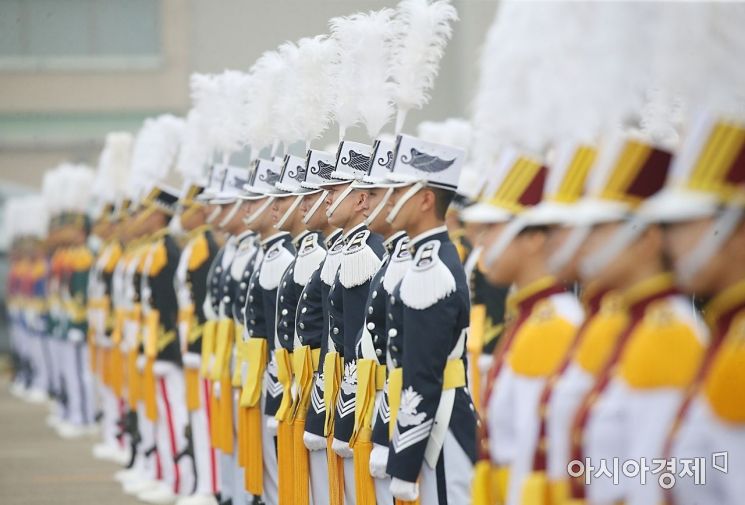
 On the 1st, in celebration of Armed Forces Day, nursing cadets and cadets from the Air Force Academy, Naval Academy, and Army Academy are entering the event venue at Daegu Air Base (11th Fighter Wing) during the "71st Armed Forces Day Ceremony." /Daegu=Photo by Joint Press Corps
[Asia Economy Yang Nak-gyu, Military Specialist Reporter] The military plans to provide related education to cadets at military academies to expand talent in the field of defense science and technology. Until now, the method was to select talent from science and engineering universities and deploy them in this field, but the problem was that these selected science and engineering talents did not serve long in the military.
According to the Ministry of National Defense on the 29th, some second-year cadets from each military academy will be sent for commissioned education at the Korea Advanced Institute of Science and Technology (KAIST). The final decision on the number of cadets per academy and the timing will be made next month after the research service results for defense talent development, which was entrusted to the Korea Institute for Defense Analyses (KIDA) in June, are released.
The military plans to assign research and development specialties to cadets who receive commissioned education at KAIST and deploy them to the Agency for Defense Development (ADD). These cadets will be assigned to new research fields such as artificial intelligence (AI), quantum, and cyber, rather than the existing defense science and technology fields held by ADD.
This changes the stage for expanding defense science and technology talent from ‘science and engineering universities’ to ‘military academies.’ Until now, since 2014, the Ministry of National Defense has selected science and engineering university students (2nd to 3rd year) enrolled at KAIST, Pohang University of Science and Technology (POSTECH), Ulsan National Institute of Science and Technology (UNIST), and Gwangju Institute of Science and Technology (GIST), deployed them to ADD, and had them conduct research projects for three years. This system, benchmarked after Israel’s Talpiot program which cultivates science and technology elites, has seen 79 people complete the process up to this year.
However, 38 of them completed only their mandatory service period and were discharged after short-term service. Currently, all 41 personnel assigned to ADD remain. The military expects that selecting talent from cadets who have already entered with long-term military service in mind and assigning them to ADD will partially resolve the short-term service issue.
© The Asia Business Daily(www.asiae.co.kr). All rights reserved.
![Clutching a Stolen Dior Bag, Saying "I Hate Being Poor but Real"... The Grotesque Con of a "Human Knockoff" [Slate]](https://cwcontent.asiae.co.kr/asiaresize/183/2026021902243444107_1771435474.jpg)
















