Domestic travelers transiting through affected countries must quarantine for 10 days even if vaccinated
No domestic cases detected yet; "Risk and spread assessment to expand or adjust target countries"
KCDC: "Current variant PCR tests cannot detect Omicron... plan to develop new tests"
"Omicron detection possible through whole genome or targeted genomic analysis"
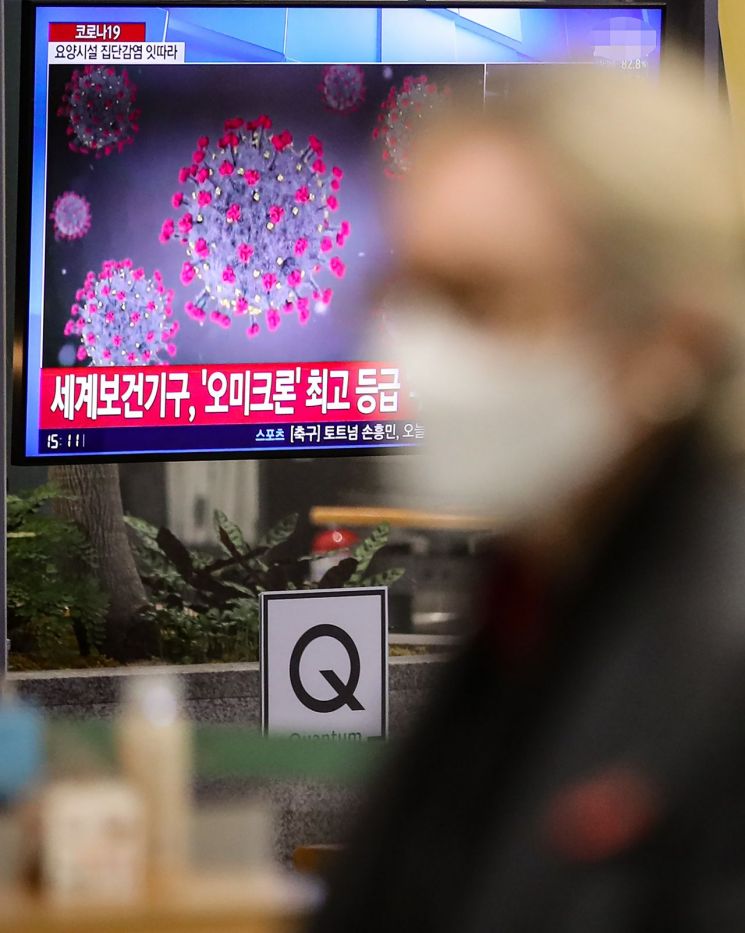 On the afternoon of the 28th, as global health authorities tighten measures to prevent the spread of the Omicron COVID-19 variant reported in South Africa, a foreign airline crew member is seen walking past a TV screen showing news about Omicron at the Incheon Airport arrival hall.
 [Photo by Yonhap News]
[Asia Economy Reporter Lee Gwan-joo] To block the domestic inflow of the COVID-19 variant virus 'Omicron,' the government plans to expand the list of countries subject to entry bans, following the prohibition of entry for foreigners coming from eight countries in Southern Africa.
The Central Disease Control Headquarters (CDCH) announced on the 28th, "We will continuously monitor the Omicron variant virus to assess its risk and spread, and consider expanding or adjusting the list of countries subject to strengthened quarantine measures or other restrictions."
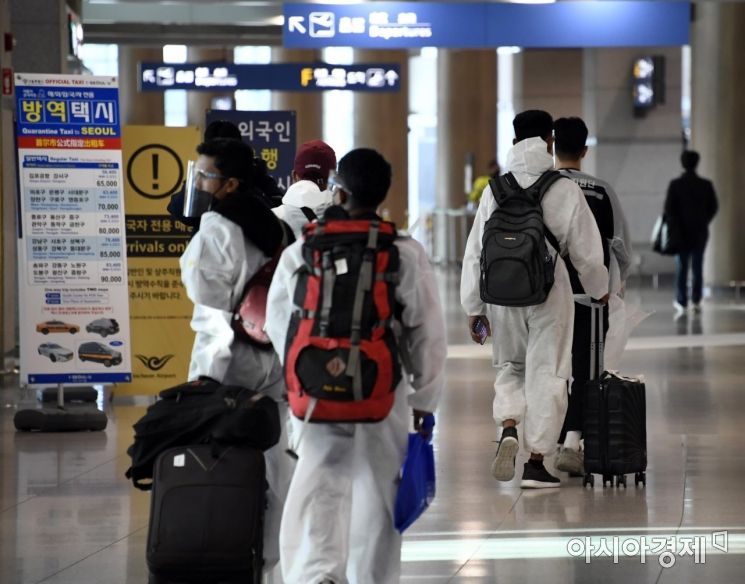 On the 28th, Terminal 1 of Incheon International Airport, where the government banned entry from eight African countries to prevent the domestic influx of the COVID-19 variant 'Omicron' spreading across South Africa.
The CDCH held an emergency meeting the previous day and designated eight countries where the Omicron variant has emerged?South Africa, Botswana, Zimbabwe, Namibia, Lesotho, Eswatini, Mozambique, and Malawi?as countries subject to strengthened quarantine measures, high-risk countries, and countries excluded from quarantine exemptions, effective from 0:00 on the 28th.
Although there are no direct flights from these countries to Korea, foreigners arriving via connecting flights will be restricted from boarding during the check-in process, and even if they arrive in Korea, entry will not be permitted. In effect, entry of all foreigners coming from these eight countries into Korea is banned.
Korean nationals arriving from these countries will be quarantined in facilities for 10 days regardless of vaccination status. They must possess a negative test certificate before coming to Korea and undergo a separate diagnostic test.
In Europe, confirmed cases of Omicron infection have already triggered emergency responses. Omicron infections have been confirmed in Belgium, the United Kingdom, Germany, Italy, and the Czech Republic, and have also been detected in Hong Kong and Israel. No cases have yet been reported in Korea.
Meanwhile, since the entry restrictions took effect at 0:00 on this day, eight Korean nationals who stayed in the designated countries and entered Korea via other countries have been recorded. Among the entrants from Africa over the past five weeks, 22 tested positive, with 14 confirmed to be infected with the Delta variant. The remaining eight had low viral loads, making variant analysis impossible, according to health authorities.
The CDCH stated, "Currently, the variant PCR tests in use identify four types of variants: Alpha, Beta, Gamma, and Delta," and added, "We plan to develop a variant PCR test specifically for Omicron." At present, Omicron identification is possible only through whole genome or targeted genome analysis, not by PCR.
© The Asia Business Daily(www.asiae.co.kr). All rights reserved.
![Clutching a Stolen Dior Bag, Saying "I Hate Being Poor but Real"... The Grotesque Con of a "Human Knockoff" [Slate]](https://cwcontent.asiae.co.kr/asiaresize/183/2026021902243444107_1771435474.jpg)

















