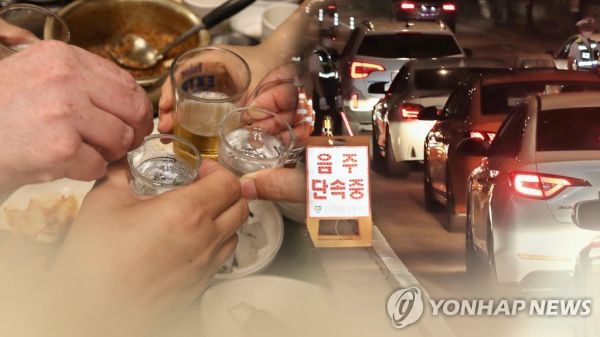
[Asia Economy Reporter Baek Kyunghwan] Following the Constitutional Court's ruling that the 'Yoon Chang-ho Act,' which imposes aggravated punishment on individuals who drive under the influence more than twice, is unconstitutional, the prosecution is taking follow-up measures such as amending indictments related to the cases.
On the 28th, the Supreme Prosecutors' Office announced that it has instructed local prosecution offices to take measures in response to the loss of effect of the punishment provisions due to the unconstitutionality ruling on Article 148-2, Paragraph 1 of the Road Traffic Act. The provision declared unconstitutional by the Constitutional Court, Article 148-2, Paragraph 1 of the Road Traffic Act, stipulated that those who violate the DUI prohibition regulation more than twice shall be punished by imprisonment for not less than 2 years and not more than 5 years, or a fine of not less than 10 million won and not more than 20 million won. This so-called 'Yoon Chang-ho Act' was revised in September 2018 following the death of Yoon Chang-ho, who was hit by a vehicle driven by a drunk driver in Haeundae-gu, Busan.
First, the Supreme Prosecutors' Office instructed that for ongoing investigations, cases falling under the unconstitutional aggravated punishment provision should be prosecuted under the general DUI regulation, but the aggravating factors should be actively reflected in sentencing to request penalties commensurate with the crime.
Additionally, for cases currently on trial, including retrials after remand and first and second trials, the prosecution will amend the indictment to apply the general DUI regulation. For cases where the trial has concluded and sentencing is pending, the prosecution plans to immediately request the resumption of proceedings and amend the indictment to request penalties commensurate with the crime.
Furthermore, if a court has already issued a guilty verdict under the Yoon Chang-ho Act, the prosecution has decided to file appeals or further appeals on behalf of the defendant. For cases where the trial results have been finalized, if the punished party requests a retrial, the prosecution will take measures such as amending the indictment.
Earlier, the Constitutional Court ruled that the provision of the Road Traffic Act imposing aggravated punishment for violating the DUI prohibition regulation more than twice is unconstitutional. The court pointed out, "There is no temporal limitation between the past DUI violation that constitutes the aggravating condition and the repeat DUI violation subject to punishment, nor does it require that the past violation be a prior conviction with a sentence or a confirmed guilty verdict."
For example, if the past violation occurred more than 10 years ago and DUI was committed afterward, it is difficult to evaluate this as a repetitive act. The court added, "It is rare to find cases where unlimited subsequent offenses are aggravated without any temporal limitation due to past offenses, and this does not align with the intent to recognize statutes of limitations or the extinction of punishment."
However, there was also an opinion that this provision does not violate the principles of proportionality between responsibility and punishment or the principle of equality, and is not unconstitutional. Justices Lee Seon-ae and Moon Hyeong-bae dissented, stating, "This provision was legislated as a criminal policy measure to strictly punish and prevent repeat DUI offenses following the so-called 'Yoon Chang-ho incident,' and since repeated DUI is highly blameworthy, the aggravated punishment of repeat DUI offenders under the challenged provision has a rational basis."
© The Asia Business Daily(www.asiae.co.kr). All rights reserved.
![Clutching a Stolen Dior Bag, Saying "I Hate Being Poor but Real"... The Grotesque Con of a "Human Knockoff" [Slate]](https://cwcontent.asiae.co.kr/asiaresize/183/2026021902243444107_1771435474.jpg)
















