Some Vehicle Models Have 6 to 12 Months Delivery Wait Time
Possibility of Missing Excise Tax Reduction Benefits
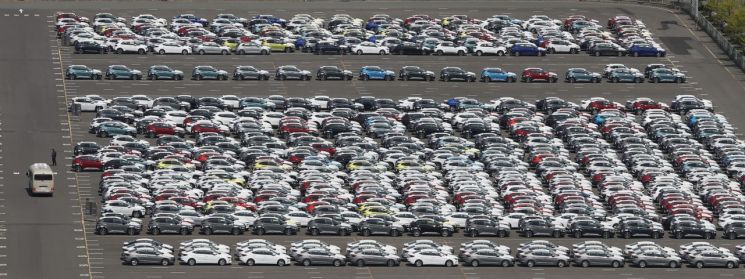
[Asia Economy Reporter Ki-min Lee] Although the individual consumption tax reduction for passenger cars has been extended, some customers are expected not to benefit from it. This is because the prolonged shortage of automotive semiconductors may delay vehicle deliveries next year as well.
According to the industry and government on the 28th, the policy to reduce the individual consumption tax for passenger cars, which was scheduled to expire at the end of this year, has been extended for six months until June next year.
Earlier, Hong Nam-ki, Deputy Prime Minister and Minister of Economy and Finance, announced at the 48th Emergency Economic Central Countermeasures Headquarters meeting held at the Government Seoul Office on the 23rd that the reduction of the individual consumption tax for passenger cars would be extended until June next year.
Previously, the government lowered the individual consumption tax by 70% (from 5% to 1.5%) in March last year to stimulate passenger car sales and consumption amid the spread of COVID-19, then reduced the cut to 30% (from 5% to 3.5%) in July of the same year, continuing the tax reduction measures. Due to the prolonged semiconductor shortage causing a decrease in vehicle production and sales, the reduction was extended twice this year.
The industry responded that this government measure has put out the urgent fire. Complete car manufacturers can avoid disruptions in production and sales plans due to the expiration of the individual consumption tax reduction, and customers can also benefit from the tax reduction.
However, since some models still have a delivery waiting period of about 6 months to 1 year, some consumers are highly likely not to receive the benefits of the individual consumption tax reduction.
If you sign a contract for Hyundai Motor's exclusive electric vehicle Ioniq 5 this month, it takes 8 months until delivery; the mid-size sports utility vehicle (SUV) Santa Fe Hybrid takes 8 to 9 months; and the Genesis GV60 takes more than a year.
Kia's delivery waiting periods are 10 months for the mid-size SUV Sorento gasoline model, 12 months for the hybrid, 9 months for the compact SUV Sportage gasoline and hybrid models, and 8 months for the mid-large sedan K8 models excluding the 3.5ℓ gasoline vehicle, including the 2.5ℓ gasoline, hybrid, and LPi models. The EV6 is also known to take more than a year.
Although the supply situation of automotive semiconductors has improved compared to early this year, it is expected to continue until the first half of next year at the latest. Because of this, some companies are releasing 'minus option' vehicles to shorten the delivery period as much as possible.
There are also calls for the government to gradually abolish the individual consumption tax on passenger cars regardless of vehicle delivery periods and consumption stimulation. Professor Kim Pil-su of the Department of Automotive Studies at Daelim University pointed out, "Passenger cars are no longer a luxury item but a daily necessity," adding, "It is problematic to apply a concept that is decades old, and it is appropriate to extend the tax reduction temporarily and then reform it."
© The Asia Business Daily(www.asiae.co.kr). All rights reserved.

















