Enforcement of Serious Accident Punishment Act from January 27... CEOs and Management Officials Can Be Held Accountable
Importance of 'Safety and Health' Rises with ESG Management Focus
Kia Reviews CSEO Appointment After Establishing Industrial Accident Management System in December
Dongkuk Steel Expands Safety Staff by 40%... Hyundai Heavy Industries Increases by 20%
Construction and Steel Industries Establish CEO-Direct Safety Teams
Small and Medium Enterprises Still Facing Confusion
[Asia Economy Reporters Choi Dae-yeol, Hwang Yoon-joo] With the enforcement of the Serious Accidents Punishment Act just two months away, companies are making every effort to strengthen safety-related organizations and manuals. Since the Serious Accidents Punishment Act is the first punitive damages-type legal regulation introduced in Korea, companies believe that violations will result in significant penalties. Furthermore, the emphasis on workers' safety and health issues as part of the ESG (Environmental, Social, Governance) management trend worldwide after COVID-19 has elevated industrial accident prevention as a critical management test.
According to the industry on the 29th, Kia plans to establish a comprehensive industrial accident management system next month and appoint a Chief Safety and Environmental Officer (CSEO) to oversee company-wide safety and health management. The CSEO is a newly created position mandated by the Serious Accidents Punishment Act, which requires organizations dedicated to safety, and is responsible for safety and health planning, employee training, and risk management.
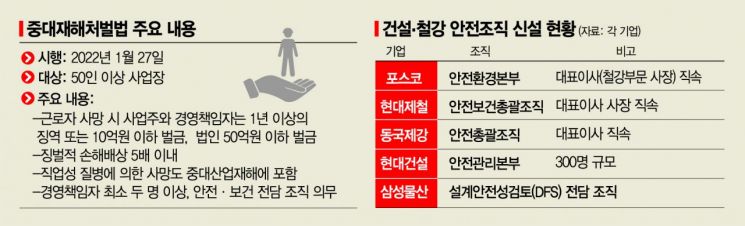
Hyundai Heavy Industries recently increased the safety personnel in its Safety Management Headquarters by 20%, and Dongkuk Steel expanded its safety and environmental specialists from about 60 to 86. This reflects their intention to strengthen worker safety training and apply safety manuals more conservatively on-site in line with the enforcement of the Serious Accidents Punishment Act.
Previously, Hyundai Construction established a Safety Management Headquarters with about 300 employees, and Samsung C&T created a dedicated ‘Design Safety Review (DFS) team.’ Hyundai Steel has mandated safety and health rules and common-sense training for office workers since last month and is conducting education for employees. POSCO has gone a step further by creating an organization dedicated to managing the safety of its subcontractors.
There are two main reasons companies are establishing or reorganizing safety organizations. First, they want to avoid being the first case subject to the law after its enforcement on January 27 next year. If a fatal accident occurs at a workplace after the law takes effect, the corporation faces fines up to 5 billion KRW and punitive damages up to five times the amount of damages. Particularly sensitive is the provision that holds not only the business owner but also management responsible. In the event of an industrial accident, the CEO could be detained. A steel industry official said, "Companies where worker fatalities occur after the enforcement of the Serious Accidents Punishment Act will be stigmatized as dangerous workplaces and are likely to face strict legal application as a pilot case. There is a consensus that no company wants to be the first violator."
The global ESG management trend has also prioritized industrial accident issues. Last year, when major overseas business sites were shut down due to COVID-19, companies realized that health guidelines could impact productivity and sales. Additionally, to achieve high ESG evaluation scores, companies must maintain low industrial accident rates.
The problem is that unlike large corporations moving closely in preparation for the law’s enforcement, small and medium-sized enterprises (SMEs) with limited personnel and funds are still experiencing confusion. SMEs have been requesting exemption clauses, citing unclear responsibilities for management officers and the scope of primary contractors’ liability for accidents at subcontracted sites?issues that have been controversial since the law’s enactment. However, it is unlikely these demands will be accepted at this time. The National Assembly has already shifted into election mode, and the government reportedly prefers to discuss any necessary amendments after the law is enforced.
A representative from the Korea Employers Federation said, "The recent 200-page explanatory guide on the Serious Accidents Punishment Act issued by the Ministry of Labor has even led to jokes about needing an interpretation of the guide itself. Large companies are preparing by applying existing laws such as the Industrial Safety and Health Act, but SMEs lacking related information and personnel still find it difficult."
© The Asia Business Daily(www.asiae.co.kr). All rights reserved.

















