The End of the 'Ultra-Low Interest Rate Era'... Accelerating Monetary Policy Normalization Through Next Year
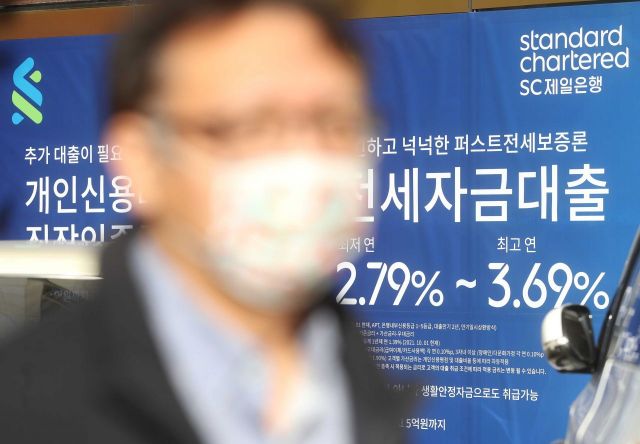 The era of near-zero interest rates that began after the COVID-19 crisis has come to an end after 1 year and 8 months. On the 25th, the Monetary Policy Committee of the Bank of Korea held a meeting to decide on monetary policy direction and raised the base interest rate by 0.25 percentage points from 0.75% to 1%. The photo shows a loan-related notice posted on the exterior wall of a bank in downtown Seoul on the same day. Photo by Mun Ho-nam munonam@
[Asia Economy Reporter Jin-ho Kim] Following the Bank of Korea's interest rate hike on the 25th, bank loan interest rates are likely to rise further. With the tightening of loan regulations by financial authorities alongside the increase in the base rate, borrowers' interest burdens are expected to grow even heavier.
In particular, the banking sector anticipates that mortgage loan interest rates will surpass an annual 6%, and unsecured loan rates will exceed an annual 5% as early as this year or by early next year at the latest. This is because the Bank of Korea is likely to raise the base rate one or two more times by next year. Analysts suggest that the era of so-called 'debt investment (debt-fueled investment)' and 'all-in borrowing (borrowing to the fullest extent)' that spread like a trend during the ultra-low interest rate period has come to an end.
According to the financial sector on the 27th, the Monetary Policy Committee of the Bank of Korea held a meeting on the 25th and decided to raise the base rate by 0.25 percentage points from the existing annual 0.75% to 1.0%.
With the Bank of Korea pushing for normalization of monetary policy, loan interest rates are expected to rise rapidly for the time being. Additional base rate hikes are forecasted for early next year following this increase, which is expected to quickly push up market interest rates. Previously, when the base rate was raised once in August, major loan interest rates surged by more than 1 percentage point.
In fact, the average mortgage loan interest rates of the five major commercial banks showed a clear upward trend, rising from 2.76?3.15% in August to 2.87?3.37% in September, and 3.05?3.76% in October. The average interest rates on unsecured loans also increased from 2.89?3.14% in August to 3.15?3.58% in October.
This reflects the upward trend through average interest rates, but the actual loan interest rate increases felt by borrowers are much greater. The upper limits of mortgage and unsecured loan interest rates at major commercial banks are already in the mid-5% and high-4% ranges, respectively. As of the 25th, the variable mortgage loan interest rates (new COFIX) at the four major commercial banks ranged from 3.58% to 4.954% annually.
Especially with the Bank of Korea signaling additional base rate hikes early next year, the upward trend in loan interest rates is expected to accelerate. A financial sector official commented, "Since monetary policy has entered a normalization track, loan interest rates are likely to continue rising steadily for the time being."
The problem lies in the borrowers' interest burden. More than 80% of mortgage borrowers have variable interest rates, and investors who engaged in so-called debt investment through unsecured loans are now facing an emergency. The increased interest burden means that 'all-in borrowing or debt investment' has become impossible in this new era.
For example, a borrower who took out a 300 million KRW mortgage loan in August with a 30-year term at 4% interest would pay about 1.43 million KRW monthly. However, if the interest rate approaches 6% within the year, the borrower would have to pay about 1.8 million KRW monthly. This means a monthly interest burden difference of 300,000 KRW within just 3 to 4 months.
According to the Bank of Korea's 'Financial Stability Report' released in September, if the base rate rises by another 0.25 percentage points within the year following the August hike, household interest burdens are estimated to increase by 5.8 trillion KRW compared to the end of 2020.
The interest rate spread between deposits and loans, which has widened the most in 11 years, is also likely to expand further. This is because financial authorities have stated they will not intervene, and additional base rate hikes are expected early next year following this increase. According to the Bank of Korea, the deposit-loan interest rate spread based on balances stood at 2.14 percentage points at the end of September, marking the highest level since October 2010 (2.22 percentage points).
© The Asia Business Daily(www.asiae.co.kr). All rights reserved.

![Clutching a Stolen Dior Bag, Saying "I Hate Being Poor but Real"... The Grotesque Con of a "Human Knockoff" [Slate]](https://cwcontent.asiae.co.kr/asiaresize/183/2026021902243444107_1771435474.jpg)















