US Treasury Bonds, Gold, and Japanese Yen Strengthen
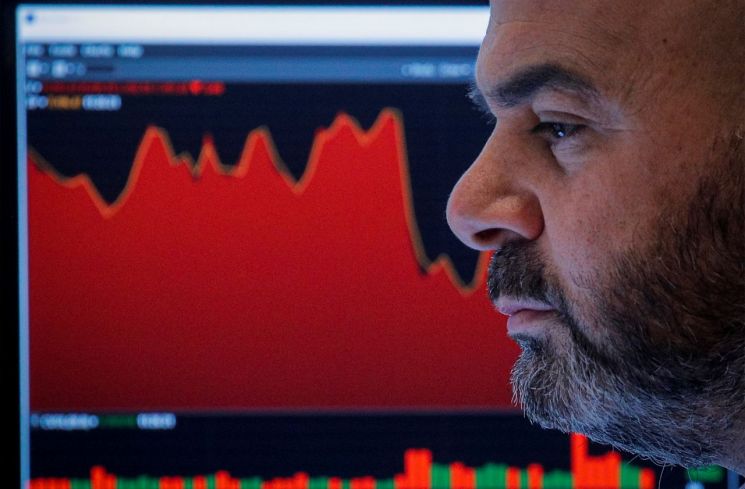
[Asia Economy New York=Correspondent Baek Jong-min] The new COVID-19 variant 'Omicron' has struck the financial markets in the US and Europe following Asia. The New York Stock Exchange experienced the largest drop in Black Friday history. Oil prices plummeted by 12% amid concerns over weakening demand. While the preference for safe-haven assets spread, boosting US Treasury bonds and gold prices, cryptocurrencies suffered significant declines.
On November 26 (local time), the biggest shopping day in the US, 'Black Friday,' the Dow Jones Industrial Average fell 905.04 points (2.53%) from the previous close to 34,899.34, the S&P 500 index dropped 106.84 points (2.27%) to 4594.62, and the Nasdaq index declined 353.57 points (2.23%) to 15,491.66.
The Dow index struggled, falling more than 1,000 points intraday. The Wall Street Journal reported that the Dow's decline was the largest ever recorded on a Black Friday. The Nasdaq index plunged sharply despite a drop in Treasury yields.
Concerns that the new variant may be more contagious than the Delta variant sharply dampened investor sentiment. Following the Asian markets, the plunge continued in Europe and the US. The UK stock market fell more than 3%, while the German, French, and Italian markets dropped over 4%.
The 10-year US Treasury yield fell to around 1.48%. Treasury yields had risen to 1.69% earlier this week, reflecting expectations of an early rate hike, but the situation reversed rapidly.
The worsening COVID-19 situation also affected expectations for US rate hikes. The Chicago Mercantile Exchange (CME) FedWatch tool significantly lowered the probability of a rate hike by June next year to 53.7%. The chance of a rate hike in September also dropped to 84.1%.
As the preference for safe-haven assets spread, the dollar's value plunged. The dollar index fell 0.82% to 96.078. Meanwhile, the yen strengthened against the dollar.
New York oil prices dropped more than 12%, falling below $70 per barrel. On the New York Mercantile Exchange, January West Texas Intermediate (WTI) crude oil prices closed at $68.15 per barrel, down $10.24 (13.06%) from the previous session.
Amid the broad market plunge, cyclical stocks and travel-related shares tumbled, while vaccine-related and COVID-19 beneficiary stocks showed strength.
Cruise companies Carnival and Royal Caribbean both saw their shares plunge more than 10%, while United Airlines, American Airlines, and Delta Air Lines shares dropped over 8-9%. Aircraft manufacturer Boeing's shares fell more than 5%, and credit card company American Express shares also declined over 8%. Hotel chain Marriott dropped 6.5%.
Bank stocks such as JPMorgan and Bank of America, which had been strong riding the rise in Treasury yields, also fell more than 4%. Caterpillar, which had been strong on infrastructure investment expectations, declined 4%.
Moderna, which had been weak after announcing an oral COVID-19 treatment, surged 17%.
Zoom Video, which had been weak due to COVID-19 slowdown concerns, rose more than 6%. Exercise equipment maker Peloton also gained over 5% amid earnings concerns.
Energy stocks showed a decline of around 3% due to the sharp drop in oil prices.
On the Chicago Board Options Exchange (CBOE), the Volatility Index (VIX) surged 10.04 points (54.04%) to 28.62. This was the largest one-day increase since January 27 (61.64%).
Cryptocurrencies also plunged. Bitcoin fell 7% to trade at $55,400. Bitcoin entered a correction phase, dropping more than 20% from its peak of $69,000. Ethereum also declined by 9%.
The sharp market drop on the day is also analyzed to be influenced by shortened trading hours and reduced volume due to the Thanksgiving holiday.
Paul Hickey, an analyst at Bespoke Investment Group, explained, "At this point, there is little known about the virus, making it difficult to make informed investment decisions."
© The Asia Business Daily(www.asiae.co.kr). All rights reserved.
![Clutching a Stolen Dior Bag, Saying "I Hate Being Poor but Real"... The Grotesque Con of a "Human Knockoff" [Slate]](https://cwcontent.asiae.co.kr/asiaresize/183/2026021902243444107_1771435474.jpg)
















