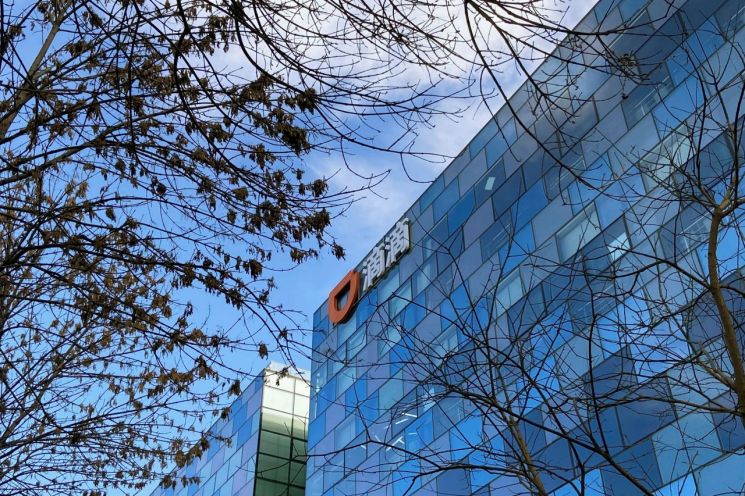
[Asia Economy Reporter Kim Suhwan] Chinese authorities have reportedly demanded that Didi Chuxing, the country's largest ride-sharing company, voluntarily delist from the U.S. stock market.
On the 26th, Bloomberg News cited sources saying, "The Chinese government wants Didi Chuxing to voluntarily delist from the New York Stock Exchange," adding, "This is due to concerns raised by the government over the potential leakage of various data held by Didi Chuxing."
China's internet regulatory authority, the Cyberspace Administration of China (CAC), has instructed Didi Chuxing to formulate a specific delisting plan, the report added.
According to the report, options under consideration include Didi Chuxing becoming a private company again or listing on the Hong Kong Stock Exchange.
If the voluntary delisting actually takes place, it would inevitably deal a significant blow to Didi Chuxing, which achieved the largest U.S. stock market listing among Chinese companies since Alibaba Group.
However, sources said that no concrete plan has been finalized yet, and there remains a possibility that the government may withdraw its delisting directive.
Earlier, despite warnings from the Chinese government, Didi Chuxing proceeded with its New York Stock Exchange listing this summer and has since faced regulatory pressure from authorities.
The authorities have launched an antitrust investigation into Didi Chuxing and have considered imposing substantial fines. Additionally, as local governments have pledged to increase investments in Didi Chuxing, control by state-owned enterprises is expected to strengthen.
The government's demand for Didi Chuxing's voluntary delisting may be part of this broader pressure.
Even if Didi Chuxing opts to list on the Hong Kong Stock Exchange, it would have to hand over control of the personal data it holds to a third party as per government demands. This would inevitably lead to a decline in Didi Chuxing's corporate value. For a ride-sharing platform company like Didi Chuxing, utilizing users' personal information is a core factor in generating revenue, and giving this up would be detrimental.
Meanwhile, Bloomberg News reported that if Didi Chuxing actually decides to voluntarily delist, a chain reaction could occur with other Chinese companies listed on the U.S. stock market also moving toward delisting.
The day before, a senior Chinese government official warned that Didi Chuxing's voluntary delisting could have a serious negative impact on U.S.-China relations.
With numerous foreign investors, including Americans, having invested in Didi Chuxing, a sudden delisting would inevitably cause losses to these investors. Consequently, the U.S. government is likely to respond strongly.
In particular, as regulatory pressure on large Chinese companies intensifies, American investors may increasingly avoid investing in Chinese firms.
Bloomberg News predicted, "The various regulatory measures imposed by the Chinese government on Didi Chuxing are severe even compared to other companies," and added, "This will instill fear among American investors who have invested in Chinese companies such as Alibaba Group."
© The Asia Business Daily(www.asiae.co.kr). All rights reserved.

















