Government Announces '1st Hydrogen Economy Implementation Basic Plan'
Only Clean Hydrogen Supplied by 2050...Targeting 20% Domestic Production, 40% Overseas Production, 40% Imports
"High Storage and Transportation Costs Equal to Production Costs...Preferring Renewable Energy Over Cheap Nuclear Power"
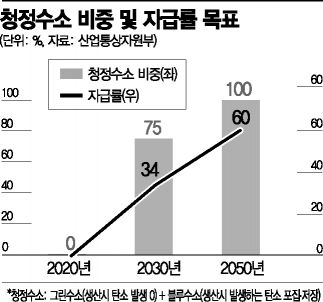
[Sejong=Asia Economy Reporter Kwon Haeyoung] The government has decided to supply the entire annual hydrogen demand of 27.9 million tons by 2050 with carbon-free "clean hydrogen" and raise the self-sufficiency rate to 60%. However, the plan excludes the use of cheap nuclear power for hydrogen production and only includes renewable energy utilization plans, leading to criticism that it is an unrealistic "half-baked" blueprint.
On the 26th, the government held the Hydrogen Economy Committee chaired by Prime Minister Kim Boo-kyum at Lotte Hotel in Seoul and announced the "1st Basic Plan for Hydrogen Economy Implementation," which contains these details. This plan is the first implementation policy under the Hydrogen Act enacted in February.
According to the plan, the government will expand the clean hydrogen self-sufficiency rate from the current 0% to 35% by 2030 and over 60% by 2050. Clean hydrogen refers to green hydrogen, which emits no carbon during production, and blue hydrogen, which captures and stores carbon emitted during production. The plan is to produce 5.58 million tons, or 20% of the total hydrogen demand in 2050, domestically, and 11.16 million tons, or 40%, overseas using Korean capital and technology in countries such as Australia. The remaining 40%, or 11.16 million tons, will be imported from abroad.
The focus is on the clean hydrogen production roadmap. To produce hydrogen, water electrolysis technology is required to obtain hydrogen by electrolyzing water. The government plans to establish a gigawatt (GW)-scale green hydrogen production base through demonstrations of water electrolysis powered by electricity generated from renewable energy. The production cost is expected to decrease from 3,500 KRW per kilogram in 2030 to 2,500 KRW in 2050. Additionally, early commercialization of carbon capture and storage (CCS) technology will be pursued through demonstrations such as the East Sea gas field, and carbon storage capacity of over 900 million tons will be secured by 2030. Through this, blue hydrogen production is planned to reach 750,000 tons by 2030 and 2 million tons by 2050.
However, the government's hydrogen production plan excludes the use of nuclear power. While major countries such as the United States, Russia, and France are developing clean hydrogen production technology based on nuclear power, our government has only presented plans to use renewable energy such as solar and wind power for hydrogen production. The goal of achieving 60% hydrogen self-sufficiency by 2050 with two-thirds produced overseas is also because the government insists on using only renewable energy for hydrogen production, making it inevitable to rely on cheaper overseas sources.
This overlooks the fact that storage and transportation costs are as high as hydrogen production costs. According to data submitted by Korea Gas Corporation to Rep. Han Mookyung of the People Power Party, importing 23.9 million tons of hydrogen from overseas in 2050 will cost 66 trillion KRW solely for liquefaction, transportation, and storage.
Professor Jung Dongwook of the Department of Energy Systems Engineering at Chung-Ang University said, "The renewable energy facility capacity required to produce 5.58 million tons of domestic clean hydrogen in 2050 is roughly 200 GW, exceeding the total domestic power generation capacity (125 GW as of 2019)." He added, "Due to the lack of domestic renewable energy facilities, overseas production is inevitable. While it is necessary to consider hydrogen production using nuclear power, which emits zero carbon, it is unlikely the government would opt to use nuclear power for hydrogen production given the current situation of reducing nuclear power-based electricity generation."
Meanwhile, at a pre-event on the same day, SK E&S, Chungcheongnam-do Province, Boryeong City, and Korea Midland Power signed a business agreement to establish an eco-friendly clean hydrogen production base. Prime Minister Kim attended the signing ceremony and emphasized the role of the private sector in spreading the hydrogen economy.
© The Asia Business Daily(www.asiae.co.kr). All rights reserved.

















