‘UT’ and ‘Tada’ are aggressively expanding their market presence in the domestic mobility kingdom dominated by Kakao Mobility. They are competing fiercely by offering discounts on taxi fares and distributing large amounts of cash to taxi drivers. Taking advantage of Kakao Mobility, which is embroiled in monopoly controversies and is lowering its guard, they are actively increasing their market share.
Will Tada Recreate Its Glory?
According to Viva Republica on the 26th, the company started the beta service of ‘Tada Next’ from the previous day. Viva Republica operates the financial platform ‘Toss.’ Tada Next has adopted a premium taxi strategy using 7-seater or larger models such as the Hyundai Staria. It maintains the spacious and comfortable environment and friendly drivers that made the past service innovation ‘Tada Basic’ popular, while addressing its weaknesses. Tada Next is driven by drivers holding taxi licenses. Tada Basic operated in a rental car format, which provoked opposition from the taxi industry and ultimately led to the passage of the ‘Tada Ban Law (Amendment to the Passenger Transport Service Act),’ resulting in the service’s termination in April last year.
Tada Next is actively recruiting users and drivers. It offers users a 20% discount coupon on fares and provides taxi drivers with up to 18 million KRW in cash. Additionally, it offers drivers a 50% discount on commissions, which is the biggest issue for them.
UT, a joint venture between SK Telecom’s subsidiary T map Mobility and Uber, is also aggressively expanding its presence. On the 1st, UT launched an integrated app combining Uber and T map Taxi and started attracting customers. UT is also drawing users by offering a 20% discount on fares. In particular, UT is planning to leverage the global brand ‘Uber’ to attract overseas customers. Domestic UT app users can use the same service in over 10,000 cities worldwide, and users who used the Uber app abroad can use UT services domestically. UT is also working to increase its market share in the franchise taxi market dominated by Kakao Mobility. A UT official stated, "We plan to expand franchise taxis to 10,000 vehicles within this year and add more than 10,000 franchise taxis next year."
The Strong ‘Kakao Taxi’ Kingdom
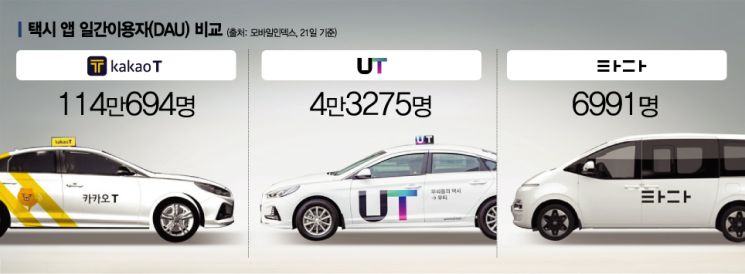
However, Tada and UT still have a long way to go before they can topple Kakao Mobility’s kingdom. According to mobile index data from IGAWorks, the daily active users (DAU) of taxi apps for Kakao Mobility are more than 20 times higher than those of Tada and UT. Kakao Mobility’s app ‘Kakao T’ had a DAU of 1,140,694, UT had 43,275, and Tada had 6,991 as of the 21st. In terms of convenience, Kakao Mobility is still considered superior. Among drivers, UT’s app is often criticized for being too complicated. Users also continue to complain about the app’s usability.
Experts emphasize that Tada and UT need to offer differentiated services from Kakao Mobility to activate competition. Choi Kyung-jin, professor of law at Gachon University and head of the Big Data Policy Research Center, said, "Mobility platforms have strong dependency, making it difficult for users to switch from what they are used to. Unless differentiated plus-alpha services are provided beyond simple mobility, it will be hard to become a market leader."
© The Asia Business Daily(www.asiae.co.kr). All rights reserved.











