[Asia Economy Reporter Seulgina Jo] "Only the online video service (OTT) industry is suffering from the turf war between government ministries."
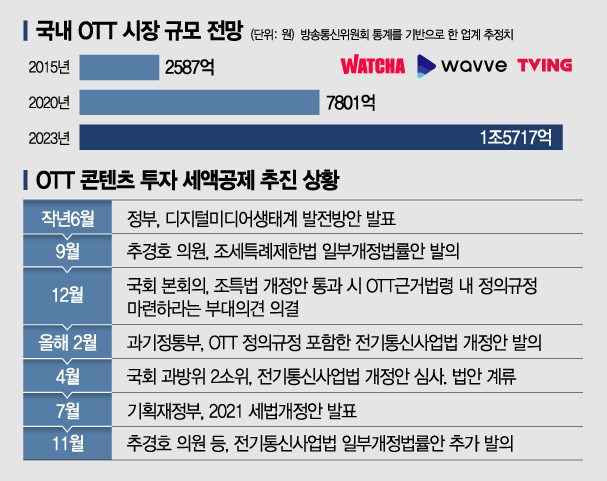
The domestic OTT promotion policy, announced last year to foster a 'Korean version of Netflix' through content investment tax credits, seems to have lost its way due to inter-ministerial turf battles. To implement the OTT promotion policy, it is urgent to first establish a legal basis within relevant laws, but this time the Korea Communications Commission (KCC) blocked discussions in the National Assembly.
◆Amendment Including Legal Support Basis for OTT Deferred Due to KCC Disagreement
According to the industry on the 26th, the National Assembly's Science, Technology, Information and Broadcasting and Communications Committee held a subcommittee meeting on information and communication broadcasting law bills (Bill Subcommittee 2) the day before to discuss the amendment to the Telecommunications Business Act containing the legal support basis for OTT, but the resolution was deferred.
On that day, the KCC opposed a partial amendment bill recently introduced by People Power Party lawmaker Choo Chul-ho, considering the urgency of the OTT promotion policy. The reason was that it did not include business areas such as real-time VOD and live broadcasting. However, inside and outside the industry expressed doubts about the KCC's move. In the April 2nd subcommittee meeting, some lawmakers pointed out that the government bill would not include business areas such as real-time VOD and live broadcasting, but the KCC did not oppose the government bill at that time.
Lawmaker Choo's bill mainly establishes a definition of OTT as an online video service provider that provides video content such as videos through information and communication networks among providers of value-added communication services. Previously, the government bill, which defined OTT providers as a 'special type of value-added communication service provider,' was not comprehensive enough and has been pending for nine months, resulting in a prolonged policy gap for OTT. The bill was proposed reflecting some of the pointed-out issues more concretely.
At the 2nd subcommittee meeting, resolutions on both Lawmaker Choo's bill, which considered the issues raised in the first review, and the government bill were proposed but blocked due to the KCC's opposition. The Ministry of Science and ICT emphasized the importance and timeliness of the legal amendment and requested a re-examination, but it was not accepted. Eventually, even the senior expert requested a chance to speak, stating unusually, "Lawmaker Choo's bill is more concise and easier for the public to understand, so it needs to pass," and "There is no substantive difference between the government bill (which the KCC supported) and Lawmaker Choo's bill (which the KCC opposed)."
◆Promised to Grow OTT... Policy Discord Amid Ministry Turf Wars
There are repeated criticisms that the background is a turf war among ministries to secure jurisdiction over the rapidly growing OTT market. The Ministry of Science and ICT, KCC, and Ministry of Culture, Sports and Tourism, which are fighting for the next government’s organizational restructuring, have shown policy discord while competing for platform leadership in conflicts over the Online Platform Fairness Act and music copyright rates.
An industry insider sighed, "There are differing positions among ministries regarding laws covering digital media in general, including OTT," adding, "It is a frustrating situation where even basic legislation is blocked, and the government-wide promotion policy has not been properly implemented for a year and a half."
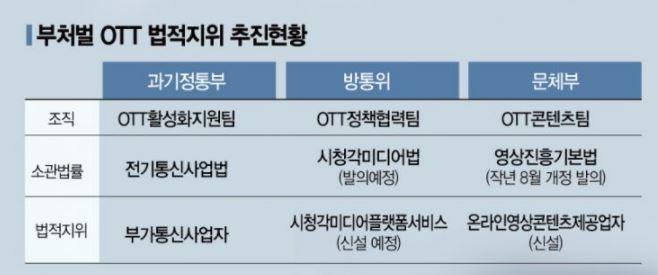
Currently, the KCC is promoting the 'Audiovisual Media Service Act,' which places OTT under the KCC’s regulatory jurisdiction like broadcasting and IPTV. On the other hand, the Ministry of Culture, Sports and Tourism’s amendment to the 'Act on the Promotion of Films and Videos (Film and Video Act),' announced for legislative notice in the first half of this year, defines OTT as an 'online video content provider' and intends to place it under its jurisdiction. The Ministry of Science and ICT views OTT as a special type of value-added communication service provider under the Telecommunications Business Act amendment.
The reason why only OTT and others are suffering due to the turf war among ministries is why complaints are pouring in from inside and outside the industry. The KCC’s opposition to the amendment on that day is also evaluated as an intention to secure regulatory authority by organizing OTT laws centered on the Audiovisual Media Service Act. Regarding this, a KCC official said, "In the April subcommittee, we agreed (to the government bill) on establishing support grounds 'without granting legal status,'" adding, "We thought it necessary to further discuss the definition because it does not cover business areas such as real-time VOD."
◆Will the Policy Gap Lengthen? Today’s National Assembly Tax Subcommittee Also in Focus
The bill discussed this time is significant in that it establishes a legal support basis that will serve as the foundation for various OTT promotion policies to prevent the rapidly growing market from being taken over by overseas OTTs such as Netflix. The government announced the Digital Media Ecosystem Development Plan last June, expanding content production tax credits to OTT in addition to existing TV programs and movies and introducing a voluntary rating system, but the lack of OTT definition in related laws has kept the policy at a standstill.
However, due to the failure of the review the day before, the OTT policy gap can only be prolonged. The National Assembly’s Planning and Finance Committee Tax Subcommittee was scheduled to review the 'Restriction of Special Taxation Act Amendment' on the 26th, which would expand production cost tax credits to OTT if the amendment including the legal support basis for OTT passed the Science and ICT Committee’s 2nd subcommittee. However, since the OTT definition has not been established, difficulties are expected in reviewing the Special Taxation Act amendment. Moreover, considering that the political sphere will soon enter the presidential election phase, concerns are raised that rapid legislation itself will be difficult.
Some suggest that considering the urgency of OTT support policies, instead of the Telecommunications Business Act amendment, establishing OTT definition provisions in other laws such as the Special Taxation Act could be an option. Currently, Article 25-6 of the Special Taxation Act stipulates that the tax credit target is "costs incurred domestically for the production of broadcasting programs and movies as prescribed by Presidential Decree."
© The Asia Business Daily(www.asiae.co.kr). All rights reserved.


















