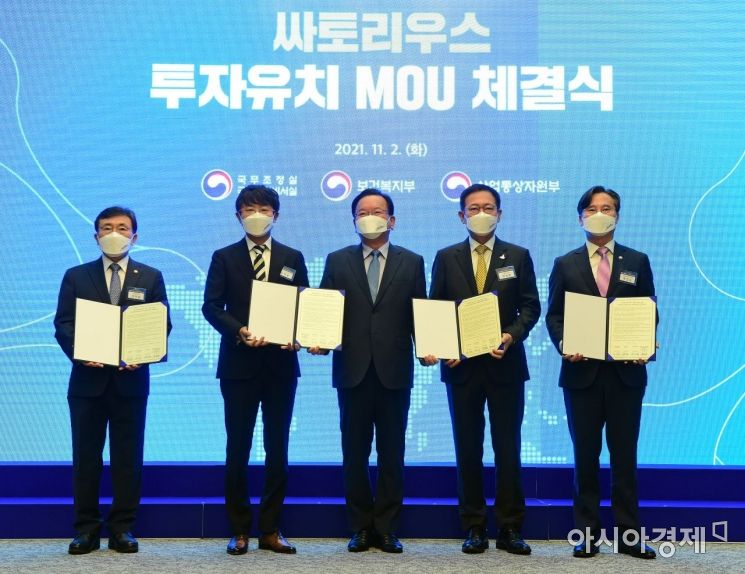
 On the 2nd, attendees are taking a commemorative photo at the 'Sartorius Investment Attraction MOU Signing Ceremony,' a preliminary event of the 2nd Global Vaccine Hub Promotion Committee held at Post Tower in Jung-gu, Seoul. From the left: Kwon Deok-cheol, Minister of Health and Welfare; Kim Deok-sang, CEO of Sartorius Korea; Kim Boo-kyum, Prime Minister; Park Nam-chun, Mayor of Incheon Metropolitan City; Park Jin-gyu, 1st Vice Minister of Trade, Industry and Energy. Photo by Kim Hyun-min kimhyun81@
[Asia Economy Reporter Lee Chun-hee] The global vaccine raw materials and equipment company Sartorius is accelerating the establishment of its production plant being prepared in Songdo, Incheon.
The Ministry of Health and Welfare announced on the 25th that Minister Kwon Deok-cheol met with Joachim Kreuzburg, Chairman of the German multinational company Sartorius Group in the field of vaccine raw materials and equipment, at The Plaza Hotel in Jung-gu, Seoul, in the afternoon.
This meeting took place on the occasion of Chairman Kreuzburg's visit to Korea. They discussed the follow-up progress and future cooperation plans regarding the "Business Agreement on Sartorius' Investment in Korea for Building a Global Vaccine Hub Infrastructure," signed on the 2nd at the event chaired by the Prime Minister, involving Sartorius, the Ministry of Trade, Industry and Energy, the Ministry of Health and Welfare, and Incheon City.
Sartorius plans to establish a factory in Songdo, Incheon, investing $300 million (approximately 356.9 billion KRW) with a goal of starting production in 2024. The site covers an area of 24,000㎡ and will produce cell culture media, single-use bags, pharmaceutical filters, membranes, and provide bio-process contract development and research services. The estimated employment is 750 people.
Minister Kwon emphasized that Sartorius' $300 million investment decision in Songdo, Incheon, will serve as an opportunity to broaden cooperation horizons not only with existing vaccine production equipment and raw material suppliers such as Samsung Biologics, Celltrion, and SK Bioscience but also with many other Korean vaccine manufacturers. Currently, Samsung Biologics receives cell culture media, single-use bags, and filters from Sartorius, Celltrion receives single-use bags and filters, and SK Bioscience receives cell culture media, filters, and single-use bags.
Minister Kwon also inquired about the future schedule for Sartorius' investment in the Asian production plant in Songdo, Incheon, and Chairman Kreuzburg replied that he would inform once the final decision is made at the Sartorius Group board meeting.
Meanwhile, Minister Kwon mentioned the large-scale vaccine production plant expansion plans currently underway by Samsung Biologics and Celltrion in Songdo, Incheon, expressing confidence that this will be a continuous growth momentum for Sartorius in Korea. Samsung Biologics is currently constructing its 4th plant with a capacity of 256,000ℓ, investing 1.74 trillion KRW, scheduled for completion next year. Additionally, it is building the 5th and 6th plants with an investment of about 2.5 trillion KRW, aiming for completion in 2024. Celltrion is also pushing forward with the construction of its 3rd plant and research center with a capacity of 60,000ℓ, targeting completion in 2024.
Furthermore, Minister Kwon highlighted that Korea has signed 17 free trade agreements (FTAs) with 57 countries worldwide, possessing an extensive trade and commerce network, and is significantly strengthening health and medical cooperation with ASEAN countries such as Indonesia, Vietnam, the Philippines, and Myanmar. He also stated that Korea can serve as Sartorius' production forward base and export hub covering the Asian region.
As the chairman of the Global Vaccine Hub Working Committee, Minister Kwon also introduced Korea's global vaccine hub strategy. The government is actively promoting the ‘Global Vaccine Hub Strategy,’ investing 2.2 trillion KRW in government funds by 2026 to fully support research and development, clinical trials, production, distribution, workforce training, and exports in the vaccine sector. In particular, the vaccine and raw materials sector has been designated as a national strategic technology, providing an 8% tax credit benefit for facility investments by mid-sized companies like Sartorius, and plans to ease unreasonable regulations such as simplifying approval procedures.
Minister Kwon proposed active cooperation with Sartorius regarding the World Health Organization (WHO)'s plan to designate a 'Global Bio Workforce Training Hub,' stating that the government ministries are preparing to submit a letter of intent (EOI) for participation.
Chairman Joachim Kreuzburg expressed gratitude for the Korean government's active support for Sartorius and the efforts of the Korean government and companies toward global vaccine hub development, stating that they will actively cooperate in global bio workforce training as well.
© The Asia Business Daily(www.asiae.co.kr). All rights reserved.

















