"Low Birthrate, Natural from an Evolutionary Biology Perspective... Childbirth Is a Major Burden for Women"
Emphasis on Improving Social Infrastructure Such as Education
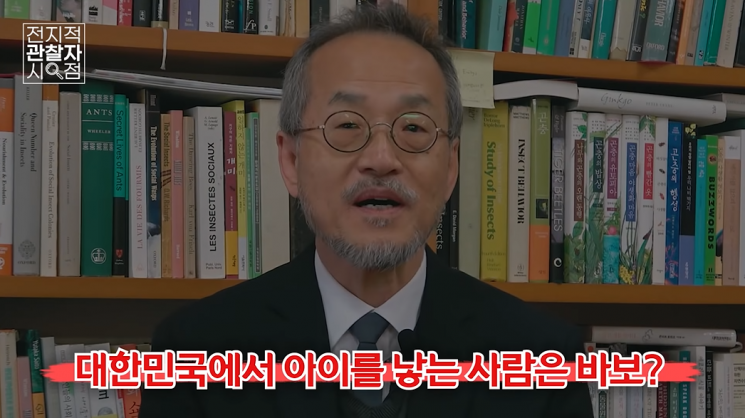 Choi Jae-cheon, Ewha Womans University Distinguished Professor, spoke about South Korea's low birthrate phenomenon in the video titled "It Is Strange to Have Children in South Korea" uploaded on the YouTube channel "Choi Jae-cheon's Amazon" on the 23rd. Photo by YouTube channel "Choi Jae-cheon's Amazon" video capture
[Asia Economy Reporter Park Hyun-joo] Choi Jae-chun, a world-renowned sociobiologist and Ewha Womans University distinguished professor, sharply criticized, saying, "People who have children in Korean society nowadays are fools," and added, "How stupid must one be? They must have an IQ below two digits to have children." This statement interprets the low birthrate phenomenon in Korean society from the perspective of evolutionary adaptation.
On the 23rd, in a video titled "People who have children in Korea are strange" uploaded on the YouTube channel 'Choi Jae-chun's Amazon,' Professor Choi said, "From the perspective of an evolutionary biologist, the low birthrate phenomenon in Korean society is a perfectly natural evolutionary adaptation," and added, "Animals that give birth recklessly and cannot manage offspring where there is no food or shelter around are unlikely to survive the evolutionary process."
Professor Choi emphasized that Korean society is a difficult environment to have and raise children. He said, "Is it possible to have and raise children in Korea? This issue has become a serious concern from an individual's standpoint," and added, "No matter how you calculate it, (childbirth) is never a wise decision. Those who boldly choose to have and raise children for happiness despite knowing the hardships are, in the end, patriots."
In response to the question, "Isn't Korea a country where it is reasonably okay to have children and live?" he answered by comparing the past and present. He said, "In the past, elders said, 'Children will grow up on their own once born.' I have never seen my friends or acquaintances calculate money regarding marriage or childbirth. They were unplanned about whether they had a house or what they would eat in the future," and added, "(In contrast) today's young people calculate a lot starting from marriage expenses. Although not a scientific answer, it is the unhappiness of a generation that has become excessively wise and smart compared to the past."
Professor Choi further analyzed, "It is true that the younger generation's standards for wanting to raise children in a proper and good environment are excessively high," and "Because they do not meet those standards, they hesitate to have children and get married."
He also viewed childbirth as a significant burden on women. "Neither the state nor men have the right to ask women in this low birthrate era, 'Why don't you have children?' In my view, having children inevitably involves tremendous sacrifice," he said, adding, "Korean men need to change. There are limits to the transformations men can make individually. It is truly difficult."
Finally, Professor Choi regarded the Korean government as late in recognizing the low birthrate problem. He emphasized, "This country must invest enormous amounts of money to fundamentally overhaul social infrastructure so that children can grow up happily. This must include the education system," and added, "Only when there is a vision where children grow up happily after being born, and parents can enjoy a happy family watching their children, can the low birthrate problem be changed."
© The Asia Business Daily(www.asiae.co.kr). All rights reserved.

















