Institute for Basic Science, "May Accelerate the Realization of Ultra-fast, Ultra-low Power Large-capacity Spin Memory Devices"
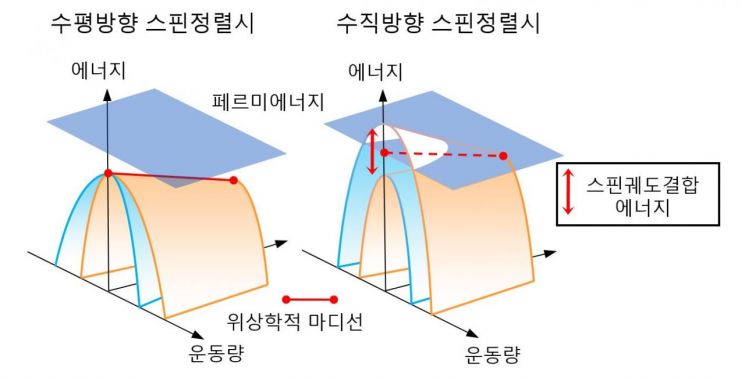 Schematic diagram of topological magnetic semiconductor. Image courtesy of the Institute for Basic Science.
[Asia Economy Reporter Kim Bong-su] Domestic researchers have discovered the colossal anisotropic magnetoresistance phenomenon in magnetic semiconductor materials for the first time in the world. They have identified a magnetic semiconductor material whose magnetoresistance magnitude can change up to a billion times depending on the spin angle when the magnetic field strength is constant. This is expected to accelerate the realization of ultra-high-speed, ultra-low-power, large-capacity spin memory devices.
The Institute for Basic Science (IBS) announced that the Center for Atomic-scale Low-dimensional Electronic Systems and the Center for Strong Correlation Materials have published these research results in the international journal Nature on the 25th.
The colossal anisotropic magnetoresistance phenomenon is expected not only to serve as a bridge combining the characteristics of conventional semiconductors and topological magnetic materials but also to be utilized as spin information devices that are resistant to external noise and free from information loss. Spintronic technology, which uses spin information devices, is considered a technology that can complement or replace existing semiconductor technology due to its high energy efficiency and simultaneous capability for information processing and storage.
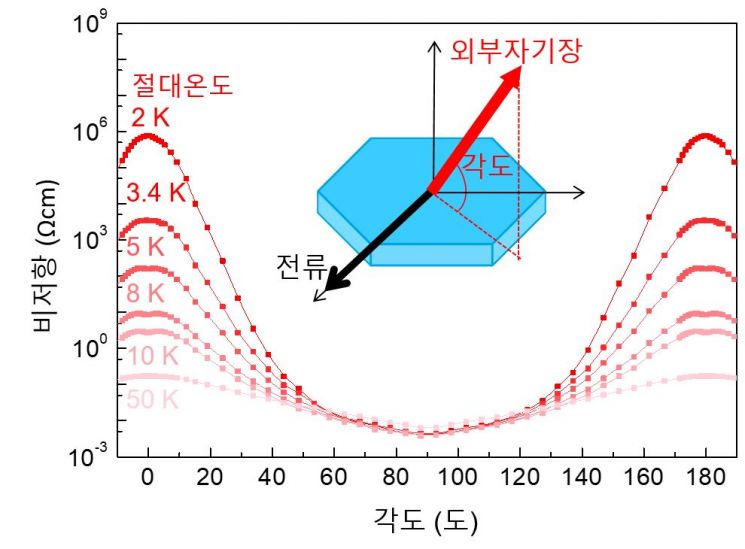
This research focused on finding candidate topological magnetic materials with semiconductor properties, in contrast to most previously reported topological magnetic materials which were metallic. As a result, it was discovered through conductivity and optical property measurements that the spin direction of the magnetic semiconductor manganese silicon telluride compound (Mn3Si2Te6) can be rotated using an external magnetic field, allowing easy control between an insulating state where current does not flow and a metallic state where current flows. Theoretically, electronic structure calculations and topological analysis confirmed that this is due to an insulator-metal phase transition.
This is an intrinsic characteristic appearing in magnetic materials with topological electronic states, which are robust against external noise and impurities. The Mn3Si2Te6 magnetic material with these properties can effectively control current flow not only by electric fields like conventional semiconductors but also by magnetic fields or spin directions. Therefore, by effectively utilizing these features, the realization of ultra-high-speed, ultra-low-power, large-capacity spin memory devices that use both charge and spin information can be accelerated.
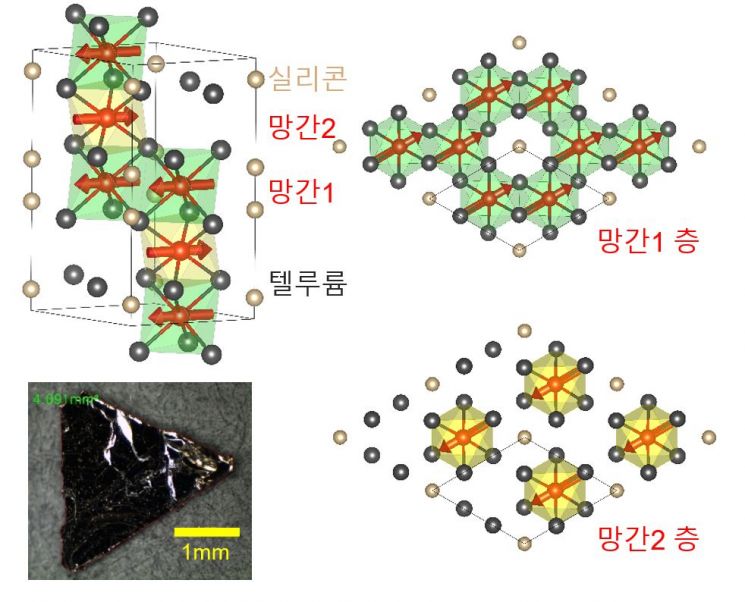 Crystal structure and photo of the topological magnet Mn3Si2Te6. Image courtesy of the Institute for Basic Science
The research involved Junseong Kim, a research fellow at the Center for Atomic-scale Low-dimensional Electronic Systems (also a professor in the Department of Physics at POSTECH), Beomjung Yang, a research fellow at the Center for Strong Correlation Materials (also a professor in the Department of Physics and Astronomy at Seoul National University), Kyu Kim, Ph.D. at the Korea Atomic Energy Research Institute, and Jaehun Kim, a professor in the Department of Physics at Yonsei University.
Research fellow Junseong Kim explained, "Following the discovery of magnetic metals with topological electronic states in 2018, this achievement applies the same principle to magnetic semiconductors. It is an example demonstrating that domestic joint research teams are playing a leading role in the field of magnetic topological materials."
© The Asia Business Daily(www.asiae.co.kr). All rights reserved.
![Clutching a Stolen Dior Bag, Saying "I Hate Being Poor but Real"... The Grotesque Con of a "Human Knockoff" [Slate]](https://cwcontent.asiae.co.kr/asiaresize/183/2026021902243444107_1771435474.jpg)


















