[Asia Economy Reporter Jeong Hyunjin] It is forecasted that the proportion of exports to the United States will exceed 15% for the first time since 2004 this year. As the United States has emerged as South Korea's top overseas investor since 2017, the strategic value of the U.S. in the Korean economy is rising again, prompting calls for intensified dialogue between the two countries.
On the 24th, the Federation of Korean Industries (FKI) reported that the cumulative export volume to the U.S. over the past five years from 2017 to this year (January to October) reached $385.8 billion, marking a 17.9% increase compared to the previous five years (2012?2016). During the same period, exports to China amounted to $735.7 billion, expanding by 7.1% compared to 2012?2016. While China leads in total volume, the growth rate of exports to the U.S. has expanded more than twice as fast.
In particular, exports to the U.S. increased by 31.0% year-on-year this year, with the U.S. share of total exports reaching 15.0%, the highest since 2004 (16.9%). After falling to 10.1% in 2011 following 2004, this share has recovered, expanding by about 5 percentage points. China's share rose to 26.8% in 2018 but declined to 25.2% this year, down 1.6 percentage points from its peak.
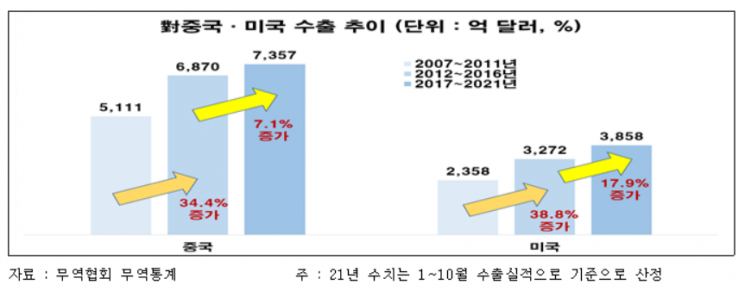
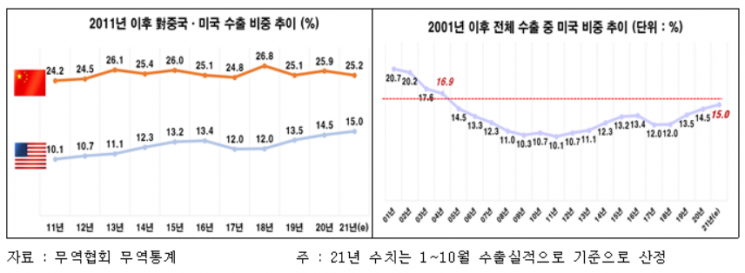
The FKI analyzed that the increase in Korea's exports to the U.S. was driven by a more than 50% rise in exports of semiconductors, data storage media, and secondary batteries over the past two years, fueled by the expansion of the non-face-to-face economy due to COVID-19 and increased demand for electric vehicle batteries following the Biden administration's green policies. The decrease in the share of exports to China is attributed to a reduction in China's overall import demand due to U.S. import restrictions and a decline in Chinese companies' demand for Korean memory semiconductors, leading to a contraction in Korea's exports to China.
Looking at the scale of foreign direct investment (FDI) in the U.S. and China, the surge in FDI to the U.S. has elevated the U.S. to South Korea's top investment destination since 2017 based on investment balance. From 2017 to 2020, Korea's cumulative FDI in the U.S. increased by 75.1% compared to 2013?2016, while FDI in China grew by only 23.5%.
The FKI analyzed that the sharp increase in direct investment to the U.S. during the previous Donald Trump administration was a result of the U.S. requesting Korean companies to invest domestically to create jobs and enhancing incentives. Major Korean companies such as Samsung, Hyundai Motor, SK, and LG plan to invest a total of $39.4 billion (approximately 44 trillion KRW) in the U.S. by 2025 in areas including foundries and batteries, suggesting that the upward trend in Korean companies' direct investment in the U.S. will continue for the time being.
While exports and direct investment to the U.S. have steadily increased since 2017, total overseas sales to China by Korean companies peaked at $250.2 billion in 2013 but have since declined to about $140 billion due to reduced local demand and intensified competition. As a result, it is expected that Korean companies' overseas sales in the U.S. will surpass those in China as of last year.
Kim Bongman, head of the FKI's International Cooperation Office, stated, "The Biden administration is strongly driving the reconstruction of supply chains for four core items based on 'Made in America' (batteries, semiconductors, critical minerals/materials, and pharmaceuticals), so it is highly likely that Korean companies' direct investment and exports in the semiconductor and battery sectors to the U.S. will further increase." He added, "To respond swiftly to the global supply chain restructuring movement and to further expand trade and investment between Korea and the U.S., both countries must work together." He also emphasized the need for dialogue between Korea and the U.S., provision of business incentives, and protection of business confidential information.
© The Asia Business Daily(www.asiae.co.kr). All rights reserved.
![Clutching a Stolen Dior Bag, Saying "I Hate Being Poor but Real"... The Grotesque Con of a "Human Knockoff" [Slate]](https://cwcontent.asiae.co.kr/asiaresize/183/2026021902243444107_1771435474.jpg)

















