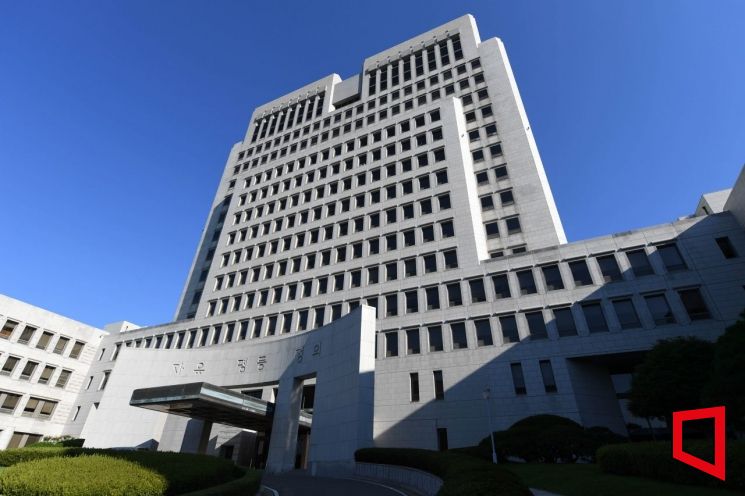
 Supreme Court, Seocho-gu, Seoul. Photo by Mun Ho-nam munonam@
[Asia Economy Reporter Kim Daehyun] The Supreme Court has ruled that Samsung SDI's 'fixed overtime allowance' does not qualify as ordinary wages.
On the 23rd, the Supreme Court's 3rd Division (Presiding Justice Lee Heung-gu) announced that it overturned the lower court's ruling in favor of two workers, including worker A from Samsung SDI's Ulsan plant, who filed a wage payment lawsuit against the company, and remanded the case to the Busan High Court.
Previously, Samsung SDI had paid salaried workers such as office staff a fixed allowance equivalent to 20% of their base salary under the name of 'overtime allowance' from before 1980 until 1994, without separately paying for weekday extended or night work allowances. Hourly wage workers were paid statutory allowances calculated based on actual extended and night work hours without any fixed allowance.
In 2014, Samsung SDI labor and management agreed in wage negotiations to apply 600% of bonuses to ordinary wages, but the workers argued that the fixed overtime allowance should also be included in ordinary wages and filed a lawsuit in 2016.
The first and second trials judged that the fixed overtime allowance was regular, uniform, and fixed pay, and therefore qualified as ordinary wages.
However, the Supreme Court ordered a retrial and reconsideration of the case, reasoning that there was no evidence to consider the overtime allowance received by salaried workers regardless of extended or night work as "compensation for work ordinarily provided during prescribed working hours," and that hourly wage workers received separate extended and night work allowances.
The court stated, "It is difficult to view the fixed overtime allowance in this case as compensation for prescribed work," and added, "The lower court's judgment misunderstood the legal principles regarding the requirement of compensation for prescribed work, which is a condition for ordinary wages."
© The Asia Business Daily(www.asiae.co.kr). All rights reserved.
















