Korea Atomic Energy Research Institute Develops Eco-Friendly, Harmless Processing Method for 'Graphene Quantum Dots'
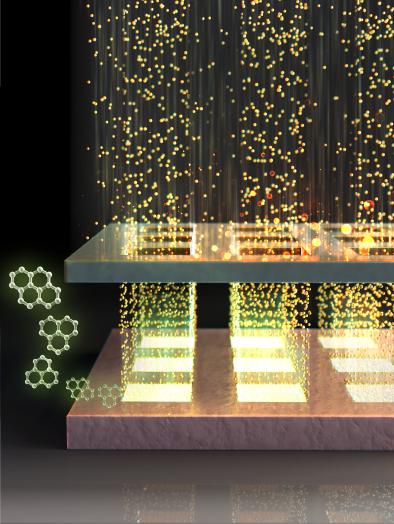 Schematic diagram illustrating the process of creating graphene quantum dots below by irradiating with an ion beam. Photo by Korea Atomic Energy Research Institute
[Asia Economy Reporter Kim Bong-su] Graphene, known as the "dream new material," is more than 200 times stronger than steel and has electrical conductivity 100 times higher than copper. A domestic research team has attracted attention by successfully manufacturing high-purity, highly crystalline graphene of just a few nanometers (nm) in size using only ion beam and heating processes without heavy metals or chemicals. It is harmless to the human body and can be widely used in semiconductors, solar cells, displays, sensors, and more.
The Korea Atomic Energy Research Institute announced on the 23rd that Dr. Ha Junmok and Dr. Yeo Sunmok's Proton Science Research Group developed a "dry manufacturing and patterning technology for highly crystalline, high-purity graphene quantum dots using ion beam technology."
Graphene quantum dots refer to graphene reduced to a few nanometers (nm) in size, which then exhibit semiconductor properties. When current flows through or light is shone on them, they emit light like semiconductors. They are harmless enough for medical use, and various studies are underway to apply them broadly in medical and industrial fields.
The research team developed a new dry manufacturing process for graphene quantum dots. Without using any chemicals, they can produce highly crystalline, high-purity graphene quantum dots using only ion beam and heating processes. Metal ion beams are irradiated onto desired areas of a semiconductor silicon substrate to generate iron nanoparticles. These iron nanoparticles undergo two heating processes at temperatures ranging from 800 to 1000 degrees Celsius to synthesize graphene quantum dots, and then all evaporate at high temperatures, leaving only the graphene quantum dots behind.
The team succeeded in manufacturing pure graphene quantum dots without impurities at precise locations through this process. Notably, they also succeeded in patterning the quantum dots into circuit shapes on the substrate, marking the world's first achievement. Recently, some overseas researchers succeeded in patterning graphene quantum dots, but none have succeeded in manufacturing pure graphene quantum dots like this.
Generally, graphene quantum dots are produced by chemically breaking down graphite chunks with strong acids or bases into a liquid state. This process often includes unnecessary byproducts and uses toxic substances, leading to controversy over the potential harm of the finished graphene quantum dots to the human body. Above all, the liquid state of the produced graphene quantum dots makes patterning difficult, limiting industrial applications such as displays, solar cells, and sensors.
Kim Yoojong, head of the Proton Science Research Group, said, "This technology can overcome the obstacles that have so far hindered the commercialization of graphene quantum dots," expressing expectations that "it will accelerate the industrial and medical commercialization of graphene quantum dots."
Dr. Ha Junmok also emphasized, "It is important that we manufactured biocompatible pure graphene quantum dots without using any chemicals," adding, "We will continue to develop the technology to perfectly replace existing quantum dots made using heavy metals."
© The Asia Business Daily(www.asiae.co.kr). All rights reserved.
![Clutching a Stolen Dior Bag, Saying "I Hate Being Poor but Real"... The Grotesque Con of a "Human Knockoff" [Slate]](https://cwcontent.asiae.co.kr/asiaresize/183/2026021902243444107_1771435474.jpg)
















