DGIST Professor Mun Jeil's Research Team
"Helps Early Diagnosis and Treatment of Dementia"
[Asia Economy Reporter Kim Bong-su] Domestic researchers have identified the cause of olfactory loss in Alzheimer's dementia patients. This is expected to aid in the development of diagnostic and treatment methods.
The research team led by Professor Moon Jae-il of the Department of Brain and Cognitive Sciences at Daegu Gyeongbuk Institute of Science and Technology (DGIST) announced on the 22nd that, through a joint study with researchers from Maastricht University in the Netherlands, they identified the cause of olfactory loss in Alzheimer's dementia patients from postmortem donated human olfactory tissue.
According to data from the Ministry of Health and Welfare's nationwide dementia epidemiological survey, the number of dementia patients was approximately 700,000 in 2017 and is expected to increase to 3.03 million by 2050. Among all dementia patients, 70% suffer from Alzheimer's dementia. Most Alzheimer's dementia patients experience not only memory and cognitive decline but also depression and sensory dysfunction. In particular, over 90% of Alzheimer's dementia patients suffer from olfactory loss, but the pathological cause has not yet been specifically identified.
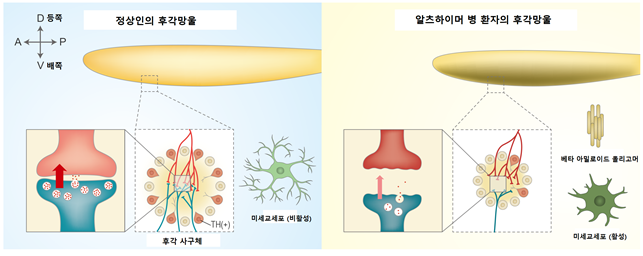
To maintain normal olfactory function, the olfactory glomeruli present in the olfactory bulb, which initially processes olfactory signals, must be structurally and functionally intact.
Focusing on this point, the research team uncovered the cause of olfactory loss due to Alzheimer's dementia. They obtained olfactory bulb tissue from six postmortem donated Alzheimer's dementia patients and seven healthy donors from the Dutch Brain Bank and conducted in-depth histopathological evaluations to observe detailed structural changes in the olfactory glomeruli. They used immunochemical analysis to assess not only overall anatomical and histological structural changes in the olfactory bulb but also changes in beta-amyloid, microglia, and neurotransmitter expression.
The study found morphological damage characterized by atrophy of the olfactory bulb in Alzheimer's dementia patients. Beta-amyloid protein accumulation was observed in the olfactory glomeruli. Additionally, there was a decrease in neurotransmitter expression levels related to synaptic activity, as well as reductions in synaptic density and synaptic vesicles, confirming synaptic atrophy within the glomeruli.
Furthermore, beta-amyloid accumulation was found to be associated with microglial activation. This suggests that glomerular abnormalities caused by neuroinflammation may directly affect olfactory loss in Alzheimer's dementia patients.
As a result, the research team demonstrated for the first time a direct neuropathological link between neuroinflammation caused by beta-amyloid and olfactory loss in Alzheimer's dementia patients.
Professor Moon stated, "Through this study using postmortem olfactory nervous system tissue from Alzheimer's dementia patients, we clarified the pathological mechanism between Alzheimer's dementia and olfactory loss, which had not been clearly identified until now. Ultimately, it is highly significant that we revealed the damage to the olfactory glomeruli, where the peripheral and central olfactory nervous systems first meet to form synapses, is importantly related to the onset of Alzheimer's dementia."
This research was published online on the 28th of last month in 'Brain Pathology,' a top 10% journal in the field of clinical neurology.
© The Asia Business Daily(www.asiae.co.kr). All rights reserved.
![Clutching a Stolen Dior Bag, Saying "I Hate Being Poor but Real"... The Grotesque Con of a "Human Knockoff" [Slate]](https://cwcontent.asiae.co.kr/asiaresize/183/2026021902243444107_1771435474.jpg)











