National Assembly Legislative Research Office, 'Issues and Institutional Challenges in Traffic and Logistics Due to Urea Solution Shortage for Diesel Vehicles'
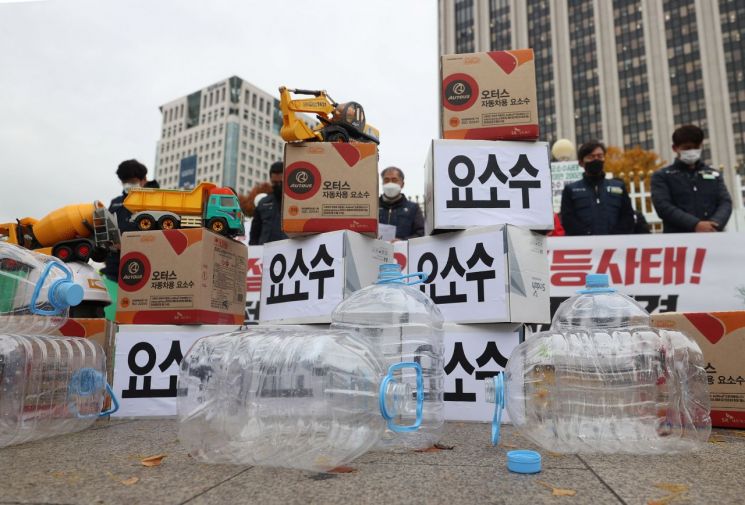
[Asia Economy Reporter Joo Sang-don] To fundamentally resolve the 'urea solution crisis' caused by the Chinese government's strengthened export regulations, it has been suggested that the activation of eco-friendly transportation alternatives to replace fossil fuel vehicles is necessary.
Recently, the National Assembly Legislative Research Office published a report titled "Issues and Institutional Tasks in Transportation and Logistics Due to the Shortage of Urea Solution for Diesel Vehicles," which contains these contents.
Park Jun-hwan, a legislative researcher at the Legislative Research Office, said, "The recent operational difficulties of diesel vehicles caused by the shortage of urea solution could lead to a crisis that makes the entire national social and economic system difficult beyond a simple logistics disruption, so a long-term and stable supply system needs to be established," adding, "Discussions are needed not only for short-term solutions but also for securing a sustainable transportation and logistics system."
The Legislative Research Office emphasized the need to secure a sustainable transportation system to replace fossil fuel vehicles, particularly highlighting the importance of policies expanding eco-friendly commercial vehicles (buses and trucks) and shifting truck transportation to railway logistics.
Researcher Park said, "The greenhouse gas emissions of one truck or bus are 2.5 times and 16 times higher than those of a passenger car, respectively, so the transition of commercial vehicles to eco-friendly vehicles is urgent. Considering the supply issue of urea, the situation is even more pressing," and added, "The proportion of eco-friendly vehicles among passenger cars is 5.2%, but only 0.4% for buses and 1.0% for trucks, so more proactive efforts are required."
He also advised reviewing the designation of urea as a stockpile material under Article 2 of the Act on Procurement Business to secure time to respond to supply shortages and other crises. He said, "Domestic production is difficult due to profitability issues, so stockpiling urea at a level similar to diesel fuel stockpiling for automotive fuel could be considered," emphasizing, "Considering the specific criteria for selecting stockpile materials under the Public Procurement Service's stockpile project operation regulations, such as 'concerns about international supply disruptions or impacts on industry and price stability,' urea should be designated as a stockpile material."
He also saw the need to establish an emergency plan. Researcher Park said, "It is necessary to prepare an emergency plan to cope with situations of urea solution shortage or suspension," adding, "Although the risk is currently low, considering the social and economic damage if urea solution supply is unexpectedly interrupted and bus or truck operations become difficult, preparation for emergency situations is necessary." Even if diesel vehicle operations are restricted, procedures are needed to ensure that transportation services with high social necessity, such as buses, freight trucks, ambulances, and fire trucks, which are essential for daily life and public services, can be maintained.
Researcher Park said, "The urea solution shortage crisis should remind us of the importance of raw materials and parts from an industrial security perspective," and added, "Just as urea is important in transportation and logistics, we must not forget institutional improvements to regularly check supply situations and prepare for shortages of materials essential to our industry but mostly dependent on overseas sources."
© The Asia Business Daily(www.asiae.co.kr). All rights reserved.

















