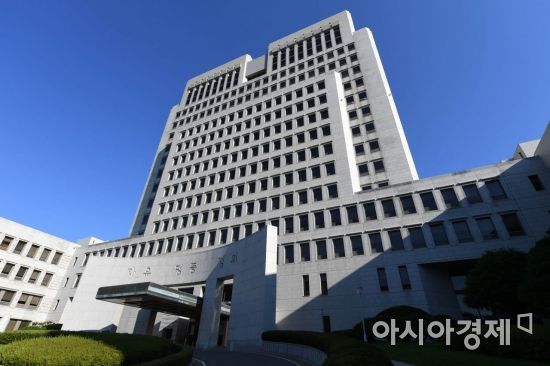
[Asia Economy Reporter Kim Hyung-min] The Supreme Court held a plenary session and issued a ruling that strictly interprets the scope of search and seizure allowed for investigative agencies.
On the 18th, the Supreme Court plenary session ruled that even if the investigative agency obtains data from a suspect's mobile phone voluntarily submitted, the evidence cannot be used without the suspect's forensic observation procedure.
The plenary session emphasized, "If a third party such as a victim voluntarily submits an information storage medium owned or managed by the suspect without a warrant, the suspect must be guaranteed the right to participate, and a list of seized electronic information must be provided."
Furthermore, if the scope of electronic information seizure is unclear, only electronic information related to the alleged facts can be seized, and exceeding this scope is considered an illegal search and seizure.
This ruling is a direct blow to the High-ranking Officials' Crime Investigation Office (Gongjucho) that took forensic data from the public mobile phone of the spokesperson of the Supreme Prosecutors' Office during the recent search and seizure of the Supreme Prosecutors' Office Inspection Department.
Gongjucho was embroiled in controversy over the legality of the search and seizure during the investigation of the so-called 'report solicitation' allegations. On the 29th of last month, the Supreme Prosecutors' Office Inspection Department voluntarily submitted the spokesperson's public phone related to the report solicitation allegations, and a week later, Gongjucho searched the Inspection Department and secured the records.
This mobile phone was used not only by the current Supreme Prosecutors' Office spokesperson Seo In-seon but also by former spokespersons Lee Chang-soo and Kwon Soon-jung. In particular, Kwon Soon-jung, former spokesperson and head of the Western Branch of the Busan District Prosecutors' Office during former Prosecutor General Yoon Seok-youl's tenure, was registered as a suspect by Gongjucho last month in connection with the report solicitation allegations.
Some in the legal community point out that the Supreme Prosecutors' Office Inspection Department illegally secured evidence by conducting forensic analysis of the public phone without the observation of former spokesperson Kwon and others, and that Gongjucho took this material as is, raising procedural issues.
Especially, as suspicions of prior collusion between Gongjucho and the Inspection Department surfaced, criticism arose that this was effectively Gongjucho's 'subcontracted inspection.'
The issue particularly arises as to whether it can be considered lawful when information on a mobile phone used by the suspect is seized by investigative agencies through search and seizure without the suspect's observation. Judging by the Supreme Court plenary session's ruling, it seems difficult to consider the search and seizure procedures and forensic process as lawful.
© The Asia Business Daily(www.asiae.co.kr). All rights reserved.

















