Gwanghwamun, Nonhyeon Station, Hongdae? Hapjeong Medium to Large Commercial Vacancy Rates Around 20%
[Asia Economy Reporter Kim Min-young] As the COVID-19 pandemic prolongs and the economy stagnates, it has been revealed that 2 out of 10 medium-to-large commercial spaces in traditional commercial districts such as Hongdae·Hapjeong, Nonhyeon Station, and Gwanghwamun are vacant.
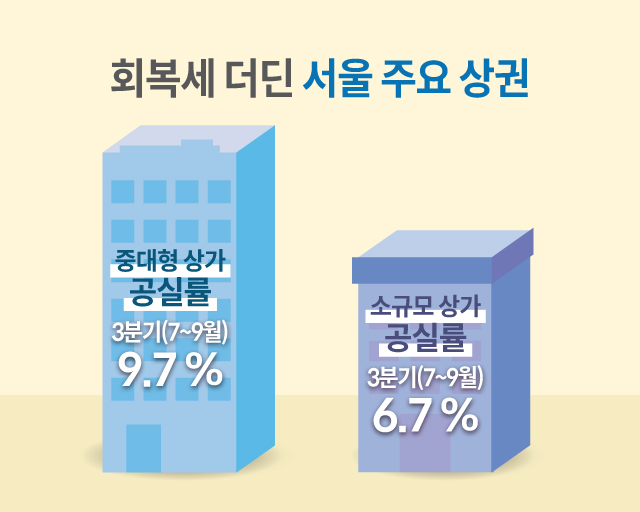
On the 17th, Rsquare, a total commercial real estate platform, analyzed data from the Korea Real Estate Board and found that the average vacancy rate for medium-to-large commercial spaces in Seoul in the third quarter was 9.7%, up 2.2 percentage points from the previous quarter. This means that 1 out of 10 medium-to-large commercial spaces is vacant. This is the highest rate since related statistics began to be compiled in the first quarter of 2013.
In particular, the vacancy rate for medium-to-large commercial spaces in Myeongdong, Seoul, was close to 50% at 47.2%. The vacancy rates in other densely packed commercial areas such as Gwanghwamun (23%), Nonhyeon Station (19.6%), and Hongdae·Hapjeong (17.7%) also significantly exceeded the average for Seoul. The Real Estate Board generally classifies commercial spaces as medium-to-large if they are over three floors and have a total floor area exceeding 330㎡, and as small-scale if they are two floors or less with a total floor area of 330㎡ or less.
The situation is no different for small-scale commercial spaces. The average vacancy rate for small-scale commercial spaces in Seoul in the third quarter was 6.7%, up 0.2 percentage points from the previous quarter. Although this is lower than the 7.5% recorded in the fourth quarter of last year, it remains high compared to the pre-COVID-19 pandemic period.
However, with the implementation of the With-Corona measures this month, attention is focused on whether major commercial districts in Seoul will revive.
An Rsquare retail official said, "Customer inquiries for retail leases are more active than before the COVID-19 pandemic," adding, "We expect major commercial districts in Seoul to revive in the fourth quarter of this year and for the commercial districts to recover to pre-COVID-19 levels by the end of next year."
© The Asia Business Daily(www.asiae.co.kr). All rights reserved.

















