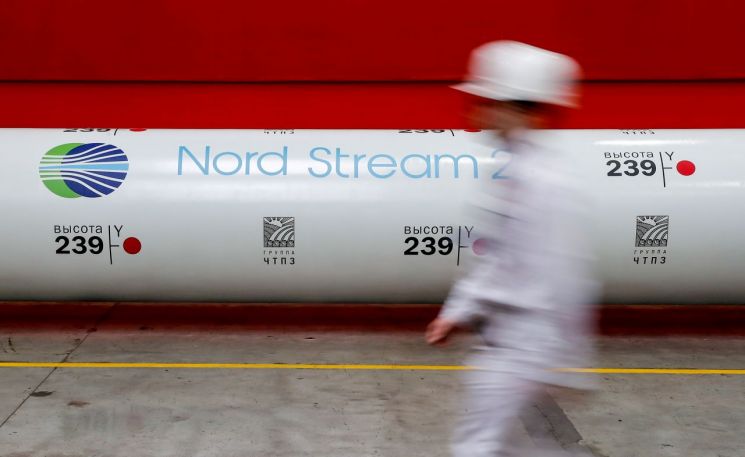
[Asia Economy Reporter Hyunwoo Lee] European natural gas prices are soaring again as the German government announced it will halt the approval process for the Nord Stream 2 pipeline connected to mainland Russia. The German government's suspension of approval is analyzed to be primarily due to diplomatic conflicts between the European Union (EU) and Russia, stemming from the Ukraine border dispute and Middle Eastern refugee issues at the Poland-Belarus border. Even if the approval process resumes, the pipeline is expected to operate only in the second half of next year, raising concerns that a gas crisis in Europe this winter will be unavoidable.
According to foreign media including CNN on the 16th (local time), the German government announced it would suspend the approval process, citing that the Nord Stream 2 operator had not properly established a gas pipeline operating subsidiary under German law. The German government stated, "The subsidiary designated to operate the Nord Stream 2 pipeline in Germany did not meet the conditions to become an independent transmission system operator," and added, "Certification is only possible when operation in a legal form under German law is feasible," explaining the reason for the approval refusal.
Following the news of the approval refusal, European gas prices surged. The Dutch TTF gas futures price, a key indicator of European gas prices, soared 18.33% compared to the previous session to 94.6 euros (approximately 127,000 KRW) per megawatt-hour (MWh). This price had surged to 116.5 euros on the 5th of last month amid growing concerns over gas supply, then fell to 64.8 euros on the 29th after the Russian government's announcement to increase gas supply, before rising sharply again.
Although the German government cited domestic law as the reason for halting the approval process, the international community points to diplomatic friction between Russia and the West as a more significant factor. According to CNN, British Prime Minister Boris Johnson stated in a parliamentary speech the day before, "The European Union (EU) is facing a situation where it must choose between Ukraine and the approval of Nord Stream 2." European countries rely on Russia for 43% of their total natural gas consumption, so if diplomatic disputes with Russia prolong, gas prices are expected to rise further.
Even if the approval process resumes, it is expected to take at least four months, increasing concerns that a gas crisis in Europe this winter will be unavoidable. James Waddell, an analyst at the international consulting firm Energy Aspect, explained in an interview with major foreign media, "The hope that this pipeline could be used this winter has now completely disappeared. It looks like it will only start in the second half of next year," adding, "Given the stored gas volume and the shortage of supply from Russia, it will be necessary to maintain the essential gas volume for electricity and district heating, which will ultimately require reducing industrial demand."
© The Asia Business Daily(www.asiae.co.kr). All rights reserved.

















