External Factors Highlighted as 'Convenience of Transportation/Commute', Increasing the Value of Station Areas
Joint Survey by Fides Development, Daewoo Construction, Aegis Asset Management, Korea Asset Trust, and Haean Architecture
Results of the '2021 Residential Space Consumer Awareness Survey' Targeting 1,000 Metropolitan Area Homeowners
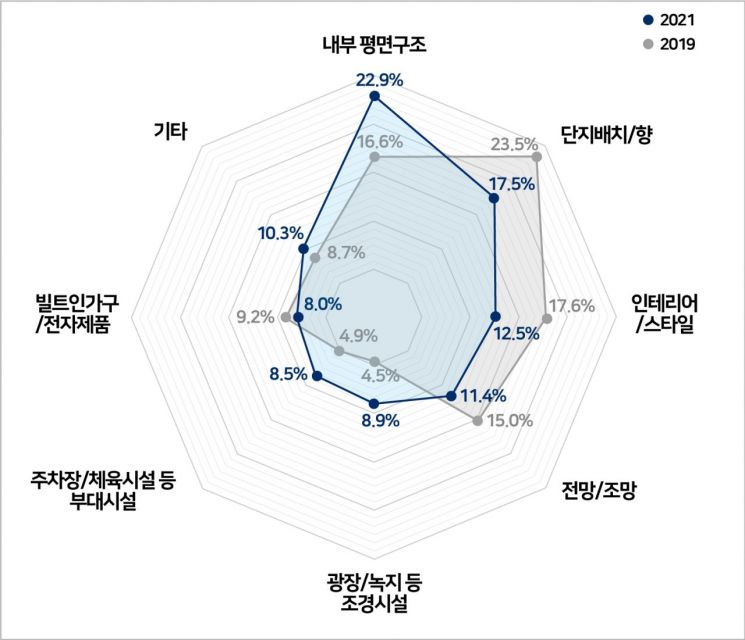 Response rates for the most important internal factors considered when purchasing residential facilities in the future.
[Asia Economy Reporter Jo Gang-wook] Homeowners in the Seoul metropolitan area identified the ‘internal floor plan’ as the most important internal factor when purchasing residential properties in the future.
On the 16th, Fides Development, Daewoo E&C, Aegis Asset Management, Korea Asset Trust, and Haean Architecture jointly conducted the ‘2021 Residential Space Consumer Awareness Survey’ through The Research Group targeting 1,000 homeowners in the metropolitan area. The results showed that the most important internal factor considered when purchasing residential properties in the future was the ‘floor plan’ (22.9%).
Next were ‘complex layout and orientation’ (17.5%), interior design and style (12.5%), view and scenery (11.4%), landscaping facilities such as plazas and green spaces (8.9%), auxiliary facilities such as parking lots and sports facilities (8.5%), and built-in furniture and electronic appliances (8.0%), in that order.
Just before the COVID-19 pandemic in 2019, ‘complex layout and orientation’ (23.5%) and ‘interior design and style’ (17.6%) had higher response rates than ‘internal floor plan’ (16.6%).
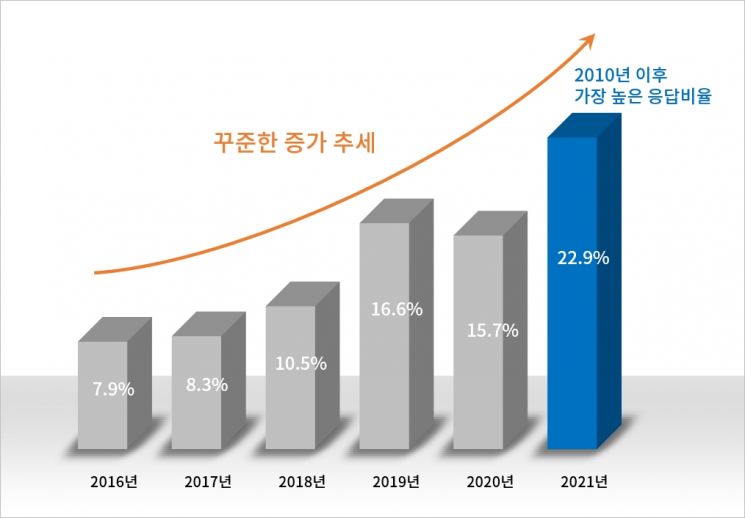
The proportion of respondents who chose ‘internal floor plan’ as the most important factor has shown an increasing trend in recent years: 7.9% in 2016, 8.3% in 2017, 10.5% in 2018, 16.6% in 2019, and 15.7% in 2020. This year’s ‘floor plan’ (22.9%) recorded the highest response rate since 2010.
A representative from the joint survey team stated, “In previous surveys, ‘complex layout and orientation’ or ‘view and scenery’ had higher response rates than ‘internal floor plan,’ but this year the ranking was reversed for the first time. It is analyzed that the priority in choosing residential facilities is fundamentally changing as the time spent at home increases due to the impact of COVID-19.”
Regarding external factors considered most important when purchasing residential properties in the future, ‘convenience of transportation and commuting’ (41.3%) ranked first, followed by ‘potential for regional development’ (17.8%) and ‘surrounding landscape and comfort’ (16.9%).
The importance of transportation has shown a gradually increasing trend. When asked how much more expensive a ‘station-area’ home should be compared to a ‘non-station-area’ home when purchasing a house, the average response was ‘10.8%’.
Analysis through additional in-depth interviews on the preference for station-area locations revealed that because convenience facilities such as shops and hospitals are established around station areas, not only office workers commuting by subway but also people who do not frequently use the station highly value the station-area’s worth.
When asked which facilities must be within a 10-minute walk from the residential area, respondents answered large supermarkets (50.9%), department stores (21.6%), traditional markets (9.2%), and complex shopping malls (7.7%) in that order. The response rate for large supermarkets increased by 3.7 percentage points from 47.2% last year, and traditional markets rose by 2.3 percentage points from 6.9% last year. Department stores and complex shopping malls saw a decrease in response rates compared to the previous year.
Regarding preferred paid residential lifestyle services for residents, the most favored were ‘professional cleaning services,’ ‘clean air services,’ ‘vehicle inspection and car wash in parking lots, and personalized fitness coaching in fitness centers,’ and ‘various programs to enjoy leisure time,’ in that order.
When asked about preferred housing types, respondents answered ‘country houses,’ ‘residential facilities offering hotel-type services,’ ‘apartments focused on couple living,’ ‘senior specialized facilities,’ and ‘residential lodging facilities, pensions, and resorts,’ in that order.
Meanwhile, Fides Development has been conducting the ‘Residential Space Consumer Awareness Survey’ since 2005 to understand the current status and perceptions related to consumers’ residential lifestyles and to develop new housing products accordingly.
The ‘2021 Residential Space Consumer Awareness Survey,’ jointly conducted by Fides Development, Daewoo E&C, Aegis Asset Management, Korea Asset Trust, and Haean Architecture, was carried out targeting 1,000 people aged 35 to 69 in Seoul, Incheon, and Gyeonggi areas. The sampling method was stratified random sampling by region, the data collection tools were structured questionnaires and option cards, and the survey method was one-on-one individual interviews conducted from September to November 2021. The sampling error is ±3.2% (95% confidence level).
© The Asia Business Daily(www.asiae.co.kr). All rights reserved.


















