[Asia Economy Reporters Seulgina Jo and Minyoung Cha] "Stop the loopholes."
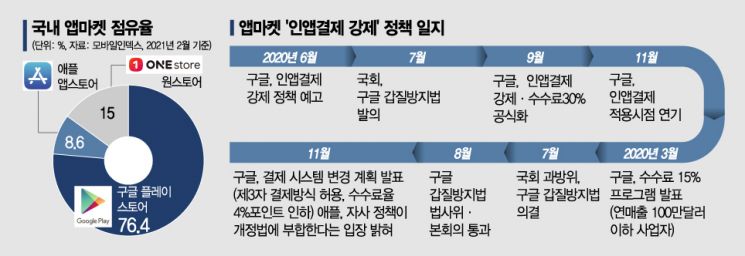
More than two months have passed since the enactment of the world’s first law banning application market operators from forcing specific payment methods?the ‘Google Gapjil Prevention Act (Amendment to the Telecommunications Business Act)’?yet controversies over ‘high commission fees’ and ‘app tolls’ continue unabated. Google, which announced it would allow external payment methods in respect of the National Assembly’s decision, recently proposed a commission rate as high as 26%, hardly different from before the law’s enforcement, while Apple has even shown signs of resistance.
This is why voices calling for enhancing the law’s effectiveness and establishing an international cooperation system are growing louder. Tim Sweeney, CEO of Epic Games, who fought a lawsuit against Apple over forced in-app payments, and Megan Dimuzio, Secretary-General of the U.S. Coalition for App Fairness (CAF), visited the Korean National Assembly, emphasizing global solidarity by saying, "Changes in Korea will continue overseas."
◇ Epic Games Visits Korea... Steps Toward International Cooperation
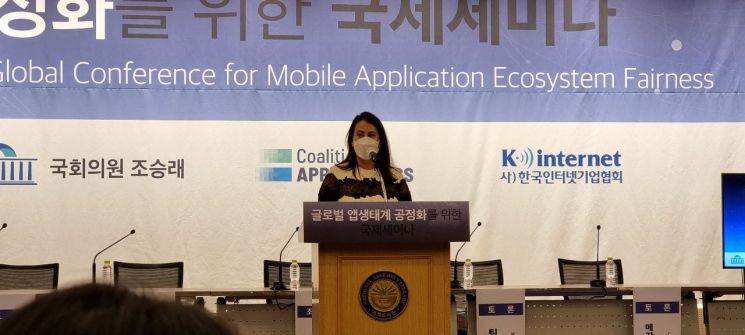
On the morning of the 16th, Sweeney attended the ‘National Assembly Seminar for Fairness in the Global App Ecosystem,’ hosted by Seungrae Cho, the ruling party’s ranking member of the National Assembly’s Science, Technology, Information and Broadcasting and Communications Committee, and others. He stated, "Korea’s law banning forced in-app payments will positively impact not only the app ecosystem but also future innovation and healthy market competition." Sweeney became a hot topic after the Google Gapjil Prevention Act was passed in Korea in September, when he posted on Twitter, "I am Korean!" in celebration.
The seminar was also attended by CAF officials who have opposed the commission fee abuses by app market giants, as well as Cedric O, France’s Minister of Digital Affairs. They criticized the app commission policies of Google Play and Apple App Store, which leverage their overwhelming market dominance, and listened closely to Korea’s legislative experience as the first country to enact such regulations. They also explored international cooperation measures involving the U.S., Europe, and other regions.
Dimuzio, Secretary-General of CAF, said, "(The Google Gapjil Prevention Act) is a world-leading legislation," noting that major countries worldwide are watching Korea’s moves closely. Representative Cho emphasized, "We will share Korea’s world-first legislative experience and establish a solid international cooperation system so that the U.S., Europe, and others can follow suit." Industry figures, including executives from Nexon, Netmarble, and NCSoft?collectively known as the 3N?also attended the event.
Joining via video, Shar Dubey, CEO of Match Group, criticized, “Apple and Google use their market authority to force in-app payments, imposing unfair burdens on app developers. Their commission fees are 15 times higher compared to other payment systems.” He added, "Countries including the U.S., Europe, India, Japan, Australia, Russia, and South Africa have launched additional investigations and fact-finding missions," emphasizing, "Those acting as gatekeepers of the ecosystem (Google, Apple, etc.) must find ways to coexist long-term without imposing excessive burdens on domestic and international developers. This is the only sustainable path."
Sijo Kuribula, Chairperson of India’s ADIF, quoted Mahatma Gandhi’s famous saying, "My concept of democracy is that the weakest should have the same opportunity as the strongest," evaluating, "The passage of Korea’s amendment clearly exemplifies this." He added, "Korea’s legislative action is a globally significant achievement in correcting the tilted fairness of the app economy. India’s antitrust authorities have introduced fact-finding investigations and are striving to enact similar laws in India."
◇ Heated Loophole Controversy, Apple Holds Firm
This seminar attracted particular attention as it was held amid intensifying controversies over Google’s commission loopholes following the enforcement of the Google Gapjil Prevention Act.
Google’s payment system change plan unveiled earlier this month allows third-party payment methods but has been criticized for having a commission rate as high as 26% and effectively nullifying the benefits of external payments, meaning there is no real improvement. The Korea Webtoon Industry Association and others pointed out, "Considering the additional 6-7% average external payment commission, there is little difference from the existing 30%," calling it "a loophole to forcibly continue Google’s in-app payments."
Apple’s stance is even more rigid. As another target of the law’s regulations, Apple reportedly maintains that its current policy complies with the amended law and refuses to accept changes. Representative Cho criticized, "Apple is seeking ways to evade the law and has not proposed any solutions."
The Ministry of Science and ICT, the competent authority, plans to announce the enforcement decree of the amendment soon to enhance the law’s effectiveness. It is expected to include measures to practically sanction Google, Apple, and others attempting to continue commission abuses. The draft enforcement decree and notification previously disclosed include provisions to impose fines of up to 2% of sales revenue for violations. The ministry is also considering whether to include wording in the decree regarding "imposing unreasonable or discriminatory conditions or restrictions on other economic benefits." A ministry official said, "We are aware of the loophole controversies and are examining the relevant provisions more closely."
Experts agree on the need to expand cooperation with the U.S., the European Union (EU), and others, while actively fostering domestic app markets to revitalize the market. Yonghee Kim, Professor of Business Administration at Soongsil University, emphasized, "The bigger problem than commission rates is that app market giants set transaction rules arbitrarily," calling for "international cooperation."
Jung Hyun Wi, Professor of Business Administration at Chung-Ang University and Vice President of the Korea Game Society, suggested, "Market competition activation is urgent. Recognizing equal content access rights to allow other app market operators to compete together and establishing institutional support for small and medium developers are necessary." Equal content access rights mean that content providers such as app developers must register their apps on all domestic app markets. This was excluded at the last minute during National Assembly discussions due to concerns that some app market operators might benefit.
Yoonjung Kim, Research Fellow at the Korea Legislation Research Institute, also stressed, "It is naturally necessary to revitalize domestic app markets because competition is needed regardless of nationality."
© The Asia Business Daily(www.asiae.co.kr). All rights reserved.













