Approved at the first National Space Committee after Prime Minister-level elevation on the 15th
Korean Satellite Navigation System project to proceed on main track for 15 years until 2035
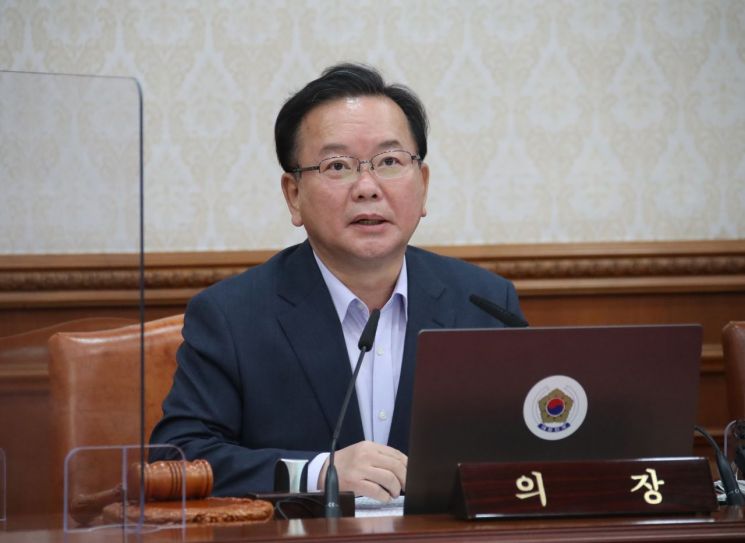 Prime Minister Kim Bu-gyeom speaking at the Cabinet meeting
 (Seoul=Yonhap News) Photo by Kim Seung-du = Prime Minister Kim Bu-gyeom is speaking at the Cabinet meeting held at the Government Seoul Office Building on November 2, 2021.
[Asia Economy Reporter Kim Bong-su] The government held the first National Space Committee meeting since its elevation to the Prime Minister level and decided to open the "space business era" within the next 10 years. To this end, it plans to significantly increase investment in space development by producing over 170 public satellites and launching about 40 space rockets, while also finalizing the specific details of the Korean Positioning System (KPS) project to be actively promoted starting next year.
On the afternoon of the 15th, the National Space Committee held a meeting at the Korea Aerospace Research Institute (KARI) in the Daedeok Research and Development Special Zone in Daejeon, chaired by Prime Minister Kim Boo-kyum, where they deliberated and approved strategies for fostering the space industry, plans for the KPS development project, and the operation plan for the National Space Committee.
The government will first develop a total of about 170 public-purpose satellites from 2022 to 2031 and promote approximately 40 rocket launches to deploy them. By type, this includes 93 ultra-small cluster satellites, 11 next-generation medium satellites, 6 multipurpose practical satellites, and 4 geostationary satellites. Additionally, a dedicated launch pad for private companies will be established at the Naro Space Center, and a space industry cluster comprising launch vehicles, satellites, materials, and components will be created to serve as a hub for the space industry.
To encourage companies' participation in space development, a phased contract system will be introduced starting with securing technological capabilities, and burdens will be reduced through measures such as technology fee reductions and easing of delay penalties (at the defense industry level, 10% of the contract amount). Specialized personnel will be trained through various human resource development programs, and educational content for future generations will be produced and distributed. In particular, industrialization support will be provided for the satellite information business, which accounts for the majority of the space industry (93.6% of global space industry revenue as of 2019). The plan also includes ▲ demonstration of 6G satellite communication technology and services, ▲ discovery of KPS-related industries, and ▲ establishment of satellite image distribution, processing, and analysis platforms, as well as promotion of private satellite image utilization through artificial intelligence (AI) algorithms.
The specific plan for the KPS project was also finalized. Starting next year, the government will officially begin developing the Korean Positioning System as a 4th Industrial Revolution infrastructure to provide ultra-precise positioning, navigation, and timing (PNT) information services. Over 14 years until 2035, a total of KRW 3.72345 trillion will be invested to launch a total of eight satellites, including three geostationary satellites and five inclined orbit satellites, to provide centimeter-level ultra-precise information. Active technology transfer to industries and fostering related service industries will contribute to revitalizing the space industry.
To this end, a KPS Development Project Headquarters will be established within KARI, and the enactment of the "(Tentative) Act on the Development and Operation of the National Integrated Navigation System" will be pursued to establish dedicated promotion systems such as the "KPS Committee" and "KPS Development and Operation Team." The government expects that, currently dependent on foreign GPS information, the stability of major national infrastructure such as finance, power, telecommunications, and transportation networks will be secured in emergencies. The provision of ultra-precise positioning, navigation, and timing information is also expected to serve as a foundation for new 4th Industrial Revolution industries such as autonomous vehicles and urban air mobility (UAM).
Prime Minister Kim said, "Despite a short history of space development, we have become the seventh country in the world capable of independently launching large satellites over one ton by launching the Nuri rocket made with our own hands on our own land." He added, "Advanced space countries are opening the space business era beyond space technology. We will focus our policy capabilities on nurturing space companies and creating a space industry ecosystem with strong self-sustainability as our next destination."
© The Asia Business Daily(www.asiae.co.kr). All rights reserved.

















