[South Korea's Parking War]<1> Frequent Parking Disputes Escalate to Murder
Neighbors Caught Fighting on the Spot
Side Parking and Double Parking Commonplace
General Parking in Electric Vehicle Charging Zones
Unauthorized Occupation by External Vehicles Also a Headache
No Measures Beyond Warning Notices
The family of the Dutch consul in Korea was booked for threatening another citizen with a vehicle during a dispute. The cause of the conflict was parking. Parking issues in our country are not a new problem. They have spread like a cancer throughout society, from residential areas to industrial complexes and commercial districts. The problem arose as the land area is limited while the number of vehicles has increased exponentially, but it has been neglected for a long time due to indifference. Asia Economy analyzes the parking problems occurring everywhere in a four-part series and seeks solutions. Editor's note
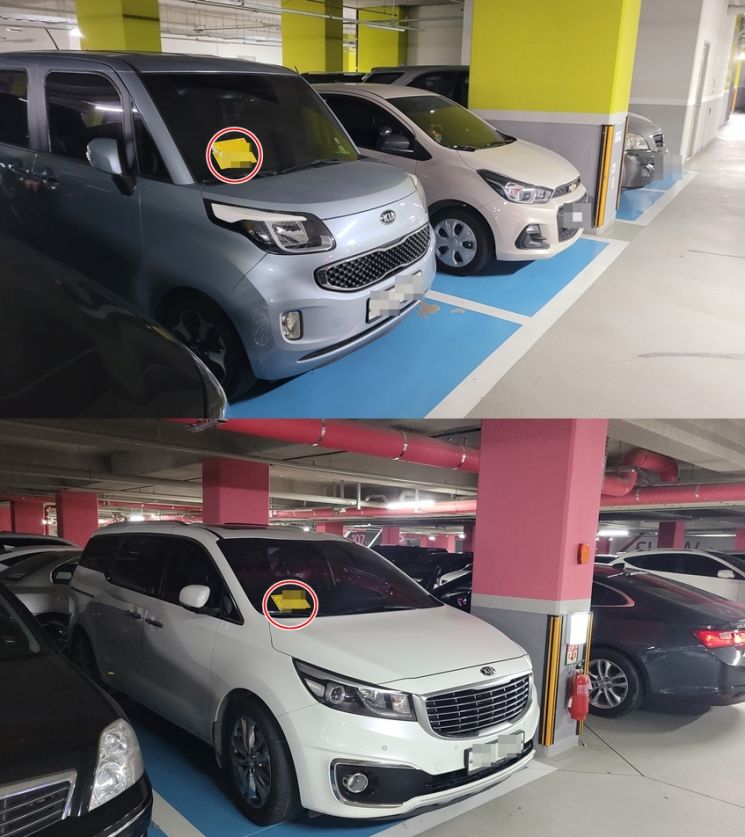 Apartments in the Seoul metropolitan area are suffering from parking problems. Unregistered vehicles parked without permission in the underground parking lot of an apartment in Seo-gu, Incheon, are occupying parking spaces meant for residents.
 /Photo by Byungdon Yoo tamond@
[Asia Economy reporters Yoo Byung-don and Jung Dong-hoon] On the 9th, a man in his 50s, Mr. A (52), who assaulted a neighboring couple over a parking issue and caused a finger fracture, was arrested by the police. Mr. A got into an argument over parking in front of a villa in Bulgwang-dong, Eunpyeong-gu, Seoul, during the evening hours, kicked the leg of a woman, Ms. B, and then repeatedly assaulted her husband, Mr. C, who came out after being contacted by Ms. B, leading to his arrest on the spot.
The chronic parking problem in residential areas, a long-standing social illness, is no longer just a matter of living environment. It has caused conflicts between neighbors and recently escalated to violent crimes such as murder and assault.
The shortage of parking spaces in aging apartment complexes has long become a daily issue. According to the current "Regulations on Housing Construction Standards," at least one parking space per household must be secured, but many multi-unit housing complexes built before 1996, when this regulation was not yet applied, have fewer than one parking space per household. As a result, indiscriminate parking practices such as side parking, diagonal parking, and even double parking are widespread.
Newly built apartments are not free from parking problems either. With frequent multi-vehicle ownership per household, many residents cannot guarantee parking spaces. An apartment in Seo-gu, Incheon, housing a total of 980 households, has 1,184 parking spaces (1.2 spaces per household), but parking wars occur every evening. After 9 p.m., it is common to see vehicles wandering in search of parking spots. Among residents, there are voices suggesting that "higher parking fees should be charged for households registering more than three vehicles."
The sighs of the increasing number of electric vehicle drivers are also growing. According to the revised law (Eco-friendly Vehicle Act) passed by the National Assembly in July, parking of general vehicles in all electric vehicle charging zones is prohibited, and a fine of 100,000 KRW is imposed for violations. However, unauthorized occupation by general vehicles still occurs.
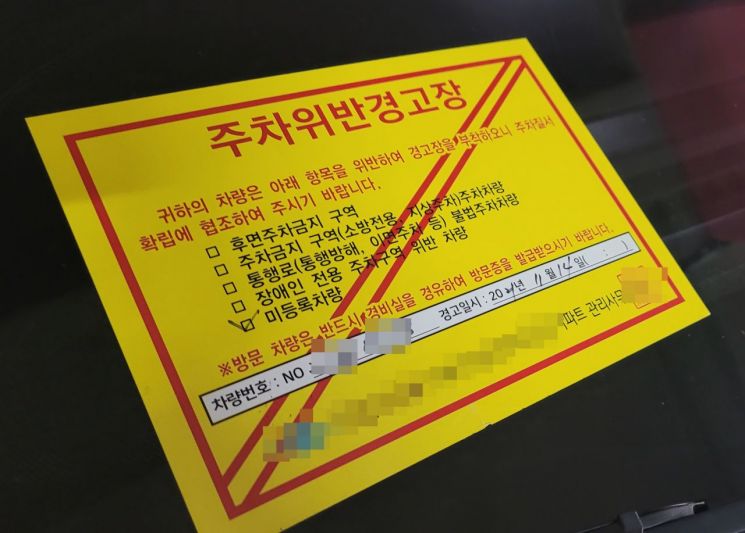
Unauthorized parking by outsiders is also a headache. In an apartment in Sang-dong, Bucheon-si, Gyeonggi Province, and another apartment in Seo-gu, Incheon, underground parking lots are filled with vehicles that have parking tickets (warning notices) attached. Most of these are unregistered vehicles. Both apartments share the commonality of being near used car trading complexes. Parking in the used car trading complexes costs 150,000 to 200,000 KRW per month, so dealers park illegally in nearby apartment parking lots to save money. Naturally, this has led to a shortage of parking spaces for residents.
Although parking problems are worsening day by day, even the managing entities have no effective measures. Apartment management offices can only issue warning notices to illegally parked vehicles and cannot take further action. Especially, repeatedly issuing warning notices to vehicles illegally parked for long periods has not yielded significant results.
Since apartment parking lots are private property, public authorities cannot intervene. Mr. Kim Young-chan (41), a resident of an apartment complex, said, "Even if you report to the city hall or police, they say they have no way to handle vehicles in apartment parking lots," and added, "I think many people exploit the fact that they cannot be legally punished."
© The Asia Business Daily(www.asiae.co.kr). All rights reserved.


















