Over 10 Years of R&D, Korea's First Eco-Friendly PLA Spunbond Developed
Full-Scale Mass Production Begins This Year, Expanding Related Market
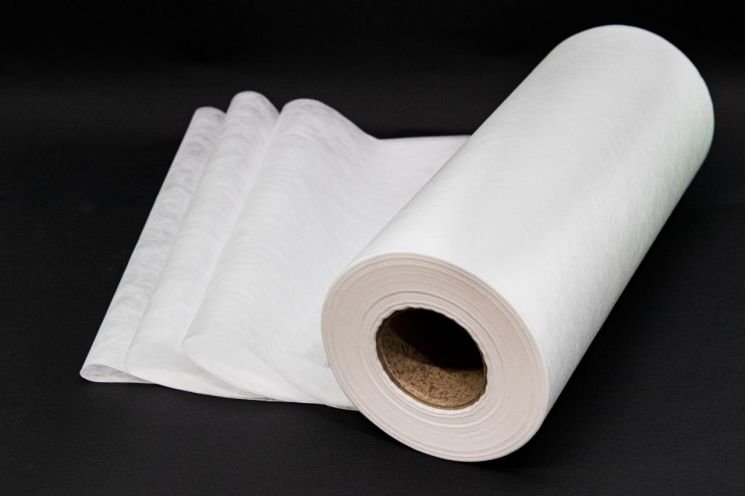 Eco-friendly biodegradable PLA (Poly Lactic Acid) spunbond nonwoven fabric showcased by Yujin Hanil Hapsem.
 [Photo by Yujin Group]
[Asia Economy Reporter Kim Jong-hwa] Recently, controversy arose when it was revealed that absorbent pads used in packaging meat and fish were being distributed while exposing microplastic components. As a result, products made from eco-friendly materials have gained attention as an alternative.
Yujin Hanil Hapsem, a textile manufacturing affiliate of Yujin Group, announced on the 15th that it has established the first mass production system in Korea for eco-friendly biodegradable 'PLA (Poly Lactic Acid) spunbond nonwoven fabric' and has begun full-scale production and sales.
The dictionary definition of biodegradation is "the process by which a substance is transformed into two or more simpler substances by living organisms," referring to the decomposition of organic matter by microorganisms. Biodegradable plastic PLA is made from starch extracted from plants such as corn and decomposes under certain conditions by microorganisms when buried, producing only natural byproducts such as carbon dioxide, methane, water, and biomass.
Since 2009, Yujin Hanil Hapsem has been conducting research and development on PLA spunbond nonwoven fabric using PLA, a plant-derived biodegradable polymer material, as raw material. After more than 10 years of R&D, it secured strict quality stability and improved productivity, becoming the first in Korea to enter full-scale mass production. To date, Yujin Hanil Hapsem is the only company in Korea mass-producing PLA spunbond nonwoven fabric.
Yujin Hanil Hapsem’s eco-friendly biodegradable PLA spunbond nonwoven fabric brand, 'GREENBON,' uses NON-GMO PLA derived from non-genetically modified corn as raw material. It is produced by a 100% eco-friendly method that manufactures nonwoven fabric using heat without chemical substances. During incineration, it does not generate harmful substances such as dioxins that cause cancer, making it an eco-friendly material harmless to the human body. Notably, last year, it obtained environmental label certification for biodegradable food utensils, reaffirming the eco-friendliness of biodegradable PLA spunbond nonwoven fabric.
PLA had difficulties in product development using PLA spunbond nonwoven fabric due to issues such as shrinkage and deformation at temperatures above 60℃. However, Yujin Hanil Hapsem succeeded in improving several problems inherent to PLA, including significantly enhancing heat resistance.
GREENBON boasts excellent flame retardancy, antibacterial properties, and thermal stability, and is widely used in absorbent pads for packaged meat and fish, as well as in tea bags, coffee filters, drip bag filters, urim bags, mask packs, cleansing pads, masks, and scrubbers.
PLA spunbond nonwoven fabric is just beginning to stretch out in the overall nonwoven fabric market. Yujin Hanil Hapsem anticipates that eco-friendly materials will become mainstream and plans to expand related markets and develop eco-friendly products by replacing PP meltblown nonwoven fabric used in masks and air purifier filters with eco-friendly biodegradable PLA meltblown nonwoven fabric.
A Yujin Hanil Hapsem official stated, "Yujin Hanil Hapsem has continuously strived to develop textiles using sustainable natural materials," adding, "We will focus on improving quality and strengthening market competitiveness so that eco-friendly biodegradable PLA spunbond nonwoven fabric can be applied to a wider range of products."
Meanwhile, following the Ministry of Environment’s national audit last month, which pointed out that a large amount of microplastics was detected in meat absorbent pads sold on the market, three major supermarkets have stopped using them and decided not to use them anymore.
© The Asia Business Daily(www.asiae.co.kr). All rights reserved.
![User Who Sold Erroneously Deposited Bitcoins to Repay Debt and Fund Entertainment... What Did the Supreme Court Decide in 2021? [Legal Issue Check]](https://cwcontent.asiae.co.kr/asiaresize/183/2026020910431234020_1770601391.png)
















