Sangui Chairpersons Propose Easing of Serious Accident Punishment Act
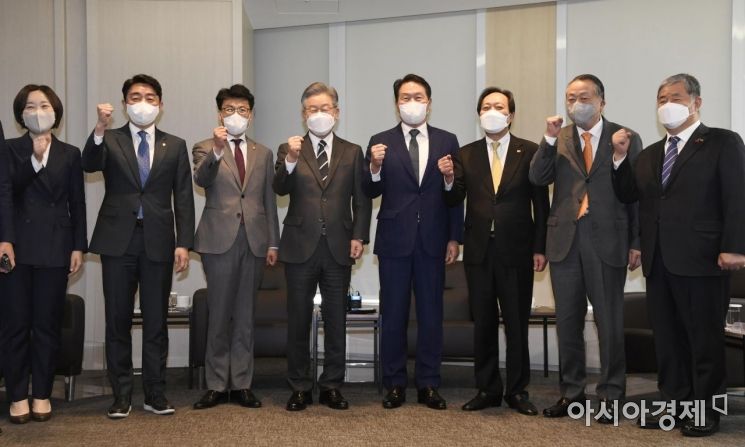 Lee Jae-myung, the Democratic Party presidential candidate, visited the Korea Chamber of Commerce and Industry in Jung-gu, Seoul on the 10th and is taking a commemorative photo before holding a meeting with Choi Tae-won, the chairman of the Korea Chamber of Commerce and Industry. Photo by the National Assembly Press Photographers Group
[Asia Economy Reporter Hwang Yoon-joo] The Korea Chamber of Commerce and Industry (KCCI) leadership has once again requested Lee Jae-myung, the Democratic Party candidate, to ease the Serious Accidents Punishment Act. The Serious Accidents Punishment Act is one of the most sensitive issues for the business community as it introduces punitive damages.
According to the KCCI and the business community on the 14th, during a private meeting held on the 10th between candidate Lee and the KCCI leadership, they reiterated their request to ease the Serious Accidents Punishment Act.
A KCCI leadership official said, "Unlike large corporations, if the CEO of a small or medium-sized enterprise is detained due to an industrial accident, it becomes difficult to manage the company, and the business site may go bankrupt," adding, "We discussed easing the application of the Serious Accidents Punishment Act."
The Serious Accidents Punishment Act is a bill that strengthens penalties when a serious accident resulting in a worker's death occurs, and it will be enforced starting January next year. Once enforced, corporate management officials such as CEOs can face imprisonment of one year or more, or fines up to 1 billion KRW. Corporations can also be fined up to 5 billion KRW.
Because of this, domestic economic organizations strongly expressed their concerns in unison when the law was enacted. As the controversy grew, some relaxations were made compared to the initial proposal (punitive damages limit reduced from more than 5 times to within 5 times, etc.). However, the business community still considers aspects such as CEO detention and punitive damages limits excessive. It is unknown what response candidate Lee gave in the private meeting.
Although there are about 70 days left until the enforcement of the Serious Accidents Punishment Act, 3 out of 10 small and medium-sized enterprises in the construction and manufacturing sectors still show insufficient safety management measures.
According to the Ministry of Employment and Labor, during the two-month 'intensive crackdown period' (August 30 to October 31) conducted to reduce industrial accident deaths, violations of the Industrial Safety and Health Act were detected at 882 sites, accounting for 33% of the total. In construction, 619 out of 2,049 sites (30%) were found in violation, and in manufacturing, 263 out of 616 sites (43%). Among these, 611 sites had safety and health management officers booked, and judicial procedures are underway as specific violation details are being investigated.
This crackdown targeted 2,665 sites, including construction sites with contract amounts under 5 billion KRW selected for poor safety measures and manufacturing businesses with fewer than 50 employees.
The Serious Accidents Punishment Act will apply from January 27 next year to approximately 50,000 workplaces with 50 or more employees. Workplaces with fewer than 50 employees are exempted until January 2024.
© The Asia Business Daily(www.asiae.co.kr). All rights reserved.

















