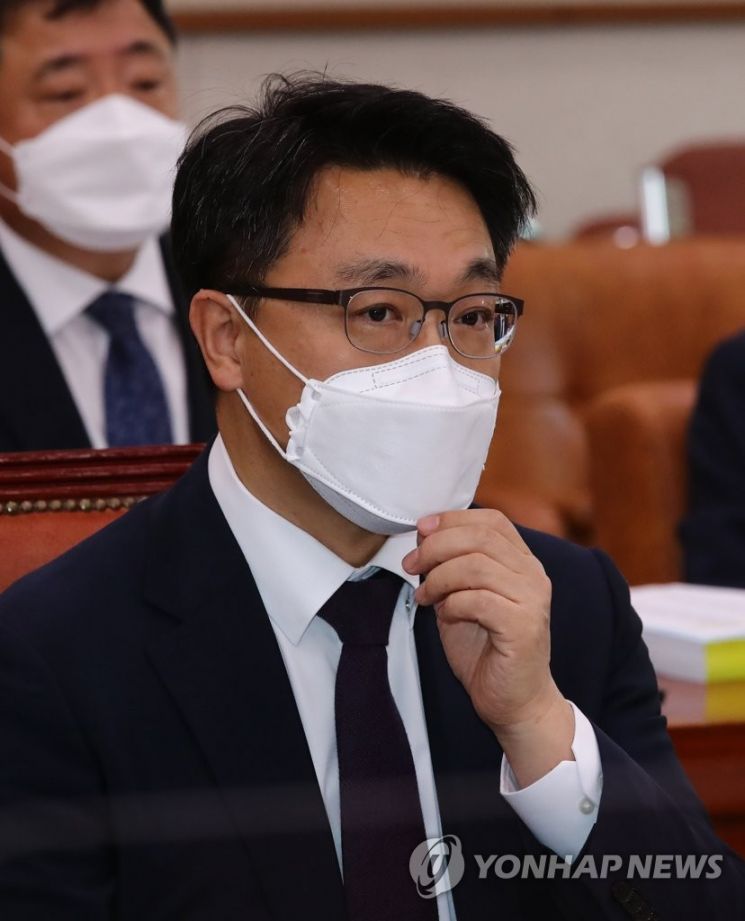
[Asia Economy Reporter Choi Seok-jin, Legal Affairs Specialist] The High-ranking Officials' Crime Investigation Agency (HCIA) is expanding its investigation related to Yoon Seok-yeol, the People Power Party's presidential candidate, by additionally registering a case concerning the 'Major Trial Panel Analysis Document,' which was one of the grounds for disciplinary action during his tenure as Prosecutor General.
Since the HCIA has already been investigating four cases related to Yoon, including ▲ allegations of inadequate investigation into the Optimus Fund fraud, ▲ obstruction of investigation in the case of former Prime Minister Han Myeong-sook's perjury coaching, and ▲ allegations of instigating complaints, the total number of investigations involving Yoon has increased to four.
Additionally, the Judicial Justice Citizens' Action for Correcting (JJACC), which has repeatedly submitted complaints related to Yoon, announced on the 15th that it would file additional complaints against former Deputy Director of Investigation Information Policy Son Jun-sung and former spokesperson of the Supreme Prosecutors' Office Kwon Soon-jung for abuse of authority and official secrets leakage related to the 'Mother-in-law Response Document' that was problematic during Yoon's tenure as Prosecutor General.
Will the 'Abuse of Authority' Charges Be Proven? Attention on Timing and Content of Re-requested Arrest Warrant for Son Jun-sung Related to 'Complaint Instigation'
Although the HCIA is investigating several cases related to Yoon, the most notable is the 'Complaint Instigation' allegation.
On September 2, News Bus reported that "the Yoon Seok-yeol prosecution allegedly instigated the People Power Party to file complaints against pro-government politicians such as Yoo Si-min, Choi Kang-wook, and Hwang Hee-seok just before last year's general election."
On September 6, JJACC filed a complaint with the HCIA against Yoon, Prosecutor General Han Dong-hoon, former Policy Officer Son, and former Spokesperson Kwon on charges including abuse of authority. It has been two months since the HCIA began investigating this case.
During this period, the HCIA coordinated summons schedules with former Policy Officer Son but suddenly requested an arrest warrant, which was dismissed by the court. Without conducting any summons investigation, the HCIA again aggressively requested a detention warrant, which was also dismissed.
It was revealed that the arrest warrants listed all individuals involved in the complaint preparation and instruction as 'unknown persons (identity unknown),' which raised doubts about the HCIA's investigative capabilities.
Subsequently, the HCIA summoned former Policy Officer Son twice and People Power Party lawmaker Kim Woong once for investigation but reportedly failed to secure any decisive testimony.
There is speculation that the HCIA could not obtain evidence or testimony to pressure former Policy Officer Son, who denies instructing junior prosecutors to prepare complaints or delivering complaints to lawmaker Kim, or lawmaker Kim, who denies conspiring with the prosecution or receiving complaints from them.
So far, apart from the Telegram message labeled 'Sent by Son Jun-sung' confirmed through media reports, the HCIA has only identified the prosecutor who searched for the real-name court ruling of informant Ji Mo related to the 'Channel A Coercion Attempt' case attached to the complaint.
Earlier, HCIA Chief Kim Jin-wook stated that the core of this case is 'abuse of authority.'
To apply abuse of authority charges to Yoon or former Policy Officer Son for allegedly orchestrating and preparing complaints against ruling party politicians at the Supreme Prosecutors' Office level during Yoon's tenure as Prosecutor General, several hurdles must be overcome.
According to experts including current and former judges, prosecutors, and lawyers, the first step is to identify the actual complaint preparer.
Once the person who actually prepared the complaint is identified as a specific prosecutor, it can be examined whether the superior who instructed that prosecutor to prepare the complaint can be charged with abuse of authority.
If the complaint preparer is identified, it must be proven through evidence or testimony that former Policy Officer Son instructed the prosecutor to perform tasks unrelated to investigation information collection or that former Prosecutor General Yoon instructed Son to do so.
Even if these facts are proven, it must be examined whether ordering the preparation of complaints against ruling party politicians falls within the official duties of the Prosecutor General or the Investigation Information Policy Officer, which is a fundamental requirement for abuse of authority charges.
Prosecutors who searched for informant Ji's court ruling attached to the complaint may be held responsible for violating the Personal Information Protection Act, and if there was a superior who instructed this, abuse of authority could be examined again.
However, this too depends on confirming the substance of the complaint instigation and verifying that the searches were conducted for the purpose of attaching materials to complaints against ruling party politicians. Since judges and prosecutors frequently search court rulings during trials or investigations, it is difficult to challenge the search itself without direct evidence linking it to the 'Complaint Instigation' allegation.
Ultimately, the turning point of this investigation is widely seen as whether the HCIA can secure custody of former Policy Officer Son.
The arrest warrant for former Policy Officer Son was the first arrest warrant requested by the HCIA since its establishment. Having suffered setbacks with the court dismissing both the arrest and detention warrants for Son, the HCIA cannot avoid the procedure of re-requesting the warrant to secure his custody. If the HCIA prosecutes Son and others without custody now, it would likely admit that the investigation was insufficient and that it lacks confidence in proving the charges.
Through two summons investigations of former Policy Officer Son, the investigation team is said to have nearly completed the inquiry related to the 'Complaint Instigation' allegation. However, there is a possibility of re-requesting the warrant after conducting additional investigations related to the 'Trial Panel Analysis Document' or the 'Mother-in-law Response Document.'
It is being closely watched whether the HCIA can specify the complaint preparer or the person who instructed the preparation when re-requesting the arrest warrant for former Policy Officer Son, and whether the court, which previously dismissed the warrant stating that "the suspect (former Policy Officer Son) is unlikely to destroy evidence or flee beyond the scope of legitimate defense rights, thus lacking necessity and substantiality for detention," will issue the warrant this time.
Simultaneous Investigation of 'Trial Panel Analysis Document' and 'Mother-in-law Response Document' Cases... Will They Be Linked to the 'Complaint Instigation' Case?
In June, the HCIA announced that it had registered a case against Yoon alone on the 22nd of last month for abuse of authority related to the so-called 'Judge Surveillance Allegation,' in which JJACC had filed complaints against six current and former prosecution officials.
The HCIA explained that after monitoring the results of Yoon's disciplinary cancellation lawsuit and analyzing the first-instance ruling of the Seoul Administrative Court on the 14th of last month, it judged that direct investigation was necessary and decided to register the case.
The court assumed that the document was prepared based on personal information collected in violation of Article 15, Paragraph 1 of the Personal Information Protection Act. Article 15, Paragraph 1 of the Personal Information Protection Act lists cases where personal information processors can collect and use personal information, such as 'when consent is obtained from the information subject' or 'when it is unavoidable to comply with legal obligations or special provisions.'
The court stated, "There is no evidence that the plaintiff (Yoon) instructed the collection of judges' personal information in violation of the Personal Information Protection Act, but after the completion of the trial panel analysis document, the plaintiff received the report and instructed to deliver the illegally collected personal information to the Anti-Corruption and Serious Crime Division and the Public Investigation Division without deleting or modifying it. Such conduct constitutes an abuse of authority by exercising the powers of the Prosecutor General, who oversees prosecution affairs and supervises public officials of the Prosecutors' Office, by giving improper instructions beyond the scope of duties to investigation information policy officers and others, violating Article 13-3, Paragraph 2 of the Code of Conduct for Prosecutors and Article 56 of the National Public Officials Act."
While Yoon cannot be seen as having instructed the collection of information about major trial panel judges in violation of the Personal Information Protection Act, his act of instructing frontline investigation departments to receive and deliver the information was deemed improper.
Article 13-3 of the Code of Conduct for Prosecutors (Prohibition of Improper Acts in Exercising Official Authority) states, "Public officials shall not engage in improper acts by exercising their official authority or de facto influence derived from their position or rank."
Paragraph 2 of the same article prohibits "giving improper instructions or demands unrelated to duties or beyond the scope of duties to duty-related public officials."
Article 56 of the National Public Officials Act (Duty of Diligence) mandates that "all public officials shall comply with laws and perform their duties diligently." While violations are grounds for disciplinary action, they are not subject to criminal punishment.
Meanwhile, on the 5th, the HCIA conducted another raid on the Supreme Prosecutors' Office Inspection Department to secure inspection materials related to the 'Complaint Instigation' allegation and the 'Mother-in-law Response Document.'
However, a few days before the HCIA's raid, it was revealed that the Supreme Prosecutors' Office Inspection Department had seized and forensically examined official phones used by spokespersons of the Supreme Prosecutors' Office during Yoon's tenure as Prosecutor General in a voluntary submission manner. Notably, the forensic process omitted notification or observation procedures for former spokesperson Kwon, the actual user and inspection target of the official phones, sparking controversy over 'illegal forensic examination.'
Following the forensic examination of the official phones used by former spokesperson Kwon by the Supreme Prosecutors' Office Inspection Department, the HCIA secured the forensic data through a raid, raising suspicions of 'subcontracted inspection' between the Supreme Prosecutors' Office and the HCIA. This is because the HCIA, struggling with the 'Complaint Instigation' investigation, received materials that should have been obtained through court warrants from the Supreme Prosecutors' Office Inspection Department instead.
As a result, a confrontation occurred between reporters demanding explanations from the Supreme Prosecutors' Office Inspection Department and Prosecutor General Kim Oh-soo. Kim stated that there was no contact with the HCIA and promised to supplement inspection regulations.
Inspection Chief Han Dong-soo refused reporters' face-to-face explanation requests and posted additional clarification on his Facebook, stating, "We seized investigation records related to the 'News Bus report allegations' and 'Mother-in-law Response Document' and only obtained the resulting report. However, considering the nature of the official phones, which are important communication tools between the prosecution and the media, we accept the criticism that more careful and meticulous consideration was needed."
In legal circles, there is analysis that the HCIA, failing to find clues in the 'Complaint Instigation' investigation, may be attempting to appeal to the court the improper exercise of public authority by the Yoon prosecution through investigations into other cases involving Yoon, former Policy Officer Son, and former spokesperson Kwon. In fact, the HCIA is known to have detailed the 'Mother-in-law Response Document' extensively when requesting the arrest warrant for former Policy Officer Son.
After reports of corruption allegations against Yoon's mother-in-law Choi Mo surfaced early last year, former Policy Officer Son reportedly instructed prosecutors and investigators in the Investigation Information Policy Office to prepare response documents under orders from superiors, and former spokesperson Kwon was involved in delivering explanatory materials and the mother-in-law's side's position to reporters, according to the HCIA's judgment.
The HCIA may use this to emphasize that Yoon's instruction of subordinates to handle private matters related to his mother-in-law's investigation constitutes abuse of authority, and that former spokesperson Kwon's active communication of the mother-in-law's position to reporters was inappropriate, supporting the possibility that the 'Complaint Instigation' against ruling party politicians was organized.
Former spokesperson Kwon maintains that providing accurate related information to reporters to prevent misinformation was a legitimate part of a spokesperson's duties, especially since allegations of inadequate investigation were also raised alongside the mother-in-law's corruption allegations.
A lawyer said, "For example, if candidate Lee Jae-myung's family was implicated in the Daejang-dong scandal during his tenure as Gyeonggi Province governor, and the Gyeonggi Province spokesperson distributed explanatory materials to reporters, it is questionable whether this should be investigated as inappropriate conduct. It can be seen as within the normal scope of duties for a spokesperson to respond to allegations involving the head of the institution or their family."
Chief Kim has repeatedly stated his intention to conclude the investigation swiftly to minimize its impact on the presidential election. The HCIA has little time left.
Attention is focused on how the HCIA will conclude the 'Complaint Instigation' investigation and whether it can prove Yoon's involvement after securing custody of former Policy Officer Son. If the HCIA fails to uncover the substance of the allegations and prosecutes only a few involved or fails to prove guilt in future trials, criticism labeling it the 'Yoon Seok-yeol Investigation Agency' and skepticism about the HCIA's investigative capabilities are expected to resurface.
© The Asia Business Daily(www.asiae.co.kr). All rights reserved.












