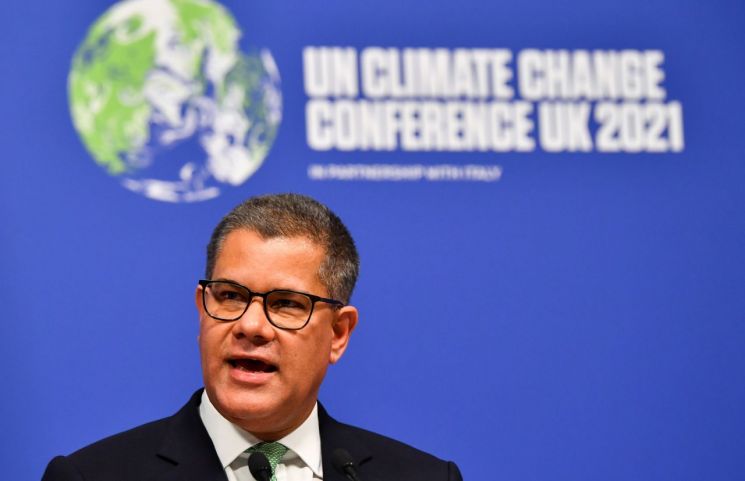
 ▲Alok Sharma, Chair of the United Nations Framework Convention on Climate Change Conference of the Parties (COP26) [Image source=Reuters Yonhap News]
[Asia Economy Reporter Kwon Jae-hee] Countries around the world have agreed to gradually reduce coal power generation in response to the climate crisis, and developed countries have committed to expanding climate funds by 2025. Additionally, to limit the global temperature rise to within 1.5 degrees Celsius, countries will reassess their greenhouse gas reduction targets next year.
At the 26th United Nations Climate Change Conference of the Parties (COP26) held in Glasgow, UK, approximately 200 participating countries adopted the "Glasgow Climate Pact" on the 13th (local time) containing these provisions.
During this UN Climate Summit, which began on the 31st of last month, participating countries engaged in intense negotiations, extending beyond the deadline by a day.
They were sharply divided into groups such as major greenhouse gas emitters like China and India, developed countries, and climate-vulnerable nations, and after fierce confrontations on key issues, they agreed on a "not perfect" set of measures.
The pact includes language to accelerate efforts to gradually reduce coal power generation without carbon capture devices and to phase out inefficient fossil fuel subsidies.
This is the first time coal and fossil fuels have been mentioned in a COP agreement.
China, India, and others resisted until the end, resulting in significantly softened wording compared to the draft.
In particular, at the last moment, India requested a change in expression, turning "phase out" of coal power generation into "phase down."
Switzerland and others expressed disappointment, and island nations on the frontlines of the climate crisis criticized the retreat in climate measures with anger.
Alok Sharma, COP26 President, with a choked voice said, "I apologize to all representatives for how the process unfolded," adding, "I understand the disappointment, but maintaining consensus is also important."
Alongside this, countries agreed to resubmit their Nationally Determined Contributions (NDCs) next year aligned with the 1.5-degree target.
Although NDCs are submitted every five years, there is no time to wait that long now.
China, India, Russia, and others have submitted NDCs that do not meet the 1.5-degree target, and analyses indicate that if countries follow their current targets, the global temperature rise will reach 2.4 degrees Celsius.
The pact expressed "deep regret" that wealthy countries have not fulfilled their promise of $100 billion (approximately 118 trillion KRW) annually in climate funds and urged them to urgently increase the amount by 2025.
Additionally, funds to support developing countries that need to adapt to warming will be doubled by 2025.
Along with this, guidelines for the international carbon market under Article 6 of the Paris Agreement were adopted, finally completing the "Paris Agreement Rulebook (Katowice Climate Package)."
This establishes transparent and unified international standards for the carbon emissions trading market between countries. Measures were put in place to prevent "double counting," where emission reductions are counted by both trading countries.
© The Asia Business Daily(www.asiae.co.kr). All rights reserved.

















