Research Team at Gwangju Institute of Science and Technology
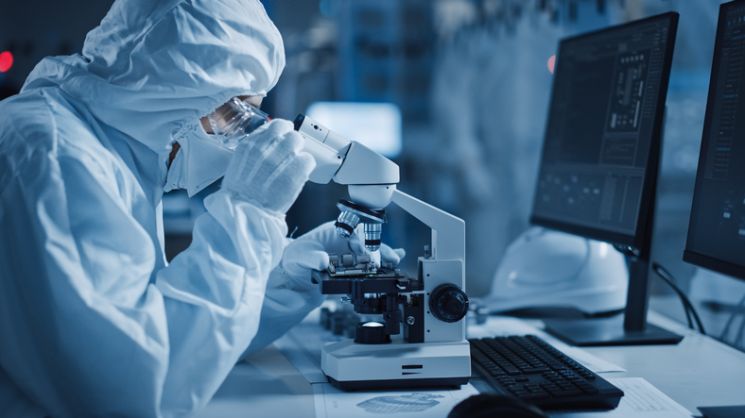
[Asia Economy Reporter Kim Bong-su] Domestic researchers have, for the first time in the world, observed the fleeting moment of metal melting occurring within one ten-trillionth of a second, successfully proving the theory that metals become stronger and then weaker at the moment of phase transition to liquid.
The Gwangju Institute of Science and Technology (GIST) announced on the 11th that Professor Cho Byung-ik's research team from the Department of Physics and Optical Science succeeded in real-time observation of the moment when metal melts and changes from solid to liquid. It is expected to contribute to future energy research such as nuclear fusion by discovering new material properties in extreme spatiotemporal domains.
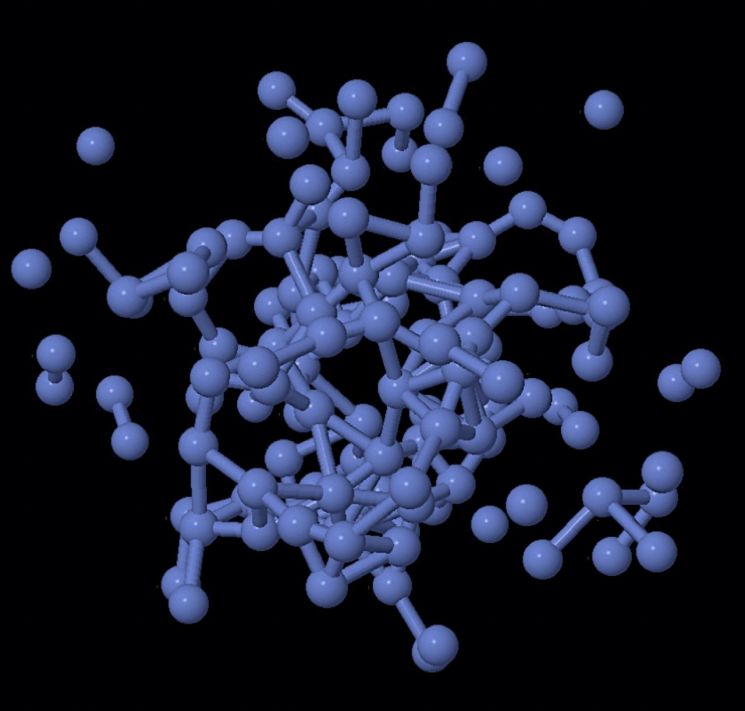
The research team used femtosecond (one quadrillionth of a second) X-ray pulses emitted from an X-ray free-electron laser to capture X-ray spectroscopic signals of electronic structure changes at the moment of melting, in order to observe the fleeting moment of metal melting within one ten-trillionth of a second caused by changes in atomic bonding due to a powerful laser.
About ten years ago, foreign researchers reported a theoretical prediction that when materials heated to ultra-high temperatures by a powerful laser, especially precious metals like gold, silver, and copper, transition to liquid, atomic bonds momentarily strengthen, passing through a harder state before the phase transition to liquid. However, such phenomena had never been directly observed.
This was because the time resolution of existing X-ray measurement techniques remained at about 10 picoseconds (one hundred billionth of a second), limiting the measurement of time domains under 1 picosecond where atomic bond changes occur.
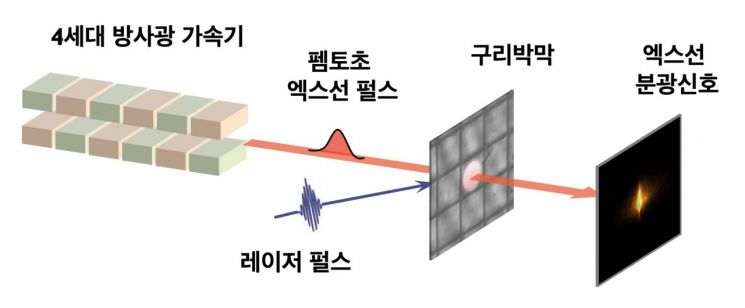
To overcome the existing time limitations, the research team used ultrafast X-ray spectroscopy employing femtosecond (one quadrillionth of a second) X-ray pulses emitted from an X-ray free-electron laser. They heated copper to ultra-high temperatures above 10,000 degrees using a powerful laser. At this time, about 10% of the electrons involved in atomic bonding entered an excited state, but the remaining electrons were more exposed to the strong attraction of the atomic nucleus, causing a phenomenon where the bonds became even stronger, which was observed for the first time using ultrafast X-ray spectroscopy.
The ultra-hot, hardened copper with strengthened bonds is maintained over several hundred femtoseconds and then gradually weakens. This result contradicts the conventional notion that atomic bonds weaken immediately and the material transitions to liquid when heated.
In fact, under extreme temperature and pressure environments such as laser nuclear fusion and the Earth's interior, many unusual material properties different from those previously known appear. The ultrafast X-ray study of ultra-hot materials heated by powerful lasers provides a key to understanding extreme unusual material properties by showing that materials above 10,000 degrees can momentarily become harder.
Professor Cho Byung-ik said, “Using femtosecond X-ray spectroscopy, it is possible not only to observe atomic bonds in the ultrafast domain but also to observe various unusual phenomena in extreme spatiotemporal domains,” adding, “Based on the knowledge and experience accumulated during the research process, I hope to play a leading role in the global scientific community in nuclear fusion energy research and other fields.”
The results of this study were published online on the 22nd of last month in Physical Review Letters, the most prestigious journal in the field of physics.
© The Asia Business Daily(www.asiae.co.kr). All rights reserved.
![Clutching a Stolen Dior Bag, Saying "I Hate Being Poor but Real"... The Grotesque Con of a "Human Knockoff" [Slate]](https://cwcontent.asiae.co.kr/asiaresize/183/2026021902243444107_1771435474.jpg)













