Preference order: hourly wage → monthly salary → weekly wage → daily wage
Food service and beverage part-timers mainly receive hourly wages, while office workers primarily receive monthly salaries

[Sejong=Asia Economy Reporter Moon Chaeseok] Seven out of ten part-time workers consider the pay calculation cycle to be an important factor in deciding whether to work. Weekly pay was found to be the most preferred over hourly or monthly pay.
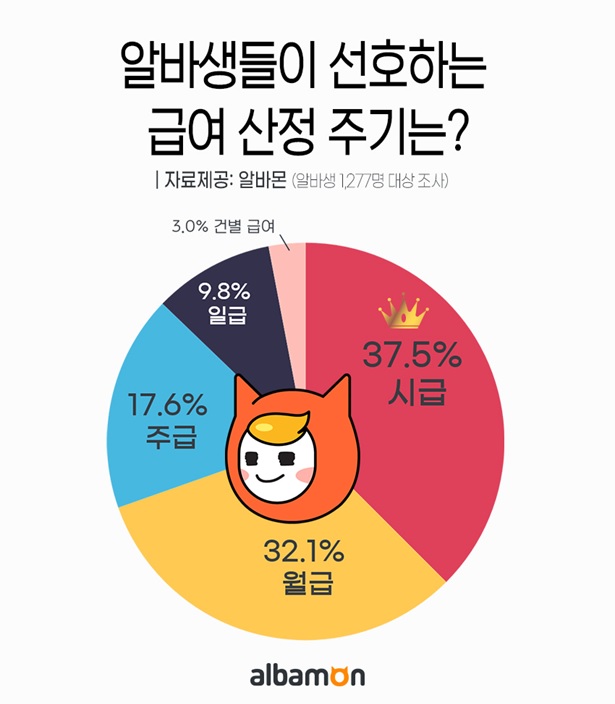
Part-time job platform Albamon conducted a survey on the 'pay calculation cycle' with 1,277 part-time workers and announced the results on the 11th. When asked if the pay calculation cycle influences their decision to work, 70% answered 'it does.' Among respondents, 31.9% said they had given up a job despite passing the interview due to the pay calculation method. Regarding 'preference for pay calculation cycle,' 37.5% chose hourly pay as their first choice. Monthly pay (32.1%), weekly pay (17.6%), daily pay (9.8%), and pay per task (3.0%) followed.
In the actual 'pay calculation cycle status' survey, 54% of respondents reported receiving hourly pay. Monthly pay (32.1%), daily pay (6.0%), weekly pay (4.9%), and pay per task (3.0%) followed. By industry and job type, 67.4% of part-time workers in the food service and beverage sector reported receiving hourly pay, the highest proportion. Office workers mostly received monthly pay at 59.8%. In production, construction, and transportation sectors, daily pay was the most common at 39.3%.
12.2% of part-time workers expressed dissatisfaction with the pay calculation cycle. Reasons included 'too long a wait until the next payday' (30.8%), 'not receiving overtime pay' (28.8%), and 'unable to cope with urgent financial needs' (25.6%).
© The Asia Business Daily(www.asiae.co.kr). All rights reserved.


















