Fuel Tax Cut by 20% from Midnight on the 12th
Gasoline Down 164 Won per Liter... Diesel Down 116 Won
Largest Ever Fuel Tax Cut... Impact May Be Less Than in 2018
2018 Cut Coincided with Falling International Oil Prices
Independent Gas Stations Likely to Lower Prices After Reducing Inventory
[Asia Economy Reporter Hwang Yoon-joo] Although the largest-ever fuel tax cut is just three days away, analysts say it will be difficult to achieve the same effect as the 2018 fuel tax cut. At that time, the fuel tax cut coincided with a decline in international oil prices, resulting in a strong consumer perception of the benefit, but now there are many variables such as Aramco's increase in oil selling prices.
According to the Korea Petroleum Association on the 12th, domestic refiners including SK Energy, GS Caltex, S-OIL, and Hyundai Oilbank plan to immediately reflect the 20% fuel tax cut in the supply to company-operated gas stations starting at 0:00 on the 12th.
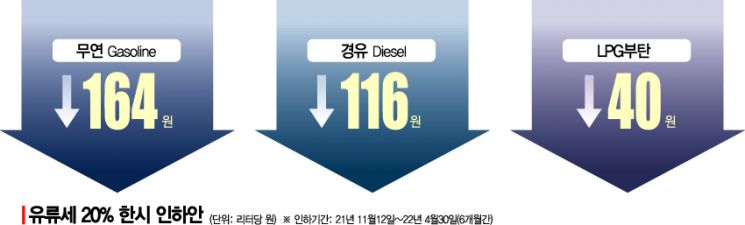
A 20% reduction in fuel tax lowers the price of gasoline by 164 KRW per liter. Applying the reduced tax rate, the average gasoline price at gas stations nationwide last week will drop from 1,787.9 KRW to 1,623.9 KRW, a 9.1% decrease. However, the fuel tax cut will be immediately reflected only at company-operated gas stations (7.8%) and budget gas stations operated by the Korea Expressway Corporation (11.4%). Independently operated gas stations run by individuals will apply the tax cut after exhausting their pre-cut inventory, so the decline in gasoline prices should be observed over time. In other words, only 19.2% of all gas stations will see the immediate effect of the fuel tax cut.
If international oil prices continue to rise, the effect of the fuel tax cut may not be fully felt. The gasoline price sold by refiners is linked to the international gasoline price traded in Singapore. Last week, the international gasoline price surpassed $100 but then dropped to around $90, and further decline is uncertain. This is because international gasoline prices follow international oil prices.
This year, international oil prices have steadily risen, reaching a peak of $84.3 per barrel (Dubai crude and WTI) on October 25. Although prices have since stabilized, the possibility of further decline is unclear. Saudi Arabia's state-owned company Aramco raised the December crude oil price sold to Asia by $1.40 per barrel compared to last month. Saudi Arabia is the top crude oil supplier to Korea. The price increase was larger than market expectations and affected the international oil price market.
In November 2018, when the fuel tax was previously cut, Dubai crude recorded $73.38 per barrel on the 1st and continuously declined to a low of $49.52 on December 26. The combination of falling international oil prices and the fuel tax cut caused gasoline prices to drop by the fuel tax cut rate (15%) within 11 days after the implementation of the tax cut.
An official from the refining industry said, "The situation of international oil prices is different from that during the 2018 fuel tax cut, so we need to observe whether gasoline prices will structurally fall significantly," but added, "When the fuel tax is cut, gasoline prices at least stabilize or decline, which is the greatest benefit to consumers."
© The Asia Business Daily(www.asiae.co.kr). All rights reserved.
![Clutching a Stolen Dior Bag, Saying "I Hate Being Poor but Real"... The Grotesque Con of a "Human Knockoff" [Slate]](https://cwcontent.asiae.co.kr/asiaresize/183/2026021902243444107_1771435474.jpg)
















