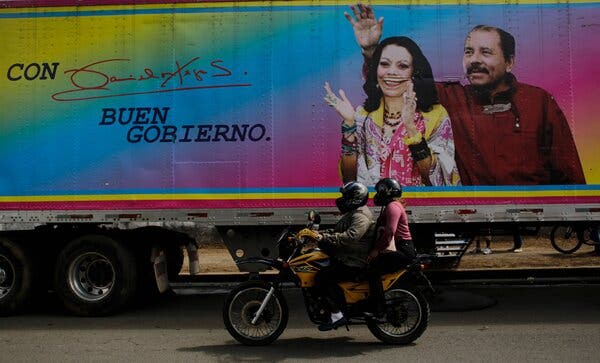
[Asia Economy Reporter Yujin Cho] Voting began on the 7th (local time) for the presidential election in Nicaragua, Central America, where President Daniel Ortega, who is seeking a fifth term, is expected to win. If the Nicaraguan dictatorship succeeds in regaining power, it is anticipated to deal a blow to U.S. President Joe Biden's pro-immigration policies.
On the 7th (local time), major foreign media including The New York Times (NYT) reported that President Ortega of the left-wing ruling Sandinista National Liberation Front (FSLN), who is running for a fourth consecutive term and a fifth overall, is likely to be re-elected.
If Ortega, who has nominated his wife as the vice-presidential candidate, succeeds in his fifth term, the world's first husband-and-wife presidential and vice-presidential administration will be extended for another five years. Ortega first came to power in 1979 by overthrowing the pro-American Anastasio Somoza dictatorship and was first elected president in 1984. After losing re-election in 1990, he has been in long-term power since 2007.
To secure re-election, the Ortega regime detained seven prominent opposition figures including leading presidential candidates, shut down opposition parties, banned large-scale election campaigns, and closed polling stations en masse. Berta Valle, the wife of a detained opposition leader, criticized, "This election is not an election but a farce to build a dictatorship dynasty."
Foreign media assessed that the key issue in this election is not the election result itself but how strongly the United States will respond.
The NYT stated that Ortega’s success in securing a fourth consecutive term and continuing an era of repression and terror proves that President Biden has failed to slow down anti-democratic movements, making it more difficult to prevent Central and South American immigrants from entering the U.S.
The flow of immigrants from Central and South American countries, which had slowed during the hardline anti-immigration policies of former President Donald Trump, has accelerated since President Biden took office. The number of Nicaraguans caught attempting illegal entry at the U.S. border surged from 575 in January, when Trump was in his final term, to 13,391 in July.
Jason Marczak, a researcher at the U.S. think tank Atlantic Council, said, "The international community is focusing not on what will happen on election day, the 7th, but on how strongly the U.S. and other democratic countries will respond."
The U.S. and the EU are already preparing to strengthen sanctions against Nicaragua. On the 3rd, the U.S. House of Representatives overwhelmingly passed an additional sanctions bill against the Nicaraguan dictatorship, introduced by Senator Bob Menendez, with 387 votes in favor and 35 against.
The bill, which had previously passed the Senate, will take effect after being signed by President Joe Biden. It includes sanctions on corruption and human rights abuses by officials in the Daniel Ortega regime and provisions related to military supply support for U.S. troops stationed in Nicaragua.
The EU also criticized this election as a "sham election" and is considering additional sanctions against the regime if President Ortega is re-elected. While it is uncertain how much impact strong sanctions will have on the Ortega regime, it is expected that the number of Nicaraguans fleeing their homeland will increase after the election.
© The Asia Business Daily(www.asiae.co.kr). All rights reserved.
![Clutching a Stolen Dior Bag, Saying "I Hate Being Poor but Real"... The Grotesque Con of a "Human Knockoff" [Slate]](https://cwcontent.asiae.co.kr/asiaresize/183/2026021902243444107_1771435474.jpg)











