Fertilizer Companies Begin Cutting Production
Supply Disruption Feared from Mid-Month
Cement Industry "This Month Is Critical"
Government Implements Measures to Prevent Hoarding
[Sejong=Asia Economy Reporters Moon Chaeseok, Kim Jonghwa] The shortage of urea is spreading to disruptions in fertilizer and cement production. The supply shortage crisis that began with urea solution is gradually expanding to other industries. Fertilizer companies are concerned about supply disruptions starting from mid-this month, and cement manufacturers using urea solution to reduce pollutants are complaining that they will not be able to endure until the end of the year.
According to NH Nonghyup and related industries on the 4th, domestic small and medium fertilizer manufacturers such as Pungnong have recently started to reduce urea fertilizer production. Urea fertilizer is a key material for crop growth. A Nonghyup official said, "Since the supply of urea has practically stopped, it is understood that fertilizers are being produced with the remaining stock," adding, "Some companies are already reducing supply." A Pungnong official stated, "The overall factory operation rate has not been reduced," but "production is being adjusted to focus on other fertilizers such as silicate instead of the main product, urea fertilizer."
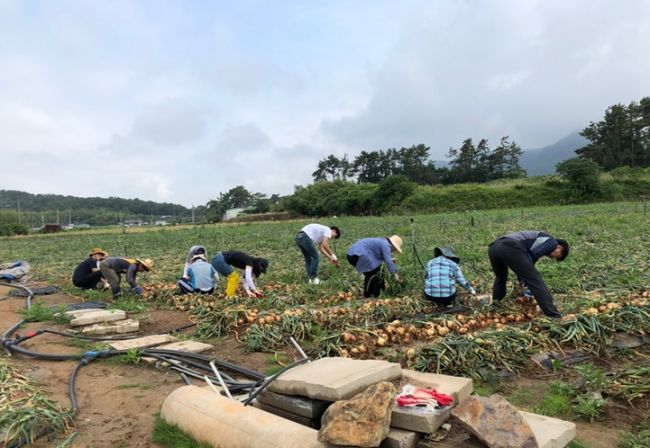
November is the off-season for farming, so fertilizer demand is not high. However, greenhouse farmers need fertilizer immediately, and many farmers must secure fertilizer quantities by the end of this year for next year’s farming, so they are on high alert for the possibility of a 'fertilizer crisis' becoming a reality.
A farmer in Jeollabuk-do said, "I inquired with companies to secure 1 million tons of fertilizer, which is 20% of the total input amount for the entire village farmland of 1,500 hectares (about 4.5 million pyeong), because I thought prices would rise, but they said 'there is no quantity to sell,'" adding, "Automotive urea solution, which used to cost 8,000 KRW per liter, cannot be purchased even if paying more than 130,000 KRW."
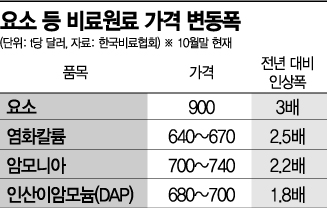
The shortage of urea fertilizer began to show signs from the first half of this year. Due to increased labor and logistics costs caused by COVID-19, Nonghyup and seven fertilizer companies raised fertilizer purchase prices by 14.8% compared to the previous year. Fertilizer prices are contracted annually with one price adjustment per year, but this year an unusual second adjustment occurred. According to the Korea Fertilizer Association, the price of urea was around 900 dollars per ton at the end of last month, about three times higher than the previous year.
Government support is also difficult. Farmers' organizations such as the National Farmers' Federation (Jeonnong) have requested the government to provide temporary logistics cost support to fertilizer companies. A Ministry of Agriculture, Food and Rural Affairs official explained, "Chemical fertilizer support is subject to reduction under the World Trade Organization (WTO) as part of fostering eco-friendly agriculture," adding, "Support is being reduced."
The cement industry is also in a tight spot. Urea solution is sprayed during the cement production process to remove nitrogen oxides generated when the kiln temperature rises above 1000℃. However, the stocks held by Lotte Fine Chemical and KG Chemical, which occupy more than 80% of the domestic urea solution market, are known to last only about 1 to 2 months. The cement industry is viewing the end of the year as a critical point. An industry official expressed concern, saying, "We can endure with the remaining stock until this year, but if we cannot secure additional urea solution around the end of the year, kiln operation will inevitably stop."
There is also a high possibility of leading to a logistics crisis. Even if the Korean Confederation of Trade Unions (KCTU) Public Transport Workers' Union Cargo Solidarity Headquarters and the National Railroad Union withdraw their announced strikes, cement transport trucks (BCT) may not operate due to lack of urea solution.
As shortages occur in various places, the government has decided to implement emergency measures to block hoarding of automotive urea solution. This aims to eradicate acts of stockpiling and reselling at high prices. Lee Eokwon, First Vice Minister of Strategy and Finance, presided over the macroeconomic and financial meeting on the morning of the day and said, "We will enact and implement next week a notice prohibiting hoarding of automotive urea solution based on the Price Stabilization Act," adding, "We will establish a hoarding report center at the Ministry of Environment and operate a joint crackdown team with the Fair Trade Commission, National Tax Service, Customs Service, and other related agencies to strictly respond to hoarding acts."
© The Asia Business Daily(www.asiae.co.kr). All rights reserved.


















