Scrap Metal Price Nears 600,000 KRW per Ton in November... Highest in 13 Years
Reminiscent of 2008 Financial Crisis with Greatest Scrap Price Volatility
Steel Industry Increasing Electric Furnace Production for Carbon Neutrality
Rising Demand for Scrap Metal, Raw Material for Electric Furnace... Prices Soar
Steel Demand Drives Construction Material Prices to Surge
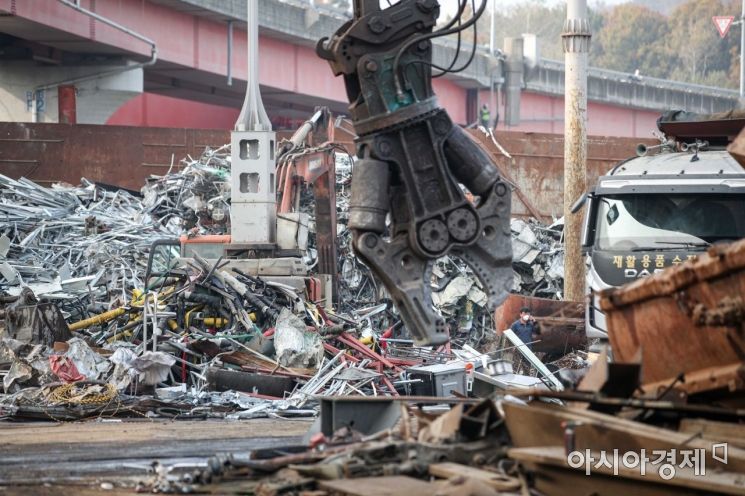 On the 4th, scrap metal is piled up at a resource development company in Gangseo-gu, Seoul, as the average domestic scrap metal price sharply rises to 595,000 KRW per ton. Photo by Jinhyung Kang aymsdream@
[Asia Economy Reporter Hwang Yoon-joo] Domestic scrap metal prices have surged to their highest level in 13 years. This is a result of the steel industry, which has high carbon emissions, expanding the share of electric arc furnaces (EAF) that melt scrap metal instead of blast furnaces (BF) to align with the government's carbon neutrality policy. Steel companies worldwide, including those in China and Japan, are showing similar trends, so the rise in scrap metal prices is expected to continue for the time being. If scrap metal prices soar, prices of construction materials with high steel demand, such as rebar and shaped steel, may also increase.
According to the steel industry on the 4th, as of November 3, the nationwide average price per ton of scrap metal was 595,000 won (based on Jungnyang A), approaching 600,000 won. This is the highest price in 13 years and 4 months since June 2008, when it was 670,000 won. It has surged by 40.9% compared to January this year (422,000 won). At this rate, the average monthly price this year is expected to exceed 600,000 won. ▶Related article page 4
Scrap metal, along with iron ore, is one of the main raw materials, with 85% of total demand being self-supplied domestically. Scrap metal is classified into six grades depending on the type, and 'Jungnyang A,' which accounts for 20-30% of domestic scrap metal transactions, mainly comes from ship dismantling and heavy equipment dismantling, making up the largest share.
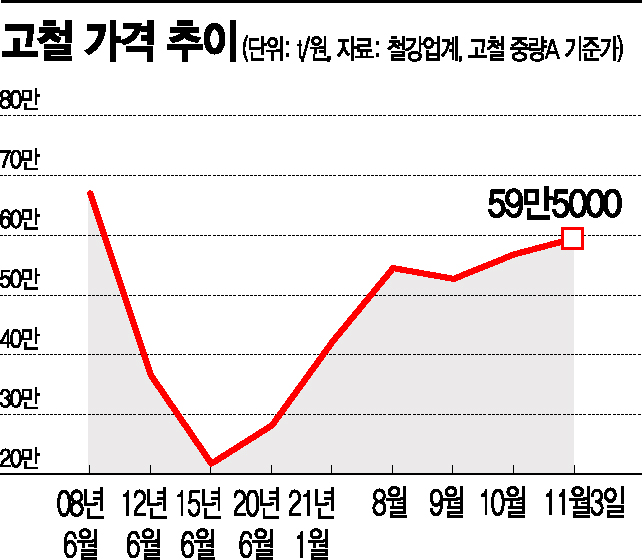
The surge in scrap metal prices is closely related to the government's announced '2050 Carbon Neutrality Scenario.' The government proposed replacing 3 million tons of new and expanded facilities in the high carbon-emission steel industry with electric arc furnaces instead of blast furnaces. Steel production is divided into the blast furnace method, which produces molten iron by putting iron ore and coke into a blast furnace, and the electric arc furnace method, which melts scrap metal in molten iron; the electric arc furnace emits less carbon than the blast furnace. Typically, producing 1 ton of steel emits 1.9 tons of carbon from a blast furnace and 0.4 tons from an electric arc furnace. Accordingly, Korea's two major blast furnace companies, POSCO and Hyundai Steel, have expanded the share of electric arc furnaces since the second half of this year, leading to a surge in scrap metal consumption and price hikes.
A steel industry official said, "Expectations for the rise in domestic steel scrap prices naturally lead to a decrease in supply," adding, "Increasing the scrap charging ratio and leading the realization of a low-carbon society is ironically causing market instability."
© The Asia Business Daily(www.asiae.co.kr). All rights reserved.


















