-Gwangju Institute of Science and Technology, Precisely Measures Relative Quantification of Intracellular Glycans at Molecular Level
-"Systematically Understanding Physiological Changes Related to Diseases"
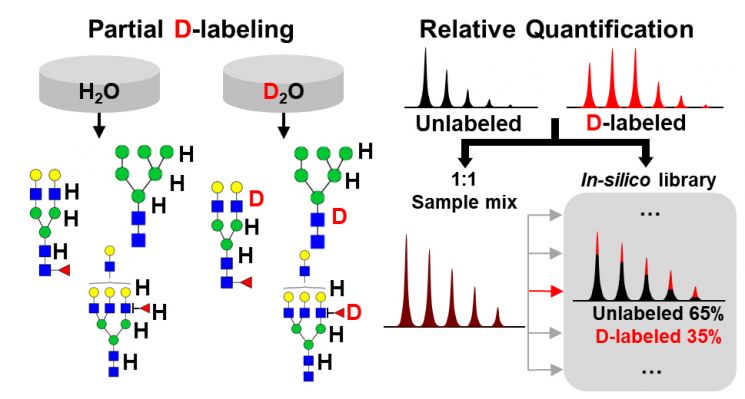 <Schematic diagram for measuring isotope distribution and calculating relative quantification of glycans using deuterium labeling method>
-Glycans extracted from cells grown in regular culture medium and glycans extracted from cells grown in deuterium-labeled culture medium show different isotope distributions in mass spectrometry. Using these two isotope distributions, a computer calculates the isotope distribution created when each sample is mixed in different ratios, generating an in-silico library. The isotope distribution in the mass spectrum obtained by mixing equal amounts of deuterium-labeled and unlabeled glycans is compared to the most similar isotope distribution in the in-silico library to determine the relative ratio between the mixed glycans.
[Asia Economy Reporter Kim Bong-su] A domestic research team has developed an analytical technology that accurately measures the concentration of glycans, which recognize various nutrients in blood or bodily fluids and help immune functions by distinguishing viruses and bacteria.
The Gwangju Institute of Science and Technology (GIST) announced on the 2nd that Professor Kim Tae-young of the Department of Earth and Environmental Engineering and Professor Ahn Hyun-joo of the Graduate School of Analytical Science and Technology (GRAST) at Chungnam National University jointly developed an analytical method that can efficiently measure the relative ratio of glycans present inside cells at the molecular level using metabolic heavy water labeling.
Glycans refer to carbohydrates bound to proteins, and changes in the type and number of glycans regulate various functions of proteins. Glycans play a key role in molecular recognition between cells and signal transduction processes, and are known to be closely related to the manifestation of diseases such as cancer, immune diseases, and neurological disorders, as well as aging. Therefore, technology that measures changes in glycan amounts in vivo plays a very important role in diagnosing diseases related to glycan functions and developing treatments.
The research team developed a quantitative analysis method that uses heavy water labeling to label all types of glycans with heavy water, then calculates the relative amounts of glycans obtained from normal and disease states using a mass spectrometer. They also labeled HeLa cells, a representative model cancer cell, with heavy water to verify the accuracy and range of glycan quantification. Through this experiment, they were able to measure relative quantitative differences up to 100-fold among more than 100 glycans, including high-mannose type N-glycans and complex/hybrid type N-glycans.
Professor Kim explained, "This study applied the heavy water labeling-based relative quantification method, originally developed for lipidomes, to glycomes," adding, "It suggests the possibility of simultaneously relatively quantifying biomolecules such as proteins, lipids, and metabolites, including glycans, using a single stable isotope label."
He continued, "Unlike existing analytical methods that can measure quantitative changes occurring in only one type of biomolecule, the heavy water labeling-based relative quantification method is expected to serve as a fundamental technology for systematically understanding physiological changes caused by various diseases."
© The Asia Business Daily(www.asiae.co.kr). All rights reserved.












