Simultaneous Resolution of Vibrational Particle Interference and Light Source Brightness Issues in Solid Quantum Systems
Research Team Led by Professor Kim Je-hyung, UNIST Department of Physics, Develops Low-Cost Room-Temperature Quantum Computer Device

[Asia Economy Reporter Kim Bong-su] A domestic research team has developed a new material that enables quantum computers, which only operate at an ultra-low temperature of minus 270 degrees Celsius, to be used at room temperature. In particular, by replacing diamond with the common silicon carbide material, they have overcome the chronic issues of reliability and efficiency in existing room-temperature solid qubit systems, drawing more attention.
Ulsan National Institute of Science and Technology (UNIST) announced on the 1st that Professor Kim Je-hyung's research team in the Department of Physics developed a technology that simultaneously solves the interference problem caused by phonons (vibrational particles) and the light source brightness problem in solid quantum systems (qubit generation systems).
Professor Kim Je-hyung explained, “By using a low-quality polycrystalline material commonly found in hardware stores instead of high-quality refined single-crystal materials like diamond, we created a room-temperature quantum system with higher reliability, speed, and efficiency than before, which is also academically noteworthy.”
Point defects in solids are representative qubits created in solid systems. This method utilizes the electron spin of a point defect where an atom is missing or photons generated by the point defect as optical qubits. The major advantage is that it operates at room temperature.
Superconducting quantum systems and ion trap quantum systems researched by IBM and others operate only at ultra-low temperatures around minus 270 degrees Celsius. However, existing solid point defect-based qubit systems had limitations in terms of information reliability and efficiency due to interference caused by unnecessary interactions with phonons inside the solid and low light extraction efficiency.
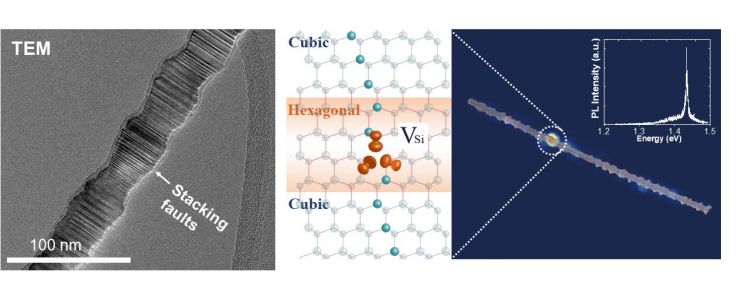 <Development of Solid Quantum Materials Operating with High Efficiency at Room Temperature>
(Left) Transmission electron microscopy image of a silicon carbide (SiC) nanowire sample. The stacking fault formed along the nanowire is clearly observed. (Center) Schematic of the stacking fault in the nanowire. A hexagonal stacking fault exists between cubic structures. Silicon atom point defects (VSi) are located inside the stacking fault. (Right) Confocal fluorescence image and optical spectrum of the point-plane complex defect structure within the silicon carbide nanowire. The brightly emitting spots in the nanowire indicate the locations of the point defects.
The research team solved these problems by using silicon carbide (SiC) nanowires, a polycrystalline nanomaterial, as the system material instead of single-crystal bulk materials. They focused on the fact that polycrystalline nanomaterials have many planar defects, unlike refined single-crystal materials. When point defects are located within planar defects, unnecessary interference caused by phonons is reduced. This is a kind of ‘using defects to control defects’ system. Additionally, unlike refined single-crystal bulk materials, the nanostructure is advantageous for light emission, resulting in significantly increased brightness. Experimental results confirmed light that is more than 30 times brighter and has a narrower linewidth than existing high-quality single-crystal samples. A narrower linewidth of the light wavelength indicates reduced phonon interference.
Professor Kim said, “Although there have been advances in solid point defect-based quantum system research due to developments in material fabrication and measurement technologies, controlling the intrinsic properties of point defects remained a challenge. We proposed a new approach that breaks conventional wisdom by controlling the properties of point defects through common planar defects in low-quality materials.” He added, “With this technology, it is expected that quantum information systems such as quantum computers, quantum communication, and sensors with higher reliability, efficiency, and speed than before can be realized even at room temperature.”
The research results were published online as a rapid communication in the international academic journal Nano Letters on the 22nd of last month.
© The Asia Business Daily(www.asiae.co.kr). All rights reserved.
![Clutching a Stolen Dior Bag, Saying "I Hate Being Poor but Real"... The Grotesque Con of a "Human Knockoff" [Slate]](https://cwcontent.asiae.co.kr/asiaresize/183/2026021902243444107_1771435474.jpg)












