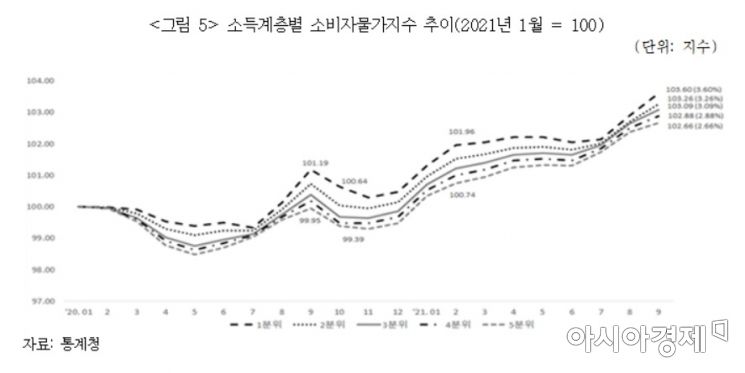
[Asia Economy Reporter Oh Hyung-gil] It has been claimed that since COVID-19, inflation rates have been relatively higher among low-income groups.
On the 31st, Lee Tae-yeol, a research fellow at the Korea Insurance Research Institute, stated in the report "Differences in Inflation Rates by Income Group after COVID-19" that "In the early stages after COVID-19, prices in the 'transportation' sector, which has a higher weight for high-income groups, declined, and subsequently, prices in 'food and non-alcoholic beverages,' which have a higher weight for low-income groups, rose sharply, resulting in consistently higher inflation rates for low-income groups."
The report calculated consumer price trends by income group and found significant differences in weighted shares across income groups in categories such as housing costs, food, transportation, education, and healthcare.
The items with the largest weight differences between the lowest income quintile (1st quintile) and the highest income quintile (5th quintile) were 'housing, water, electricity, and gas' (11.17 percentage points), 'food and non-alcoholic beverages' (8.72 percentage points), 'transportation' (-8.51 percentage points), 'education' (-5.79 percentage points), and 'healthcare' (4.69 percentage points).
Conversely, items with smaller differences between the 1st and 5th quintiles included 'communication' (0.27 percentage points), 'household goods and domestic services' (-0.62 percentage points), and 'alcoholic beverages and tobacco' (0.73 percentage points).
Lee explained, "When price instability occurs in items with large differences in consumption expenditure shares by income group, the differences in inflation rates among income groups widen. Conversely, even if price instability occurs in items with small share differences, it is unlikely to significantly affect the inflation rate differences among income groups."
He added, "Although various subsidies and support payments have been increased to alleviate the economic shocks faced by vulnerable groups, the relatively higher inflation rates experienced by these groups indicate that the effects of these policies are partially offset. For effective crisis recovery support for vulnerable groups, it is necessary to comprehensively understand how changes in economic conditions are impacting their real purchasing power."
Furthermore, he noted, "Current price instability is spreading mainly in food, energy, and rent, which is likely to disproportionately disadvantage low-income groups with higher consumption shares in these categories. It is important to pay attention to related supply-demand and industrial policies to prevent structural accumulation of price pressures in major agricultural, livestock, fishery products, and energy-related public utility charges."
© The Asia Business Daily(www.asiae.co.kr). All rights reserved.

















