Utilizing mRNA Vaccines... Moderna Uses Only Half the Dosage for Vaccination
[Asia Economy Reporter Seo So-jeong] Starting next month, people in their 50s, those aged 18-49 with underlying health conditions, Janssen vaccine recipients, and priority occupational groups will receive booster shots (additional vaccinations). The booster vaccines will primarily be messenger RNA (mRNA) vaccines, but Janssen recipients who wish to do so can receive the Janssen vaccine for their booster.
On the 28th, the COVID-19 Vaccination Response Promotion Team announced the "Vaccination Implementation Plan for November-December," stating that from next month, the booster shot target groups will be expanded to achieve over 80% vaccination completion of the population, thereby laying the foundation for a "gradual return to normal life." This implementation plan was decided after deliberation by the Vaccination Expert Committee on the 27th.
First, starting next month, the booster shot target groups will be expanded to include people in their 50s, those with underlying health conditions, and Janssen vaccine recipients. Considering the risks of infection, severe illness, death, and breakthrough infections, these groups are included in the high-risk groups for additional vaccination.
For people in their 50s, considering the high fatality rate (0.31%) and other risk factors, booster shots will be administered to those who have passed six months since completing their initial vaccination. As of midnight on the 28th, among approximately 7.91 million people in their 50s who completed vaccination, about 320,000 are eligible for vaccination in the fourth quarter. Pre-registration starts on the 1st of next month, and vaccinations will begin on the 15th.
People with underlying health conditions who are at high risk of severe illness or death from COVID-19 infection will also receive booster shots starting next month. The target groups for booster shots include those with ▲endocrine disorders (diabetes, pituitary dysfunction, adrenal diseases) ▲cardiovascular diseases (heart failure, myocarditis, myocardial infarction, chronic rheumatic heart disease, valvular disease, hypertension) ▲chronic kidney diseases (chronic renal failure, glomerular diseases) ▲chronic respiratory diseases (emphysema, chronic obstructive pulmonary disease, bronchiectasis, asthma, pneumoconiosis, other interstitial lung diseases) ▲neurological diseases (Parkinson's disease, dementia, cerebral palsy, multiple system atrophy, spinal cord injury, epilepsy, central nervous system demyelinating diseases) ▲digestive diseases (cirrhosis, chronic hepatitis B, cystic fibrosis), among others.
Booster shots will also be administered from next month to 1.48 million Janssen vaccine recipients, who have a high rate of breakthrough infections. Considering that many of these recipients are active young adults, additional vaccinations will be given to all basic vaccine recipients two months after completing their initial vaccination. Janssen recipients can receive mRNA vaccines at designated medical institutions, and those aged 30 and above who wish to can receive the Janssen vaccine as a booster. In this case, they must contact the public health center by phone for confirmation before vaccination. Pre-registration starts at 8 p.m. on the day of the announcement, and vaccinations begin on the 8th of next month.
Priority occupational groups such as first responders, healthcare workers, and care workers, who were prioritized for vaccination in the first half of the year due to their high risk of infection and transmission, can make pre-reservations starting from the 1st of next month and receive vaccinations from the 15th, provided six months have passed since their initial vaccination.
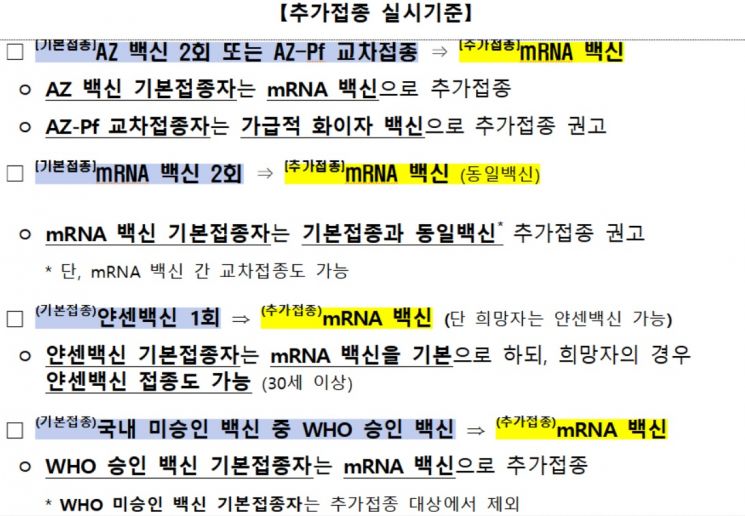
Booster shots will primarily use mRNA vaccines, and it is recommended that the vaccine types do not exceed two kinds, preferably using the same vaccine. Accordingly, those who initially received the AstraZeneca vaccine will receive additional vaccinations with mRNA vaccines such as Pfizer or Moderna. Those who received a mix of AstraZeneca and Pfizer vaccines are recommended to receive Pfizer for the booster. Janssen vaccine recipients will primarily receive mRNA vaccines, but those aged 30 and above who wish can receive the same Janssen vaccine. For those who initially received WHO-approved vaccines not authorized domestically, booster shots will be administered with mRNA vaccines.
Exceptionally, individuals who are contraindicated or should postpone mRNA vaccines can receive a suitable vaccine based on a physician's judgment, and Janssen vaccine recipients who wish can receive the Janssen vaccine.
The Moderna vaccine booster dose will be half the initial dose (0.25 ml, 50 μg antigen), while other vaccines will be administered at the same dose as the initial vaccination.
The interval between vaccinations is generally six months after completing the initial vaccination, preferably within eight months. However, immunocompromised individuals, who have incomplete immune formation from the initial vaccination, and Janssen vaccine recipients, who have a higher rate of breakthrough infections, are recommended to receive the booster starting two months after completing the initial vaccination as an exception.
The Promotion Team stated, "By achieving over 80% vaccination completion of the population, we will safely lay the foundation for a gradual return to normal life," adding, "We plan to expand the booster shot target groups to include people in their 50s, those with underlying health conditions, and Janssen vaccine recipients to enhance vaccination effectiveness and protect high-risk groups."
© The Asia Business Daily(www.asiae.co.kr). All rights reserved.
![Clutching a Stolen Dior Bag, Saying "I Hate Being Poor but Real"... The Grotesque Con of a "Human Knockoff" [Slate]](https://cwcontent.asiae.co.kr/asiaresize/183/2026021902243444107_1771435474.jpg)
















