Practicing Proactive Administration for Residents' Convenience Beyond Administrative Convenience
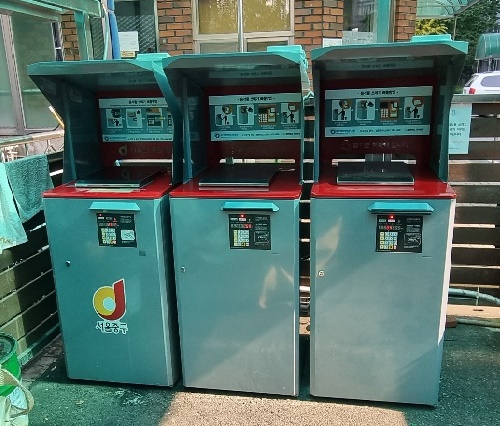 The previous Jung-gu (Phase 2) and Seongdong-gu food waste (Phase 1) volume-based waste bins were installed, but they have been replaced with the Jung-gu food waste volume-based waste bin (Phase 3).
[Asia Economy Reporter Jong-il Park] Jung-gu, Seoul (Mayor Seoyangho) is gaining residents' support through proactive administration aimed at residents' convenience, moving away from administrative convenience.
Hanjin Haemoro Apartment located on Wangsimni-ro spans two administrative districts. Building 101 belongs to Seongdong-gu, while Buildings 102 to 104 belong to Jung-gu.
Although it is the same apartment complex, the jurisdiction is divided between Jung-gu and Seongdong-gu, causing a dual system from purchasing volume-based waste bags to the procedures for disposing and transporting household waste, which has led to continuous complaints from residents.
Until now, apartment residents have separated their waste according to the cleaning contractors of each district, and two contractor vehicles frequently entered to collect the disposed volume-based waste bags, food waste, and large household waste. Residents were exposed to frequent vehicle noise, experienced inconvenience in passage, and faced constant risks of safety accidents.
In response, since September, Jung-gu has collected opinions from all residents of Building 101 and obtained prior consent. Through continuous consultations with Seongdong-gu Office and Hanjin Haemoro Apartment officials, from November 1, the collection and transportation of household waste generated in the apartment have been unified and handled by Jung-gu, enabling residents to live safely and conveniently.
With the surge in household waste due to COVID-19 and the introduction of the total volume control system for waste brought to the metropolitan landfill site, the district is making various efforts to reduce waste and promote resource circulation.
On the 12th, the district opened 'Saerom,' the nation's first specialized educational facility for solving waste problems. 'Saerom' is a specialized space to support eco-friendly resource circulation education, related exhibitions, and gatherings for residents. It also serves as a resource circulation hub for projects such as exchanging high-quality recyclables like paper packs and batteries.
Residents' responses to the volume-based waste bag exchange program for transparent PET bottles, paper packs, and used batteries, which started at the community service centers earlier this month, have also been encouraging. By participating in this program, residents naturally practice good disposal (emptying, rinsing, separating, not mixing) and the 4R eco-friendly habits in daily life: Refuse (not buying unnecessary items), Reduce, Reuse, and Recycle.
Additionally, the district is implementing various policies to solve waste problems, such as the 'Village Clean Coordinator' project that uses social job manpower to patrol habitual illegal dumping areas and manage cleaning blind spots, operating the online resource circulation education program 'Our Neighborhood Earth Care,' and supporting the environmental study club 'Earth Saving Group.'
Seoyangho, Mayor of Jung-gu, said, "We hope that the unification of waste disposal will relieve the long-standing frustrations of apartment residents," and added, "We will continue various efforts to create a pleasant village environment along with practical, resident-friendly living administration."
© The Asia Business Daily(www.asiae.co.kr). All rights reserved.

















