SME Loan Growth Rates: Woori (13.5%), NongHyup (11.5%), Shinhan (10.7%), Hana (8.8%), KB Kookmin (6.4%) Order
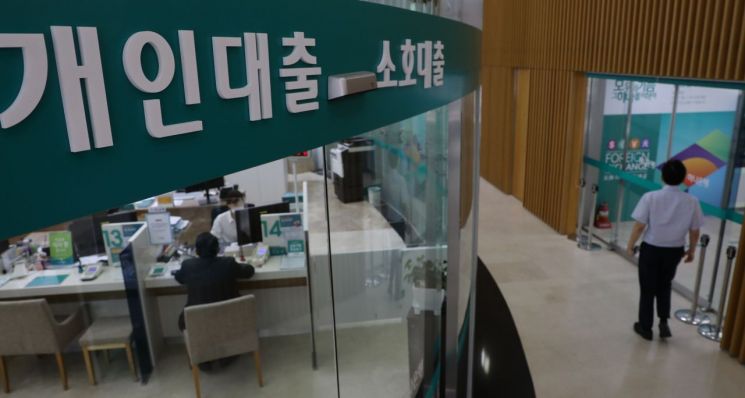
[Asia Economy Reporter Park Sun-mi] While commercial banks are tightening household loans, they are significantly increasing corporate loans to maintain overall loan growth. With the financial authorities announcing strengthened household loan management measures, it is expected that banks will find it difficult to increase household loans next year as well, accelerating the trend of focusing on corporate finance for the time being.
According to the financial sector on the 28th, as of the end of the third quarter, the year-to-date growth rates of small and medium-sized enterprise (SME) loans (including individual business owner loans) at the five major commercial banks are Woori (13.5%), NH Nonghyup (11.5%), Shinhan (10.7%), Hana (8.8%), and KB Kookmin (6.4%), respectively. During the same period, the household loan growth rates were Woori (4%), NH Nonghyup (9.5%), Shinhan (3%), Hana (5.2%), and KB Kookmin (4.9%), all of which were below the SME loan growth rates.
In particular, Woori Bank and Shinhan Bank saw the gap between SME loan and household loan growth rates widen to more than three times. Woori Financial, announcing record-breaking third-quarter results, praised the significant increase in interest income as a result of focusing on SME-centered loans.
The surge in SME loans in the banking sector is largely due to increased demand for facility funds in certain industries that have improved business conditions, amid ongoing COVID-19 related financial support. The monthly increase in total SME loans in the banking sector, as compiled by the Bank of Korea for September, was 7.4 trillion won, the highest ever since statistics began.
With the financial authorities announcing strengthened household loan management measures, the banking sector's reliance on corporate loans is expected to increase not only in the fourth quarter of this year but also early next year. This is because the environment has been created where it is difficult to further increase household loans. Until the end of this month, the maximum loan limit provided by 17 banks when renewing jeonse (long-term deposit lease) loan contracts is limited to the amount of the jeonse price increase. The loan thresholds for mortgage loans and credit loans are also becoming increasingly stringent. SC First Bank will completely suspend new sales of the mortgage loan product ‘First Home Loan’ from the 29th, and Nonghyup Bank will drastically reduce the credit loan and overdraft limits to 20 million won from the 1st of next month until the end of the year.
Within the industry, as the environment no longer allows loan growth to rely on household loans, it is expected that the focus on expanding the share of individual business owner loans within SME loans will accelerate. Unlike household loans, total volume management is not required, so banks can increase loans at their discretion. The fact that commercial banks such as KB Kookmin and Woori are offering niche products available to businesses listed on platforms like Coupang, Baedal Minjok, and Naver, and expanding non-face-to-face services for individual business owner loans, also reflects a strategy to drive SME loan growth.
Thanks to these efforts by commercial banks, there is significant potential for SMEs to increase their proportion of funding through commercial banks. According to the ‘2021 SME Financial Status Survey’ recently released by the IBK Economic Research Institute, SMEs procured 49.6% of new funds from banks last year. In particular, the proportion of SMEs’ main banking types was 46.5% for commercial banks, 35.4% for specialized banks, and 15% for regional banks as of 2015, but last year these proportions were 62%, 16.9%, and 9.3%, respectively.
An official from a bank explained, "This trend could pose a threat to IBK Industrial Bank of Korea, which holds the number one market share in SME loans," adding, "IBK, which continues to operate SME and small business support programs and increase SME loans, holds the top market share in SME loans (22.9%) as of the end of the third quarter, but as commercial banks turn their attention to targeting SMEs, SMEs now have more options."
© The Asia Business Daily(www.asiae.co.kr). All rights reserved.

![Clutching a Stolen Dior Bag, Saying "I Hate Being Poor but Real"... The Grotesque Con of a "Human Knockoff" [Slate]](https://cwcontent.asiae.co.kr/asiaresize/183/2026021902243444107_1771435474.jpg)














