"Could Bypass US Missile Defense System"

[Asia Economy Reporter Kim Suhwan] Mark Milley, Chairman of the U.S. Joint Chiefs of Staff, expressed great concern over China's hypersonic missile test, describing it as "approaching a Sputnik moment."
Recently, as China conducted hypersonic missile experiments, news emerged that it is developing weapons capable of bypassing the U.S. defense system, revealing a sense of crisis regarding the current U.S. military strength.
On the 27th (local time), Chairman Milley said in an interview with Bloomberg Television, "What we have seen is a very significant event of a hypersonic weapon system test," adding that China's recent test is "very concerning."
He stated, "I am not sure if this is the Sputnik moment, but I think it is very close to that," emphasizing that China's test has captured everyone's attention.
The term "Sputnik moment" originates from October 1957, when the former Soviet Union launched the world's first artificial satellite, Sputnik 1, shocking the U.S. and the West. At that time, the U.S., which had been complacent with its technological superiority, began to actively engage in the space race.
Earlier, major foreign media reported that China conducted two hypersonic missile test launches in July and August.
The Chinese government denied these reports, stating that the tests were routine spacecraft tests verifying reusable spacecraft technology.
Until now, the U.S. government had not officially confirmed these reports. The fact that the U.S. Joint Chiefs Chairman officially acknowledged China's hypersonic missile test indicates a significant level of vigilance toward China's missile system.
Experts pointed out that the reason China's hypersonic missiles can bypass the U.S. defense system is primarily because these missiles fly at speeds exceeding five times the speed of sound.
Additionally, the hypersonic missile China tested in July reportedly uses a "fractional orbital bombardment system" developed during the Cold War era, which places a nuclear warhead into a partial orbit and then decelerates it near the target area with a retro-rocket before dropping it.
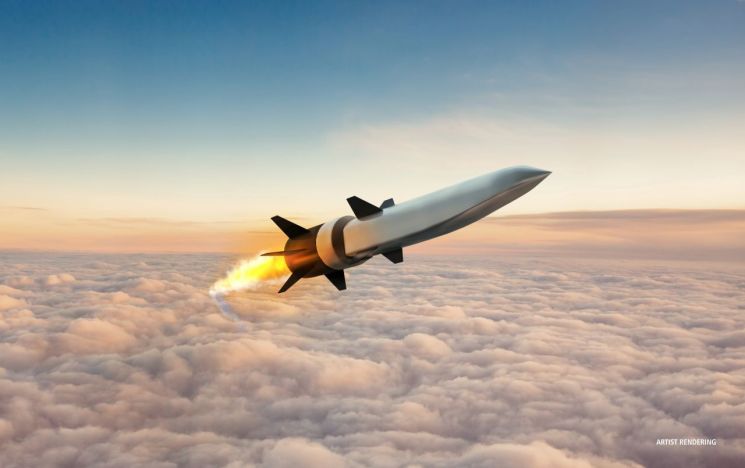
Due to these characteristics, hypersonic missiles can neutralize missile defense networks and are called next-generation game changers. For this reason, countries like the U.S., China, and Russia are accelerating technology development and actively conducting test launches.
Last month, Frank Kendall, U.S. Secretary of the Air Force, expressed concern, saying, "Hypersonic missiles are a way to bypass both missile defense networks and warning systems," adding, "They are capable of bombardment from space."
Officials warned that China could use hypersonic missiles not only for nuclear attacks but also to bomb major U.S. ports or coastal military facilities.
North Korea also attracted attention by claiming to have successfully conducted a test launch of its newly developed hypersonic missile, Hwasong-8, at the end of last month.
Chairman Milley also expressed concern over China's improving capabilities in space, cyberspace, and traditional land, sea, and air military domains.
He said, "There is no doubt that the greatest geopolitical challenge to the U.S. over the next 10, 20, and 25 years is China," adding, "We must coordinate to advance our military."
Greg Hayes, CEO of U.S. defense contractor Raytheon, said yesterday that the U.S. is at least several years behind China in hypersonic technology development.
© The Asia Business Daily(www.asiae.co.kr). All rights reserved.


















