Sales of 2.6887 trillion KRW and operating profit of 457.8 billion KRW
Increased by 21% and 49% respectively compared to the previous year
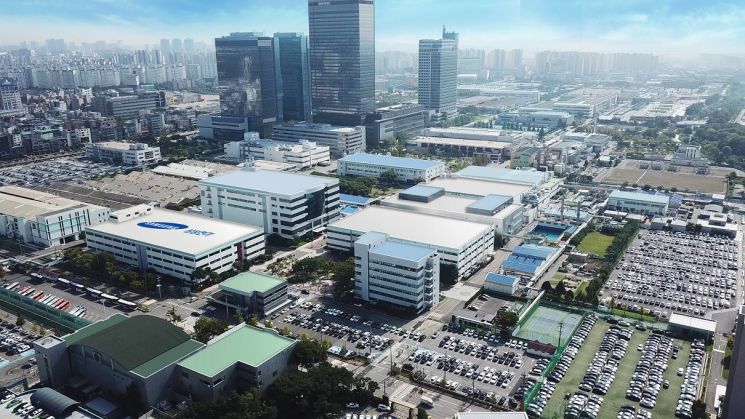
[Asia Economy Reporter Kim Heung-soon] Samsung Electro-Mechanics achieved its highest-ever performance in the third quarter of this year, driven by strong sales of high value-added products such as MLCCs (Multilayer Ceramic Capacitors) and semiconductor package substrates.
Samsung Electro-Mechanics announced on the 27th that its consolidated operating profit for the third quarter of this year was tentatively estimated at 457.8 billion KRW, a 48.9% increase compared to the same period last year. Sales reached 2.6887 trillion KRW, up 20.6% year-on-year. Both sales and operating profit marked the highest quarterly results ever. Compared to the previous quarter, sales increased by 213.2 billion KRW (9%) and operating profit rose by 118.5 billion KRW (35%).
Samsung Electro-Mechanics explained that the significant improvement in performance was due to increased sales of high value-added products such as small and high-capacity MLCCs for mobile use, industrial and automotive MLCCs, and high-spec semiconductor package substrates.
At the third-quarter earnings conference call, the company stated, "MLCC shipments in the third quarter were similar to the previous quarter, and demand for industrial and automotive applications expanded, resulting in a utilization rate close to full capacity." They added, "Inventory levels slightly increased but remained at a healthy level, and the ASP (average selling price) rose compared to the previous quarter due to the expansion of high-capacity products."
They also explained, "Although prices of some raw materials such as rare earth elements and nickel have recently increased and logistics costs have risen, the impact was minimal because their share in MLCC costs is low." Regarding MLCC factory operations amid China's power shortages, they said, "There was a temporary impact during the initial power restrictions, but normal operations resumed immediately, and the factories are currently operating without issues." They added, "Raw material suppliers are also operating their factories normally, so there are no problems with production plans." Furthermore, they stated, "We have prepared contingency measures such as emergency generators to minimize production operation risks."
Specifically, the components division recorded sales of 1.3209 trillion KRW in the third quarter, making it the largest revenue-generating business unit. Sales increased by 34% year-on-year and 11% quarter-on-quarter due to expanded supply of small and high-capacity products for smartphones and high value-added MLCCs for industrial and automotive use.
The modules division recorded sales of 787.4 billion KRW, down 3% from the previous quarter due to weakening demand in the Greater China smartphone market, while the substrates division posted sales of 580.4 billion KRW, up 24% quarter-on-quarter due to expanded supply of semiconductor package substrates. The substrates division’s sales increased 28% year-on-year and 24% quarter-on-quarter to 580.4 billion KRW in the third quarter.
Regarding the outlook for the fourth quarter, Samsung Electro-Mechanics said, "Some product sales are expected to decline due to year-end set inventory adjustments," but added, "Demand for high value-added products such as smartphone, industrial, and automotive MLCCs and 5G antenna package substrates is expected to remain solid."
Concerning the large-scale investment in FCBGA (Flip-Chip Ball Grid Array) that some have suggested as a possibility, the company stated, "We are closely analyzing market supply and demand to respond promptly to mid- to long-term market demand and customer requirements." They added, "We are considering phased capacity expansions to respond to the continued growth in demand for high-spec and high value-added products." However, they noted, "Regarding large-scale investments, we will communicate with the market once specific details are finalized."
© The Asia Business Daily(www.asiae.co.kr). All rights reserved.

















