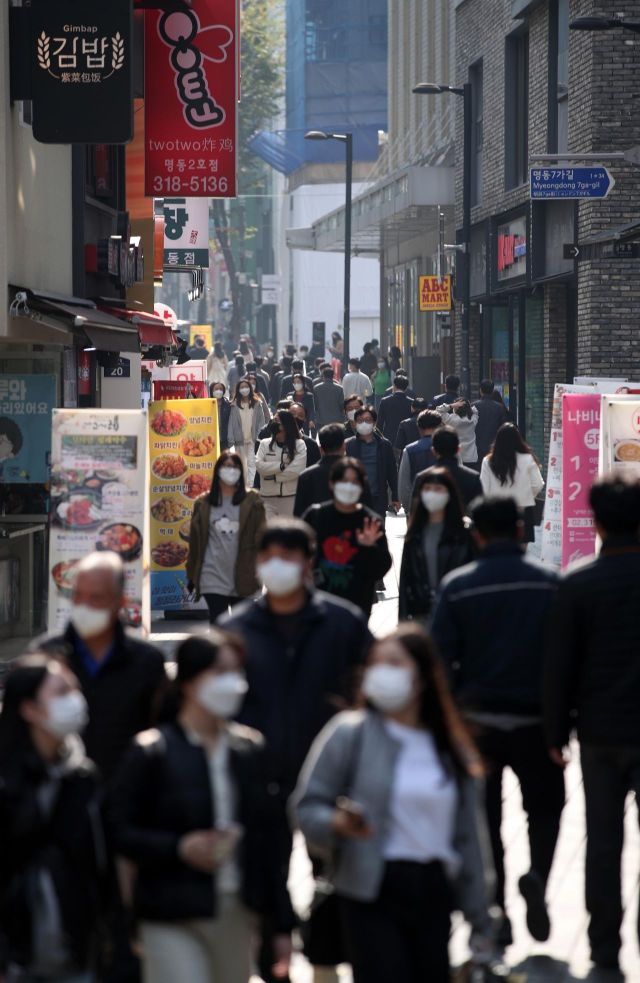
 On the 26th, ahead of the transition to the "Step-by-step Daily Recovery (With Corona)" quarantine system, the streets of Myeongdong, Seoul, are bustling with citizens trying to have lunch. The government is considering lifting operating hour restrictions first for business facilities such as restaurants and cafes under the quarantine system to be implemented next month. Photo by Kim Hyun-min kimhyun81@
[Asia Economy Reporter Seo So-jeong] A study has found that ventilating naturally for about 10 minutes three times a day or continuously operating ventilation systems can reduce the risk of airborne transmission of respiratory infectious diseases like COVID-19 to one-third.
The Central Disease Control Headquarters announced on the 27th that it has established "Wise Ventilation Guidelines" to minimize the spread of respiratory infectious diseases such as COVID-19 caused by contaminated indoor air, ahead of the winter season when indoor activities increase.
These guidelines were prepared based on the interim results of a research project commissioned by the Korea Disease Control and Prevention Agency to the Korea Institute of Civil Engineering and Building Technology (KICT).
According to the research, the COVID-19 virus can remain airborne for a long time when an infected person stays in a confined environment, and the risk of infection decreases as the amount of ventilation increases.
The Disease Control Agency presented specific ventilation guidelines and recommendations depending on building types and the presence or absence of ventilation facilities.
First, when ventilating naturally through windows, both front and rear windows should be opened to allow cross-ventilation, and natural ventilation should be maintained even when heating or cooling systems are operating. If there is no ventilation system, indoor pollutants can be expelled outside using fans or circulators.
When using ventilation systems in multi-use facilities or hospitals, internal circulation methods should be avoided, and the intake of outside air should be maximized. High-performance filters should be used, and care must be taken to prevent air leakage between the filter and cartridge.
In apartment complexes and office buildings, it is recommended to install exhaust fans with backflow prevention dampers (devices that reduce vibration). When operating kitchen hoods inside buildings, natural ventilation should be conducted simultaneously.
Dr. Bae Sang-hwan of the Korea Institute of Civil Engineering and Building Technology explained, "Basements are more vulnerable to infection because ventilation is poor," adding, "In the case of underground restaurants, using kitchen range hoods can partially remove pollutants through exhaust volume."
Dr. Bae added, "In the long term, it is desirable to have mechanical ventilation systems that can continuously expel pollutants," and "since underground facilities vary greatly by type, we plan to further supplement guidelines for underground areas in the future."
© The Asia Business Daily(www.asiae.co.kr). All rights reserved.

















