Annual Net Profit: KB and Shinhan at 4 Trillion, Hana Nears 3 Trillion
Record-Breaking Performance with First Ever Q3 Dividends in Financial Sector
Each Financial Holding Company Presents 'Digitalization' as a Key Task
[Asia Economy Reporters Sunmi Park, Seungseop Song] Amid concerns over COVID-19 and rising household debt, the five major financial holding companies announced record-breaking third-quarter earnings, surpassing their entire previous year’s performance. Balanced growth between banking and non-banking sectors allowed them to benefit from increased loan interest income and expanded fee income during the period of rising interest rates.
On the Verge of Joining the ‘4 Trillion Club’ and ‘3 Trillion Club’
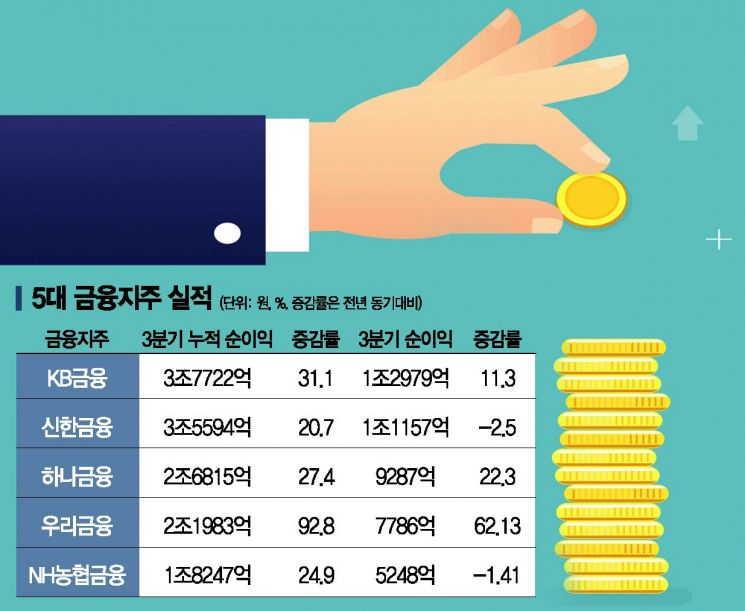
According to the financial sector on the 27th, the cumulative third-quarter net profit of the five major financial holding companies?KB, Shinhan, Hana, Woori, and NH Nonghyup?reached a total of 14.0361 trillion KRW, marking a 33.3% increase compared to the same period last year. All five financial holding companies have already surpassed last year’s full-year records by the third quarter, signaling the possibility of achieving their highest-ever annual earnings this year.
KB leads with a cumulative third-quarter net profit of 3.7722 trillion KRW, followed by Shinhan (3.5594 trillion KRW), Hana (2.6815 trillion KRW), Woori (2.1983 trillion KRW), and NH Nonghyup (1.8247 trillion KRW). At the current growth pace, KB and Shinhan are likely to exceed 4 trillion KRW in annual net profit for the first time this year. Hana Financial Group is also aiming for its first 3 trillion KRW-level performance. Woori Financial recorded the highest net profit growth rate among the five, at 92.8%, earning recognition as the fastest-growing institution in a short period.
The key to the five financial holding companies’ record profits lies in their diversified portfolio efforts, enabling balanced earnings realization from both banking and non-banking sectors. The banking sector, which contributes the most to group profits, achieved a sharp increase in interest income amid rising household debt and interest rates. Thanks to the banking sector’s strong performance, the combined cumulative third-quarter interest income of the five financial holding companies rose 12.2% year-on-year to 31.314 trillion KRW. Although banks tightened loan limits and raised interest rates to manage total household loans, strong demand for essential loans such as jeonse (key money deposit) loans had a significant impact. Except for Nonghyup Bank, which closed new household loan windows early to slow loan growth, all four other banks recorded double-digit net profit growth rates in the third quarter.
Amid the ‘debt investment’ (debt-financed investment) trend and recovering consumption sentiment, stable fee income growth supported solid performance from non-banking affiliates. Woori Financial’s non-interest income growth rate reached 57.2%, driven by strong corporate investment banking (CIB) profits and improved asset management operations. NH Nonghyup (30.2%) and KB (23.9%) also performed well, benefiting from increased fee income due to expanded securities commission revenue.
Asset quality indicators improved steadily despite the prolonged COVID-19 situation, thanks to credit policies focused on soundness and proactive risk management efforts. Woori Financial posted the lowest non-performing loan (NPL) ratio at 0.31%, followed by Hana (0.33%), KB (0.36%), NH Nonghyup (0.37%), and Shinhan (0.44%). These figures represent improvements of 0.03 to 0.11 percentage points compared to the end of the previous year.
Record-Breaking Earnings Bring Third-Quarter Dividends... ‘Digitalization’ Remains a Challenge
As the likelihood of record-high annual earnings for financial holding companies increases this year, quarterly dividends have also emerged. Shinhan Financial Group plans to pay a third-quarter dividend for the first time in the financial sector, setting an annual dividend payout ratio of 30%. The dividend was set at 260 KRW, slightly down by 40 KRW from the previous quarter. No Yong-hoon, Executive Vice President and CFO, stated, “Quarterly dividends will be fixed at a certain level to enhance predictability.”
Hana Financial Group is also considering quarterly dividends. Lee Hu-seung, Hana Financial Group CFO, said, “Shinhan Financial Group will likely pay dividends in the third quarter as well. We are preparing to pay dividends once quarterly dividends stabilize.” He also mentioned, “We are internally reviewing amendments to the articles of incorporation to stabilize quarterly dividends.”
Digitalization was identified as a common challenge for all financial holding companies. As non-face-to-face finance accelerates, the proportion of customers and revenue secured through digital platforms is increasing. KB Financial announced a strategy to become the top financial platform through the fully revamped ‘KB Star Banking’ starting today. KB Financial Group typically presents ‘Key Takeaways’?a set of challenges?during earnings announcements, and this time it was selected as a ‘rebirth’ through digital strategy. The new app allows users to access core services of affiliates without additional installation or switching. “It serves as an extended integrated platform, including a hub role that provides core services in a single application,” explained Lee Hwan-joo, Executive Vice President of KB Financial.
Shinhan Financial also prioritizes strengthening digital competitiveness and plans to continue platform innovation. Lee Sung-yong, Chief Digital Officer (CDO) of Shinhan Financial, emphasized, “We will strengthen the MyData business and launch delivery and health apps by building partnerships with various companies.” Woori Financial, which achieved record earnings without a securities firm, plans to actively pursue mergers and acquisitions (M&A) prioritizing securities firms.
The outlook for fourth-quarter earnings is also positive. Although financial authorities are tightening household debt management policies, interest margins are increasing. In particular, there is a strong possibility of speculative demand for loans before new regulations take effect next year, raising expectations for achieving the highest annual earnings ever.
© The Asia Business Daily(www.asiae.co.kr). All rights reserved.

















