October Consumer Trend Survey Released on 27th
Price Inflation and COVID-19 Case Trends Remain Variables
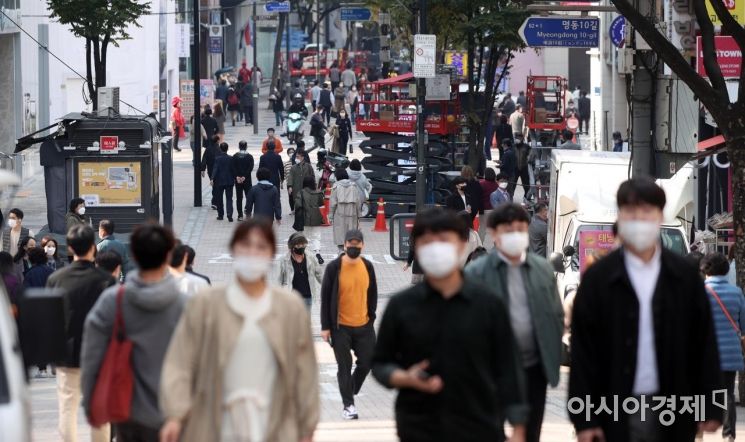 On the 26th, ahead of the transition to the "Step-by-step Daily Recovery (With Corona)" quarantine system, the streets of Myeongdong, Seoul, were bustling with citizens trying to have lunch. The government is considering lifting operating hour restrictions first for business facilities such as restaurants and cafes under the quarantine system to be implemented next month. Photo by Kim Hyun-min kimhyun81@
[Asia Economy Reporter Jang Sehee] Domestic consumer sentiment has risen for two consecutive months. This appears to reflect expectations for the government's With Corona (gradual return to daily life) policy implementation.
According to the 'October Consumer Sentiment Survey' released by the Bank of Korea on the 27th, the Consumer Confidence Index (CCSI) last month was 106.8, up 3 points from the previous month. The CCSI uses a baseline value of 100, where a value above 100 indicates optimism compared to the long-term average, and below 100 indicates pessimism.
During the fourth wave of COVID-19 in July and August this year, the index fell by 7.8 points, but rose by 1.3 points in September due to vaccination and easing of quarantine guidelines.
Hwang Heejin, head of the Statistical Survey Team at the Bank of Korea's Economic Statistics Bureau, said, "It seems that people's expectations are high due to achieving a 70% vaccination completion rate and the policy shift to With Corona."
Along with economic expectations, the current living conditions and employment opportunity outlook rose by 1 point and 6 points respectively. The interest rate level outlook remained high at 133, reflecting expectations of further base rate hikes. The household debt outlook rose by 1 point to 100, matching the level seen in July (100).
Along with improved consumer sentiment, there were many forecasts that prices would rise. The expected inflation rate, which indicates the anticipated consumer price inflation over the next year, remained at 2.4%, the same as the previous month. This suggests that prices are expected to rise by more than 2% by October next year. The inflation perception index, which reflects awareness of consumer price inflation over the past year, also recorded 2.4% for three consecutive months.
Price increases and the trend in confirmed COVID-19 cases following the With Corona implementation could become variables affecting future consumer sentiment. Team leader Hwang stated, "There remain global risk factors such as price increases, China's economic slowdown, and the US tapering announcement," adding, "If confirmed cases increase due to With Corona implementation, consumption may contract." On the day, new COVID-19 cases reached 1,952, nearly 700 more than the previous day (in the 1,200s).
Not only on the supply side but also due to the government's coexistence consumption support funds and the resumption of consumption coupons, demand-side inflationary pressures are expected to increase. Jung Gyu-cheol, head of the Economic Outlook Office at the Korea Development Institute (KDI), said, "If prices rise further, it will act as a factor restricting household consumption and corporate investment."
© The Asia Business Daily(www.asiae.co.kr). All rights reserved.
![Clutching a Stolen Dior Bag, Saying "I Hate Being Poor but Real"... The Grotesque Con of a "Human Knockoff" [Slate]](https://cwcontent.asiae.co.kr/asiaresize/183/2026021902243444107_1771435474.jpg)
















